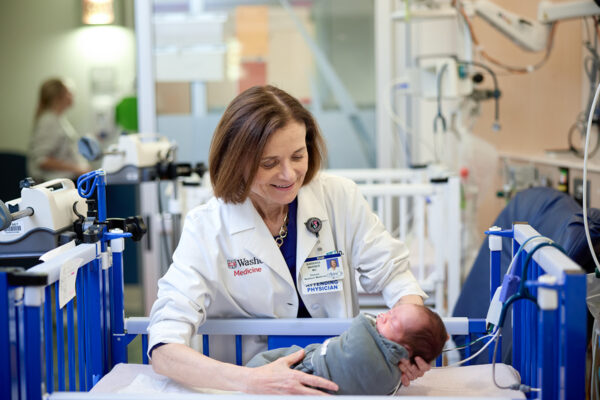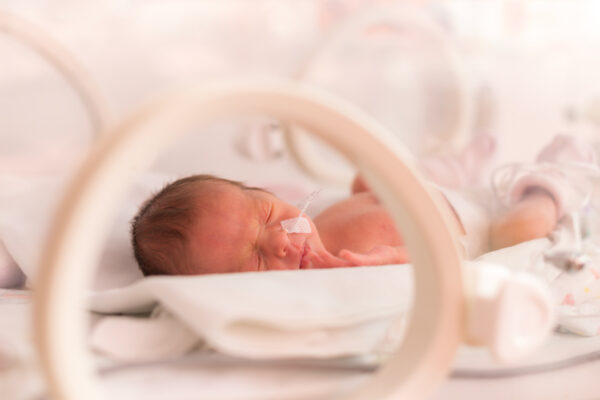
The drive from rural Benton, Ill., to St. Louis takes two hours, but for Jennie and Jake Gibbs, the hardest part wasn’t the distance, it was the uncertainty.
Last summer, Jennie was 24 weeks pregnant with identical twin boys facing a life-threatening condition when she traveled to Barnes-Jewish Hospital, where WashU Medicine obstetricians who manage high-risk pregnancies would perform a delicate fetal surgery that could determine whether both babies survived.
“We didn’t know if we would be bringing babies home at the end of this pregnancy,” Jennie recalled. “We were in a dark place in our lives.”
The twins shared a placenta, and abnormal interconnecting blood vessels were sending too much blood to one baby and too little to the other — a dangerous complication that can be fatal without treatment.
WashU Medicine maternal-fetal medicine specialists at the Fetal Care Center — a collaboration among Barnes-Jewish Hospital, St. Louis Children’s Hospital and WashU Medicine — are among the few in the country with the expertise to perform fetal surgery. They had recommended the procedure to seal the connecting vessels and restore balance to the twins’ circulation.
The four-hour surgery was successful, and after a brief hospital stay, the Gibbses returned home to their three other children, all under the age of 6. Jennie even went back to work teaching high school math and science. For the remainder of her high-risk pregnancy, she received most of her care close to home through a new collaboration between her local Carbondale, Ill., obstetrics team and WashU Medicine specialists.
Of the 32 prenatal visits in her 36-week pregnancy, Jennie and her husband Jake made the 100-mile trip to St. Louis only four times before delivery.
Jennie’s experience reflects a shift in pregnancy care thanks to a telemedicine program developed by WashU Medicine. Since its inception in 2023, the program has supported more than 2,500 high-risk pregnancies in the Carbondale area, closer to the Gibbses’ home, and is part of a broader effort to expand access to specialized prenatal care in rural communities.
The program enables patients to see their local obstetric providers in person and WashU Medicine maternal-fetal medicine specialists remotely via video calls. In high-risk pregnancies, these specialists help guide treatment decisions and coordinate care with local physicians. When patients need to be transferred to Barnes-Jewish Hospital, they arrive with the familiarity of an existing relationship with the care team.
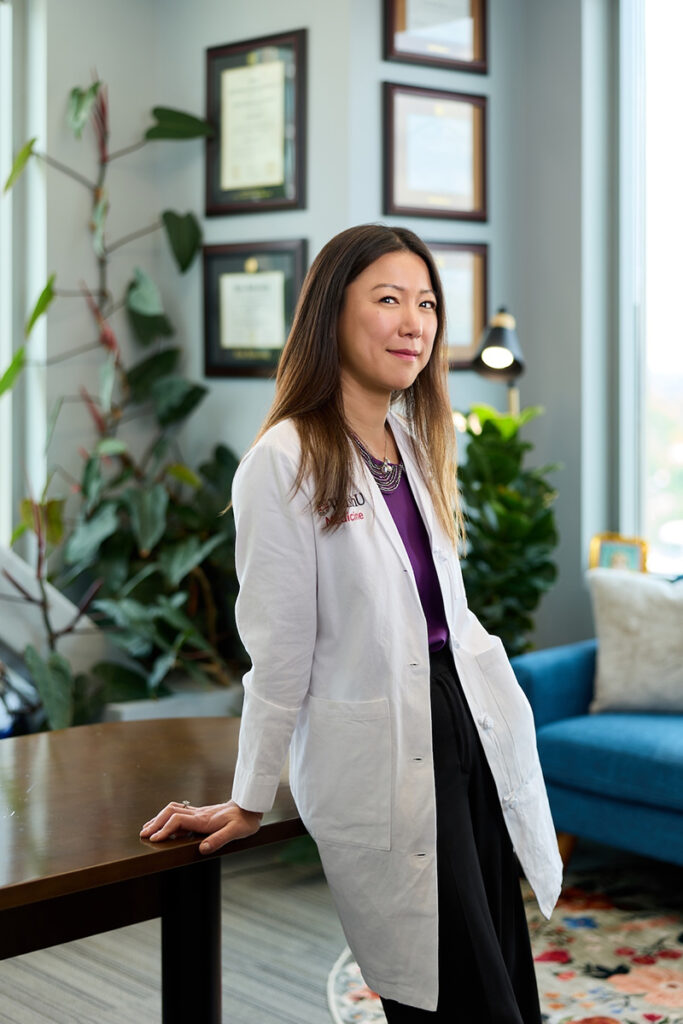
Jeannie Kelly, MD, an associate professor of obstetrics and gynecology, and Jeffrey M. Dicke, MD, a professor of obstetrics and gynecology, helped develop the innovative approach. The model, the only of its kind in the Midwest, emerged from the implementation and expansion of telehealth during the pandemic.
“The benefits of this care model for patients living in rural areas are enormous,” said Kelly, also the director of the Division of Maternal-Fetal Medicine & Ultrasound. “They stay with the local physicians they know and trust, while gaining access to highly specialized care that often is not available close by.”
Read more on the WashU Medicine website.