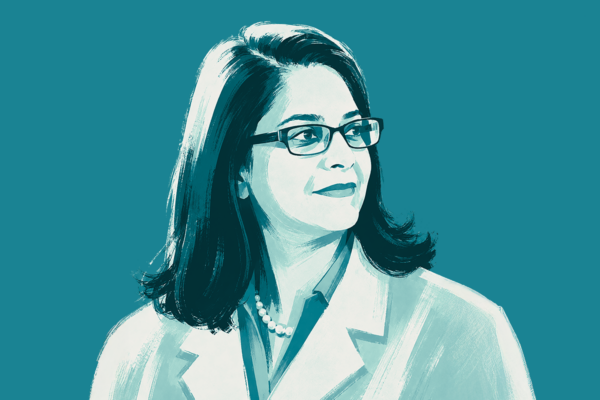
As artificial intelligence (AI) continues to reshape healthcare, WashU Medicine is exploring how to use it to improve patient care, research and clinical operations. Here, Philip R. O. Payne, the inaugural chief health AI officer for WashU Medicine and BJC Health, helps explain what AI can and can’t do, where the technology is headed, and why trust, training and human judgment are still essential.
What is the biggest misconception people have about AI in healthcare?
A common misconception is that AI is being used to replace clinicians in critical decision-making. That’s not the goal at all. AI is meant to support care teams by surfacing the most relevant information and evidence at the right time. The human aspects of care, like ethics, judgment and the incorporation of patient and family preferences, still belong to people.
What aspects of healthcare will AI transform most dramatically over the next decade?
I foresee AI transforming how patients navigate the healthcare system. It can simplify many of the tasks that often fall to patients, such as scheduling appointments and managing insurance, medical records and prescriptions. AI can also streamline clinical operations by reducing administrative burdens. For researchers, it can serve as a helpful assistant by reviewing scientific literature, analyzing data and helping generate hypotheses, particularly in the context of increasingly large and complex data sets.
If you could make one major AI bet for healthcare over the next three years, what would it be?
My bet is that AI will replace the current prior authorization process, where insurers require doctors to get approval before administering certain tests, treatments or medications to patients. Prior authorization is a major barrier to people getting care. It causes delays, excess administrative burden and frustration. Patients don’t like it. Providers don’t like it. Even insurers don’t like it. AI creates the opportunity to make faster, smarter decisions about coverage and treatment based on diagnoses, documentation and insurance rules. This would be groundbreaking because it could remove one of healthcare’s biggest bottlenecks and, most importantly, help patients get care faster.
What keeps you up at night about AI and healthcare?
Three things: ensuring our workforce is trained to use AI responsibly; earning and maintaining patient trust when we use AI to inform their care; and deciding where to focus our efforts when the technology is evolving faster than the evidence. Patient trust is essential because people need confidence that AI is being used to improve their care — not replace human judgment or compromise their privacy.
At WashU Medicine, that means not just adopting AI tools, but making sure faculty, staff and trainees are prepared to use them responsibly, being transparent with patients and being thoughtful about where AI can have the biggest impact on care, research and operations. We’ve chosen to approach AI with diligence and intention, rather than rushing to adopt every new technology.
What safeguards are in place at WashU Medicine for AI tools used during patient care?
Since the beginning, we have taken a thoughtful, human-centered approach to AI. Human oversight is crucial in every step. Before we use AI tools in patient care, for example, WashU Medicine rigorously evaluates them in real-world settings for safety, quality, cost, performance, bias and equity. We rely on our specialized informatics and data science expertise to make sure these efforts are based on a deep understanding of both AI methods and their integration into real-world workflows.
What makes WashU Medicine and BJC Health’s joint Center for Health AI well positioned to help shape the next generation of healthcare AI?
The Center for Health AI (CHAI) brings together the academic, scientific and clinical strengths of WashU Medicine with the scale and diversity of BJC Health, while also working with industry partners to develop and evaluate new technologies. That gives us the opportunity to move beyond asking whether an AI tool works in theory and understand how it performs in the complex environments where care is delivered — across inpatient, outpatient and population health settings; in urban, rural and critical access hospitals; and among diverse patient populations.
That breadth allows us to ask critical questions: Does this technology work? For whom? How does it fit into clinical workflows? Does it improve outcomes and create meaningful value?
By bringing together clinicians, researchers, data scientists, operational experts and industry partners, CHAI can help develop AI that is not only scientifically promising, but safe, effective, equitable and genuinely useful to patients, clinicians and health systems.
How will AI change the clinician’s role?
The future of medicine should be even more human-centered, not less. AI will increasingly handle tasks like summarizing patient records, reviewing images and drafting documentation. That will free up more time for clinicians to focus on what AI cannot do: understand each patient’s unique needs, preferences and concerns. If AI can reduce the burden of routine work, it gives physicians back the time and attention that patients value most. In that sense, AI has the power to make medicine more compassionate, more present and, ultimately, more human.
Payne is also vice chancellor for biomedical informatics and data science and serves as director of the Institute for Informatics, Data Science and Biostatistics, or I2DB. He is the Janet and Bernard Becker Professor with additional appointments in the Department of Medicine and in McKelvey Engineering.