In Brief
- Leila Sadat says International Criminal Court (ICC) sanctions chill teaching, research and collaboration with international legal institutions.
- Restrictions have limited student opportunities, including internships and careers involving the ICC.
- Sadat argues the sanctions are unlawful and threaten international legal education, human rights progress and constitutional protections.
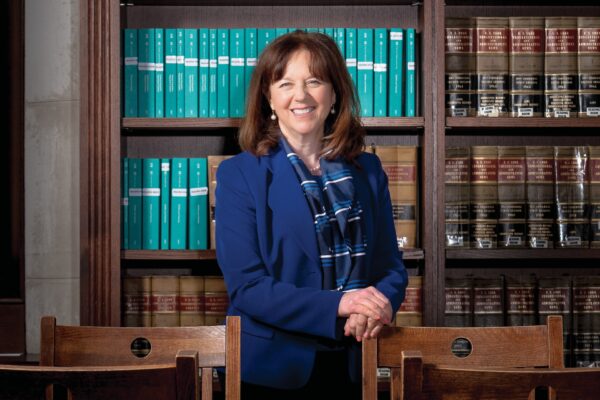
The United States imposed sweeping new sanctions against the International Criminal Court (ICC) Oct. 9, following up on sanctions imposed last year. These unlawful sanctions are threatening academic freedom, limiting opportunities for law students and making it harder for scholars to engage with international legal institutions, said Leila Sadat, the James Carr Professor of International Criminal Law at Washington University in St. Louis.
Sadat is among a group of law professors, scholars and practitioners who filed an amicus, or friend of the court, brief in a federal case challenging sanctions imposed on the ICC under an executive order that President Donald Trump issued in February 2025.

The executive order authorized sanctions against individuals and organizations associated with certain ICC investigations and prohibits providing “services to, or for the benefit of” designated persons, subject to civil and criminal penalties.
Sadat said the restrictions have consequences far beyond those directly targeted.
“The sanctions regime strikes at the heart of amici’s academic freedom by chilling their ability to engage with international legal institutions, teach about international law, collaborate with United Nations experts and ICC personnel, including any designated persons or entities, and effectively prepare their students for law careers that may implicate international law,” she said in the brief.
Amici refers to non-parties in a court case, such as organizations or experts, who offer information, expertise or insight to help judges make decisions.
Sanctions affect Sadat’s work
Sadat served as special adviser on crimes against humanity to two ICC prosecutors, Fatou Bensouda and Karim A.A. Khan, from 2013 to 2023 and has published extensively on international criminal law.
According to a declaration filed with the brief, the sanctions have affected her professional activities.
She said that frequently, she has helped students land positions at the ICC, but she no longer does so because of the sanctions. She ended a crimes-against-humanity research project she conducted for the ICC prosecutor’s office after the first Trump administration imposed sanctions.
The restrictions could affect a generation of law students by limiting exposure to international legal institutions and career opportunities, she said.
“Academics throughout United States law schools cannot speak without the threat of United States government sanctions being imposed upon them,” she said.
She believes that students will consequently be “less prepared to participate within the international legal order” and “less equipped to serve in government positions requiring international law expertise.”
Chilling academic freedom
The sanctions create uncertainty about whether routine academic activities are problematic, Sadat said.
“The restrictions prevent scholars from inviting ICC officials to speak at their law schools, collaborating with designated persons and entities on scholarly publications, supervising student research involving ICC proceedings, and engaging within other international legal institutions.
“We (amici) argue that in addition to the harm that the sanctions inflict on the interests of the United States, the sanctions are unconstitutional because they strike at the heart of the First Amendment freedoms enjoyed by all Americans, and in particular, those attached to teaching, research and education,” Sadat said.
The order’s broad language makes it difficult to know what’s allowed, she said.
“The overbreadth and vagueness of the executive order’s provisions leave scholars unable to determine whether even routine academic activities may expose them to criminal and civil liability,” Sadat said.
The amicus brief argues that engagement with the ICC and the broader international legal community is an important part of contemporary legal education, including through courses, clinics, research and faculty collaboration.
The sanctions threaten not only academic freedom but also the preparation of future lawyers and the advancement of international human rights, Sadat said.
“The International Emergency Economic Powers Act (which Trump invoked to impose the sanctions last year) is a statute used to sanction terrorist organizations and regimes; it is unconscionable and unlawful to use it to sanction international civil servants and international courts,” she said.