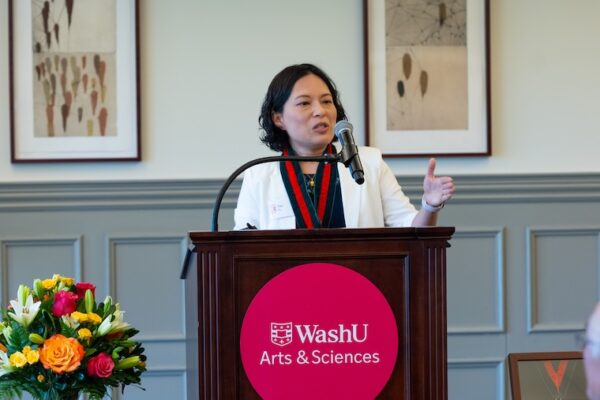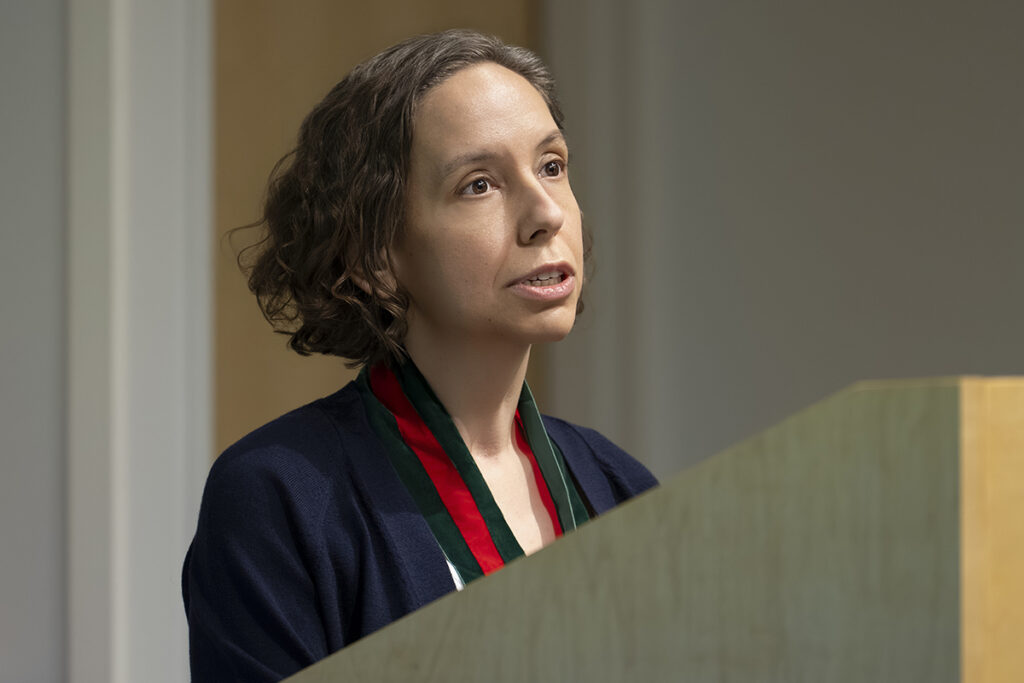
Celeste M. Karch, a national leader in the study of the genetic and cellular basis of Alzheimer’s disease and other neurodegenerative disorders, has been installed as the inaugural Barbara Burton and Reuben M. Morriss III Professor in the Department of Psychiatry at Washington University School of Medicine in St. Louis.
Karch’s research integrates human stem cell models and genomics to decode the biological underpinnings of Alzheimer’s disease.
“Celeste Karch is helping redefine how scientists understand Alzheimer’s disease and related neurodegenerative conditions,” said Chancellor Andrew D. Martin. “Her work is revealing new possibilities for earlier detection, prevention and treatment. We are deeply grateful to the Morriss family, whose generosity makes it possible to recognize not only scientific discovery but also the collaborative, forward-looking approach that drives progress in making transformative contributions to science that can benefit patients.”
David H. Perlmutter, MD, executive vice chancellor for medical affairs, the Spencer T. and Ann W. Olin Distinguished Professor and the George and Carol Bauer Dean of WashU Medicine, installed Karch.
“Celeste Karch is reshaping how the field thinks about the genetic and cellular drivers of neurodegeneration,” Perlmutter said. “She is way ahead of the field in recognizing the importance of human cellular models of Alzheimer’s disease and other neurodegenerative diseases. These models have accelerated scientists’ understanding of disease pathogenesis and the testing of new therapies. This professorship is a fitting recognition of her remarkable accomplishments and will help ensure her continued impact in the field.”
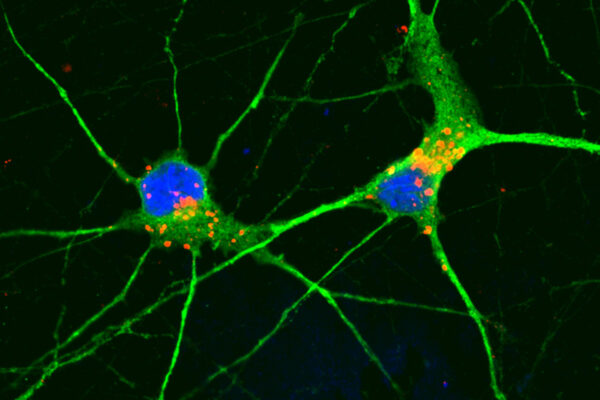
Karch’s lab takes an integrative approach to Alzheimer’s disease and dementia, bringing together genetics and “disease-in-a-dish” stem cell models to identify the cellular mechanisms that drive neurodegeneration. Her team has developed methods to analyze a person’s genetic code and determine which variants are dangerous, which are harmless, and which may even be protective — work that has helped patients and families understand their disease risk and eligibility for clinical trials.
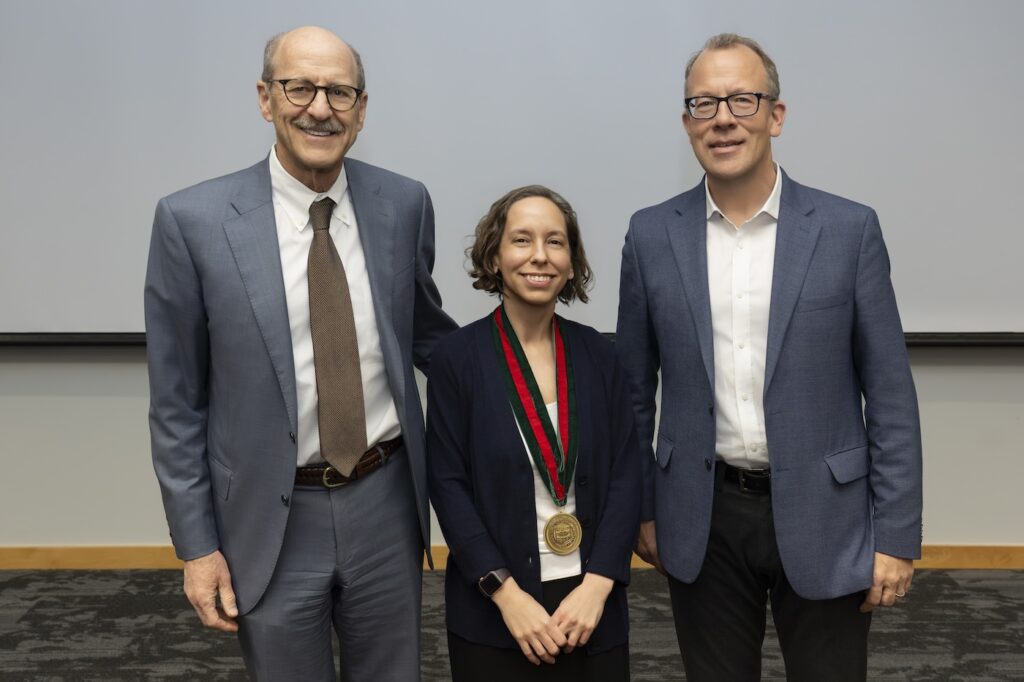
Among her major breakthroughs, Karch discovered that when the brain’s cellular recycling centers, called lysosomes, stop working correctly, the malfunction serves as an early warning sign of disease — a finding that points toward a preventive treatment strategy for a variety of neurodegenerative diseases. She also revealed how certain genes control the brain’s immune cells and can be harnessed to improve their ability to clear Alzheimer’s-related damage. And, using stem cells grown from patient skin samples, her team has demonstrated that specific genetic mutations cause immune cells to malfunction in ways that likely accelerate the progression of dementia.
Among Karch’s most significant contributions is creating one of the world’s largest collections of stem cells for dementia research. This “biorepository” contains more than 1,000 cell lines from diverse individuals, allowing scientists globally to study the human brain in ways that were previously impossible.
Karch’s scientific contributions have won her recognition as a leader in the field of neurodegeneration. Her research has been supported by the National Institutes of Health (NIH), the Alzheimer’s Association and other major funders. She is scientific director of the Dominantly Inherited Alzheimer Network (DIAN) and an active member of the Charles F. and Joanne Knight Alzheimer Disease Research Center (Knight ADRC) at WashU Medicine. Karch has also received numerous honors, including the Rainwater Charitable Foundation’s Rainwater Prize for Innovative Early Career Scientist, and she was named an investigator for the Chan Zuckerberg Initiative, a philanthropic organization founded in 2015 by Priscilla Chan and Mark Zuckerberg to help cure, prevent or manage all diseases by the end of the century.
To ensure that medical breakthroughs benefit everyone, Karch helped launch the African iPSC Initiative in 2025. This global program, established at the Biomedical Science Research Training Centre at Yobe State University in Nigeria — in partnership with Sussex Neuroscience in the U.K. and the Knight ADRC — studies how African ancestry influences dementia. Alongside her global impact, Karch remains a dedicated mentor, spending much of her time training the next generation of neuroscientists and advocating for diversity within the scientific community.
“Celeste Karch brings her extraordinary scientific vision and gift for multidisciplinary problem-solving to everything she does,” said Eric J. Lenze, MD, the Wallace and Lucille K. Renard Professor of Psychiatry and head of the WashU Medicine Department of Psychiatry. “Her lab has produced multiple major discoveries, each addressing a different piece of the Alzheimer’s disease puzzle, while simultaneously building resources and networks that elevate the entire field. We are tremendously proud to recognize her with this professorship and grateful to the Morriss family for making it possible.”
Karch completed her undergraduate education at Kalamazoo College in Michigan before earning her PhD from the University of Florida. She conducted postdoctoral research at WashU Medicine before joining the faculty in 2013.
About Barbara Burton and Reuben M. Morriss III
A graduate of Saint Louis Country Day School and Princeton University, Reuben Morriss III earned a law degree from WashU in 1964. He joined Boatmen’s Bank, beginning a long career as a leader of the St. Louis financial sector. He eventually became chairman and president of Boatmen’s Trust Co., a position he held until his retirement in 1995. He was a board chair of Mary Institute and Saint Louis Country Day School in Ladue, Mo., and of William Woods University in Fulton, Mo. He also served on the boards of St. Luke’s Hospital in Chesterfield, Mo., and the St. Louis Bi-State American Red Cross.
Barbara Burton Morriss was a graduate of John Burroughs School in Ladue and Briarcliff College in Westchester County, N.Y. She was a board member of the Alzheimer’s Association and the Central Institute for the Deaf, and she donated time and resources to many other local charitable and cultural institutions.
The couple maintained strong ties to WashU. A member of the Alumni Board of Governors, Mr. Morriss was actively engaged with WashU Law as a member of the school’s national council, campaign cabinet and alumni association board. Throughout their lifetimes, the Morrisses generously supported the School of Law, the Alvin J. Siteman Cancer Center and the Charles F. and Joanne Knight Alzheimer Disease Research Center.
The couple was married for 48 years and had two children, Burton Douglass Morriss and Barbara Dulany Morriss, and five grandchildren. Reuben Morriss III died in 2006, and Barbara Burton Morriss died in 2018.