Spinal cord stimulation has been used alongside physical therapy to help patients improve movement after spinal cord injury. More recently, using high-frequency waveforms in non-invasive stimulation has become popular to reduce discomfort during spinal cord stimulation. But incorporating this technology can dramatically increase the cost, reducing access for patients.
New research from a team of scientists in the McKelvey School of Engineering at Washington University in St. Louis suggests reconsidering whether high-frequency waveforms are as effective as the longer-duration waveforms that are already commonly available. The team worked in collaboration with researchers at the Medical University of Vienna, Austria, and the Friedrich-Alexander University in Erlangen-Nürnberg, Germany.
Ismael Seáñez, an assistant professor of biomedical engineering and of electrical and systems engineering at McKelvey Engineering and of neurosurgery at WashU Medicine, and Rodolfo Keesey, a doctoral student in his lab, examined whether high-frequency waveforms actually target the neural structures that lead to recovery as well as existing waveforms for conventional spinal cord stimulation. Seáñez’s team looked at the mechanisms behind responses prompted by high-frequency stimulation both in a human model and in computational models to determine any differences. Research results were published May 12 in Nature Biomedical Engineering.
“Computational models and human experiments revealed that conventional spinal cord stimulation promotes motor recovery by recruiting sensory nerves, which subsequently activate motor nerves,” Seáñez said. “This is counterintuitive, because our end goal is to recruit motor nerves and help the muscles move. However, sensory activation allows patients to voluntarily control the movement evoked by stimulation,” Seanez said.
“Also, when you recruit directly in the motor nerves, initially you get a very nice response, but then the muscle starts fatiguing because you recruit all the neurons in that muscle,” he said. “Sensory activation avoids this. We wanted to see if high-frequency waveforms also recruit motor neurons through the sensory pathway. If they don’t, they could be less effective at improving recovery.”
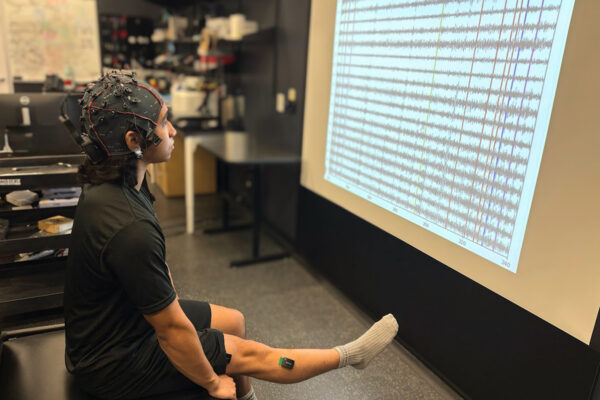
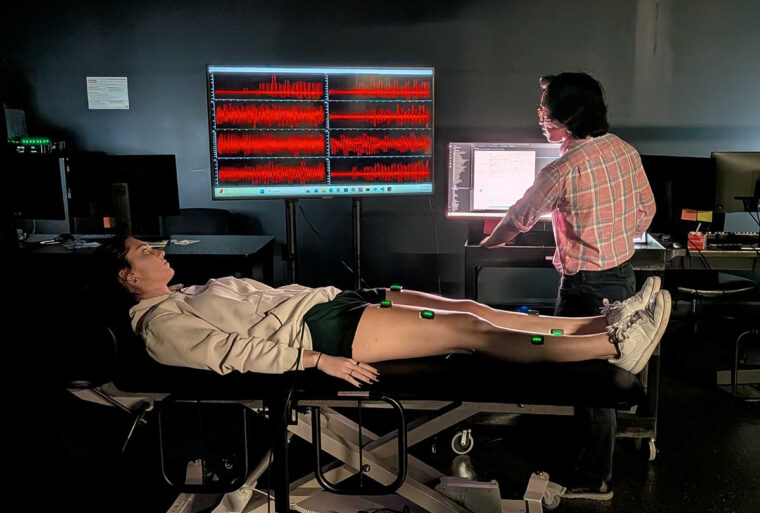
For this study, Keesey conducted three experiments. In the first, he stimulated nerves in the legs of 28 unimpaired participants to artificially activate the sensory pathway to raise the resting potential of the motor neurons.
“Neurons that fire together, wire together,” Keesey said. “Because we have all these rich sources of connections with sensory activation, we can help with rehabilitation by activating a pathway that interacts with the brain and interacts with circuits in the spine. And that allows us to have this rehabilitative mechanism. However, kilohertz-frequency waveforms were found to be less effective than conventional waveforms at activating the sensory fiber pathway. Therefore, we may miss out on all these connections. This is a bad sign for recovery.”
In the second set of experiments, Keesey and his collaborators recreated the setup in a computational model. In the final set of experiments, they tested spinal cord stimulation of the cervical and lumbar portions of the spinal cord that control the arms and legs.
“What we see is that the kilohertz frequency currents require much higher stimulation intensities to elicit muscle responses,” Seáñez said. “(It appears) that kilohertz frequency waveforms have poor specificity for the target neural structure of spinal cord stimulation.”
Keesey said sensory fiber recruitment is important because otherwise, the stimulation simply activates the muscle with less opportunity for rehabilitation.
“You lose these rich sources of input from the brain, from the spinal cord and all these mechanisms for rehabilitation and the fatigue-resistant prosthetic effect,” Keesey said.
“The first wave of tSCS devices is now clearing FDA approval for motor recovery following spinal cord injury,” Keesey continued. “These devices all use high-frequency modulated waveforms, but they can be dramatically more expensive. Not only do we already have commercially available devices that are much more affordable and can deliver conventional waveforms, our research indicates that their waveforms may be more effective for rehabilitation.”
Keesey R, Hofstoetter U, Zhaoshun H, Lombardi L, Hawthorn R, Bryson N, Alashqar A, Rowald A, Minassian K, Seáñez I. Fundamental limitations of kilohertz-frequency carriers in afferent fiber recruitment with transcutaneous spinal cord stimulation. Nature Biomedical Engineering, May 12, 2026. DOI: 10.1038/s41551-026-01684-w.
Funding for this research was provided by the National Institutes of Health’s The Eunice Kennedy Shriver National Institute of Child Health and Human Development (K12HD073945), National Institute of Neurological Disorders and Stroke (K01NS127936); the McDonnell Center for Systems Neuroscience at Washington University in St. Louis; the General Federal Ministry of Education and Research; and Austrian Science Fund.
Originally published on the WashU McKelvey Engineering website