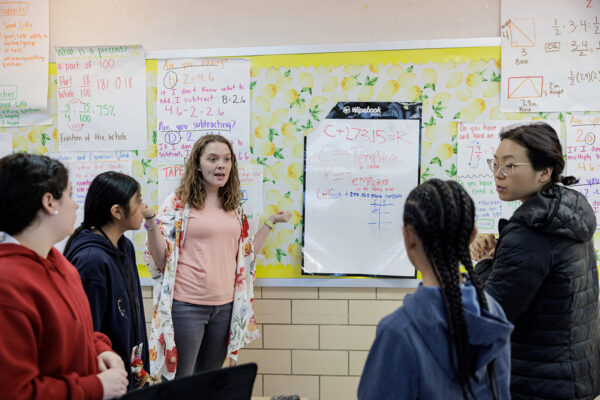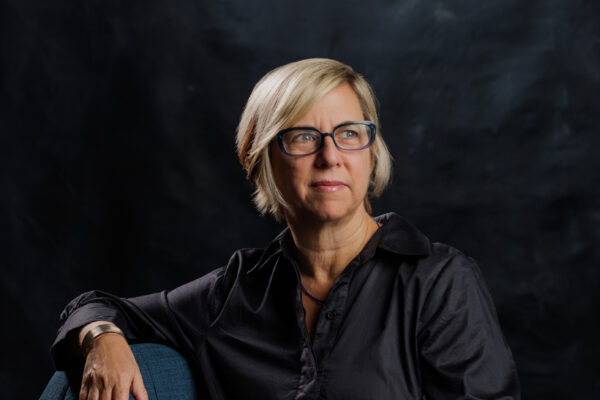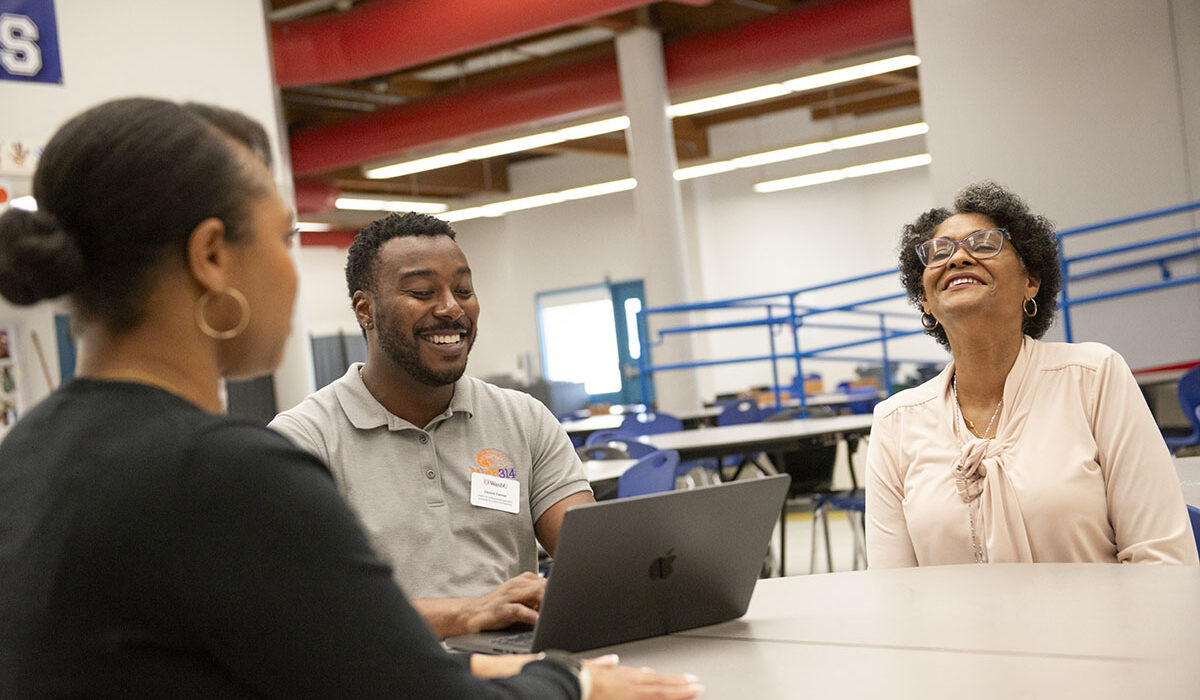
It’s professional learning day in the Hazelwood School District, and Deontá Palmer and Carmen Meeks of the WashU Institute for School Partnership (ISP) are leading a session on math instruction. Specifically, how to promote student ownership of the math curriculum.
“What does that mean?” asks Palmer, an ISP instructional specialist. “To me, it means students do most of the thinking and talking; try different strategies and explain their thinking; use math, words, tools and materials appropriately; and listen to and respond to each other’s ideas.”
Their audience: pre-K teachers. Yes, pre-K.
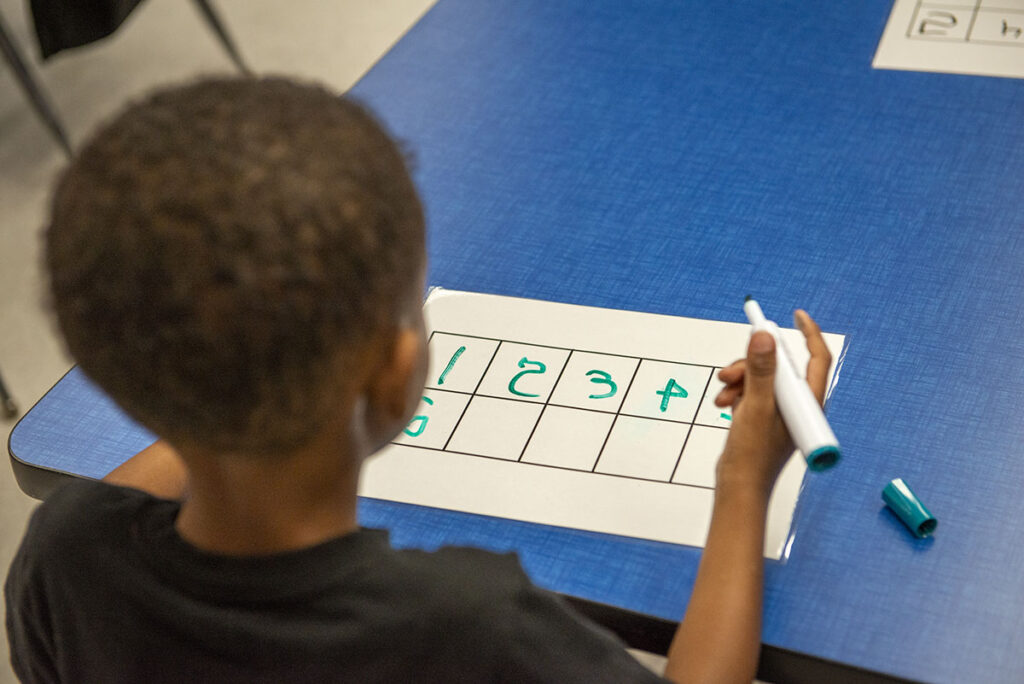
Many of us remember nursery school as a time for finger painting and story time. It still is. But prekindergarten also is when children learn important math concepts — not just counting, but how to create patterns, recognize shapes, measure objects and compare quantities. To ensure every pre-K student starts kindergarten with those foundational skills, Hazelwood has partnered with ISP’s innovative Math314 program to improve classroom instruction and student outcomes. ISP instructional specialists work closely with the district’s 61 pre-K teachers, providing professional learning programming, one-on-one coaching and lesson planning.
Two years into the partnership, Hazelwood is seeing gains. Today, 80% of students who complete the district’s pre-K program are assessed as kindergarten-ready, an increase of 27 percentage points compared to 2023. The state average is 55%. Education organizations have taken note. In 2025, the Missouri School Boards’ Association recognized Hazelwood as the Early Childhood Education Program of the Year.
The district covers nearly 20% of St. Louis County and serves about 17,300 pre-K to 12th grade students. Some 81% of students are Black and 66% qualify for free or reduced-price lunch.
“Students who leave pre-K kindergarten-ready are four times more likely to graduate high school,” said Stacy Ray, Hazelwood’s director of early childhood education. “You don’t really think about that high school graduation journey starting at age 4, but it does.”
Back at the professional development, Jack Gillespie, a pre-K teacher at Coldwater Creek Elementary, shares how he plans to incorporate math into a future lesson about Jackie Joyner-Kersee. Students will measure each other’s long jumps and record the distance. They will then compare distances to determine who jumped farthest.
“One activity, many ways for them to build number sense,” Gillespie said.
‘Our world is so different’
Launched in 2019, Math314 is embedded in elementary, middle and high schools across the region. Its first early childhood pilot, at Julia Goldstein Early Childhood Center in the University City School District, affirmed two truths that ISP’s experts have long understood. One: Early childhood math learning leads to better educational outcomes. And two: Pre-K professional development is often overlooked.
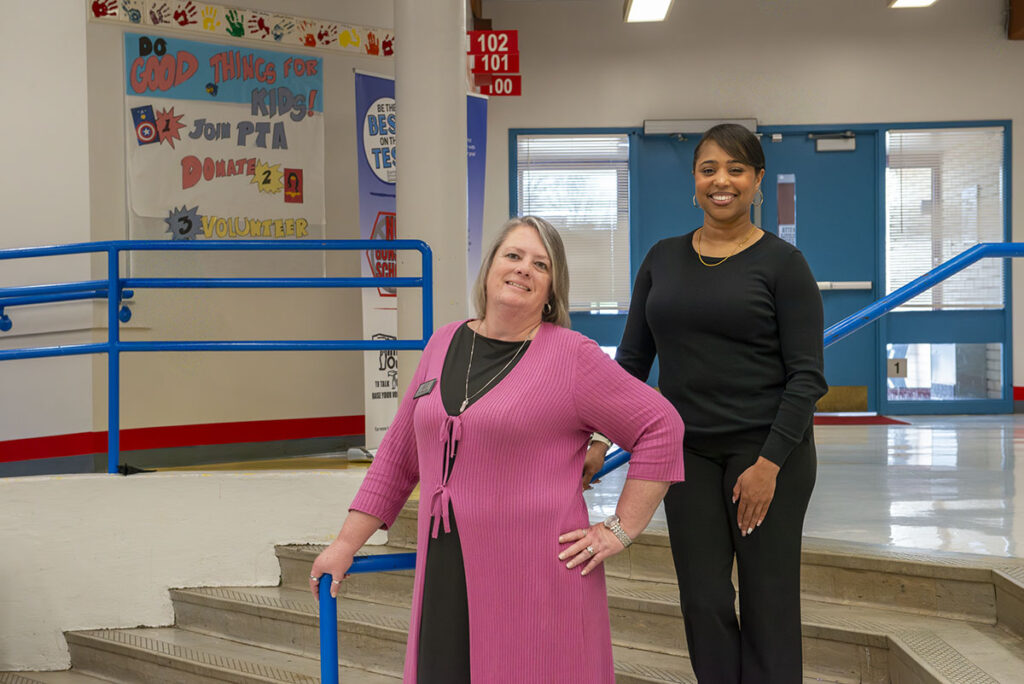
“Part of the reason that this program even came about is because early childhood teachers were going to traditional professional development that was for higher grade levels,” said Meeks, director of Math314 and school leadership programs. “These early childhood teachers were like, ‘Our world is so different from first grade or fourth grade. So much of math instruction is accessed through play and that is not a part of the conversation. We need something different.’”
In addition to delivering tailored professional development programming and coaching to all pre-K educators, Math314 trained a cohort of teacher-leaders who mentored new teachers, identified district priorities, developed their own research projects and presented at regional and national education conferences.
Ray said a growing majority of teachers now report being confident in their knowledge of best practices in math instruction.
“Carmen and her team showed teachers how to move math into the classroom in a way that makes sense and is beneficial,” Ray said. “Now I do a walkthrough, and every teacher is on pace and using the curriculum in a way that works best for their kiddos. Three years ago, if you asked them about math, they would say, ‘Oh, sure, we teach the kids to count.’ Now it’s a whole different thing. I was just in a classroom where they were making bracelets. So they were not only counting the beads, but taking those beads and making patterns and using shapes in different ways. It’s been a huge shift.”
‘I did it!’
Over at Armstrong Elementary, pre-K teacher Kimberly Reese is celebrating the number seven.
“Help me count,” she asks her students, who are spread out on a colorful rug. “We said the number was . . .”
“Seven,” they shout back. “One. Two. Three. Four. Five. Six. Seven.”
“Perfect! How many days are in a week?” she asks.
“Seven,” they call back again.
After counting the days on a calendar and then reciting the days of the week, it’s center time. The students practice their “level one” voices and then pick a fun seven-related activity. In one corner, students build towers of seven Lego bricks; in another, students roll out ropes of Play-Doh to form the number seven; and at another table, they play with picture cards.
“Which one has seven?” Reese asks.
“This one,” offers a boy, pointing to a card with six strawberries.
“Let’s count,” Reese says, and the children count to six.
“It’s this one,” says another child, counting seven frogs. “I did it!”
“The kids definitely enjoy center time,” Reese said. “They are in charge of their own learning. Sometimes they just need the autonomy to explore in a different setting.”
Meeks likes what she’s seeing.
“She’s following the curriculum so you know these students are on track to learn the things they need to know by the end of the year. And there was a lot of autonomy for the kids — ‘I’ve got a choice about what I want to do,’” Meeks observed. “It’s one thing to be able to count to seven, it’s another to be able to recognize the number seven. And it’s something else to correlate seven to the days of the week. You could see how much fun they were having, but they also were gaining these different levels of understanding.”
For Meeks, ISP’s work in Hazelwood is personal. She is a Hazelwood resident and represents Hazelwood as president of the Special School District board of education. She also is an alumna of Hazelwood Central High School. She was a smart kid, but a terrible student.
“I would get suspended,” Meeks said. “I was even discouraged from applying to college; I just felt like no one saw me. But there was one teacher. And that made a difference.”
After college, Meeks signed up for Teach for America and was placed in a struggling school in Kansas City.
“I say this is God’s blessing, but during that first month, I essentially was a teacher’s assistant, moving from class to class. During that time, I got to see the good, the bad and the indifferent,” Meeks recalled. “When I saw excellence, I would take notes and, to some degree, mimic that excellence.”
Meeks went on to work as a pre-K and elementary school teacher before serving in leadership roles in the Special School District and at South City Preparatory Academy. She joined ISP in 2022, expanding Math314’s reach to Ritenour, Kirkwood, St. Charles and other school districts. She is excited to expand ISP’s relationship with Hazelwood’s 19 elementary schools and three special education centers.
“With Hazelwood and Dr. Ray, I have this opportunity to make meaningful change in a place that matters to me,” Meeks said. “We couldn’t be more aligned in mission to make sure every pre-K student hits the ground running.”