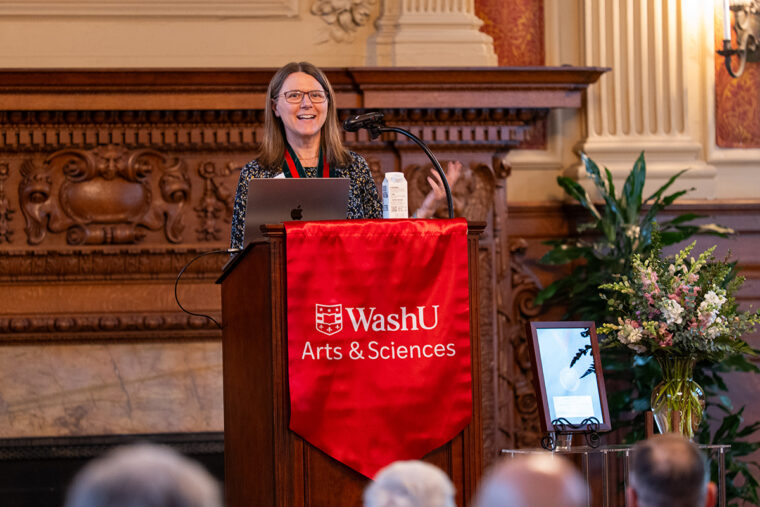
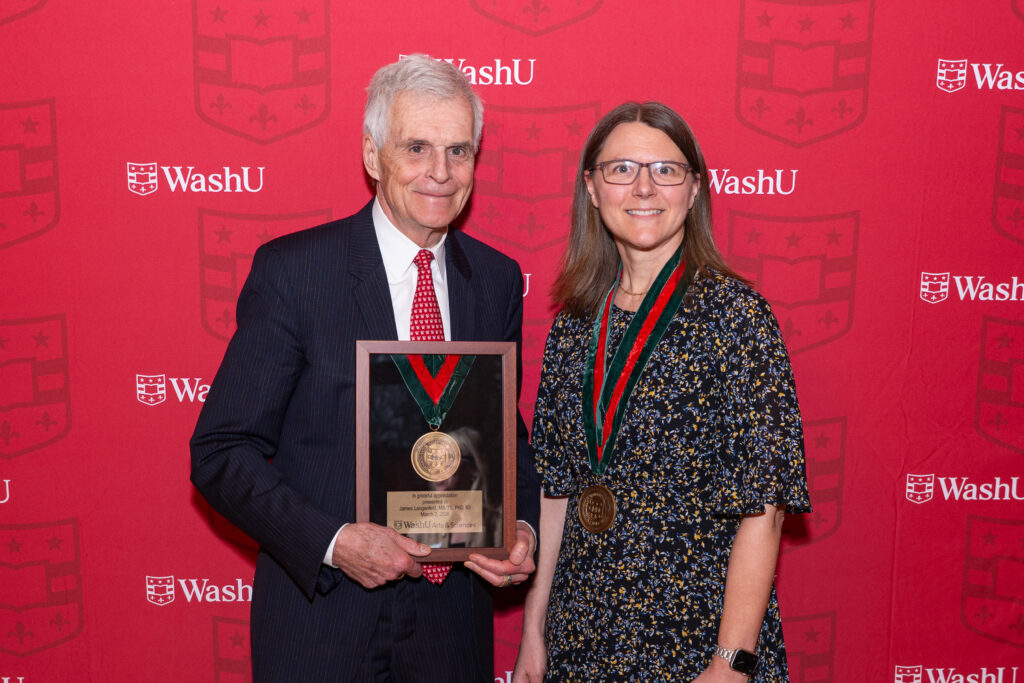
Julie Holland Mortimer, a renowned applied microeconomics scholar, was installed as the inaugural James Langenfeld Professor of Industrial Organization in WashU Arts & Sciences at a ceremony March 2.
Mortimer joined WashU’s Department of Economics in 2025, arriving from the University of Virginia. She is the current president of the Industrial Organization Society and is a research associate at the National Bureau of Economic Research.
Mortimer is widely recognized as one of the world’s leading scholars in industrial organization. Her research investigates the impact of new forms of contracting between content producers and internet retailers. She also has studied demand tension in retail settings and new methods of distributing and monetizing content such as movies, music and images. The work aims to understand the impact that real-life approaches to distribution and contracting have on consumers and the role these practices play in shaping competition between content producers and internet retailers.
The professorship was established by department alumnus James Langenfeld, MA ’75, PhD ’83. During his time at WashU, Langenfeld was a research assistant to Murray Weidenbaum for his book “Government Mandated Price Increases,” and received grants from what is now the Weidenbaum Center on the Economy, Government, and Public Policy. Langenfeld credits his WashU education for opening the doors to his career.
“We’re grateful to Jim for his incredible support of WashU and of the Weidenbaum Center over the years,” Chancellor Andrew D. Martin said.
“His gift ensures that the next generation of scholars in this field will have the same kind of support and inspiration that shaped his path. Julie Mortimer’s work exemplifies the kind of rigorous, innovative research we strive to foster at WashU. We’re proud for her to be the first person to hold this distinction.”
About Mortimer
Feng Sheng Hu, the Richard G. Engelsmann Dean of Arts & Sciences and the Lucille P. Markey Distinguished Professor, shared his enthusiasm for Mortimer’s work.
“Here in Arts & Sciences, we are working to accelerate convergence research that advances our knowledge of the forces that shape our world. Julie’s groundbreaking work on a cross-section of forces — including pricing, media distribution, copyright infringement, competition and more — has helped deepen our understanding of the ways economics shape our interactions,” he said.
In her installation address, “Trusting Data in Antitrust,” Mortimer compared her work to solving puzzles.
“Industrial organization is really the art of puzzle solving. I think of the data as the pieces of the puzzle. Your empirical methods guide how you put the pieces together. And your theoretical lens guides how you interpret the picture. Reliable data is crucial, but that alone is not enough. A lot of times we can tell two different stories with the data. The art is in how we put it together to solve the puzzle,” she explained.
Mortimer has solved many “puzzles” throughout her career, influencing industry standards and economic policy. Her research on emerging media markets — including the introduction of DVDs and the evolution of digital music and video — and intellectual property continues to shape conversation about digital goods and creativity. Likewise, her research on vertical contracts — contracts between two or more businesses operating at different points in the supply chain — has changed how economists and policymakers think about relationships between manufacturers and retailers. Her work on consumer demand, and how consumers react when products are out of stock, has transformed the way researchers and practitioners estimate demand.
Mortimer earned her bachelor’s degree at Carleton College in 1994 before spending two years in the economics research group of Ernst & Young in Washington, D.C., where her work focused on fair lending practices and federal deposit insurance. She earned her PhD in economics from the University of California, Los Angeles.
She lives in Clayton with her husband, Richard Mortimer, and their two children, Gavin and Keaton. The family enjoys spending time together at home with their pets, playing games and doing anything outdoors.
About Langenfeld
Langenfeld is a managing director of the economics and finance consulting firm BRG. He previously served as antitrust director in the Federal Trade Commission (FTC)’s Bureau of Economics. There, he was a primary drafter of the 1992 merger guidelines and headed teams of economists and lawyers assisting central European countries’ conversion from Soviet-controlled economies to market-based economies after the fall of the Iron Curtain. He has been an adjunct professor at four universities.
Throughout his career, Langenfeld has provided economic analyses and expert testimony for litigation, regulatory actions and economic policy in a variety of industries. He serves on the editorial board of several professional journals and has published numerous articles in journals and books on diverse topics in antitrust, damages, applied economics and econometrics. He is chair of the American Bar Association (ABA) section of the antitrust law developments update committee. He has served as co-chair of the ABA’s economics committee and editor of Research in Law and Economics. He has received many honors and awards, among them the FTC Distinguished Service Award and WashU’s Distinguished Alumni Award.
Langenfeld said he endowed this professorship because he believes that applied microeconomics should be a part of policymaking, business decision-making and the law.
“I have found the training that I had in applied microeconomics and industrial organization to be really important, not only from an intellectual point of view, but a policy point of view. These are a particular set of tools that, when applied to objective facts, can lead to better outcomes for people’s lives and businesses,” he said.