The phrase “the whole is greater than the sum of its parts” is doubly true for SWARM, the WashU Robotics team on the cutting edge of modular robotics. The project’s 15 members are working to create robots that can connect and cooperate to accomplish difficult or dangerous tasks.
“Think of it like an ant colony — a swarm. Just as ants will link their bodies together to form a physical bridge, our robots can autonomously lock together to build whatever structure the situation demands,” said Sebastian Theiler, captain of SWARM and a junior studying electrical engineering and robotics at the WashU McKelvey School of Engineering. “Right now, modular robotic systems are largely confined to the lab, but there are many possible applications.”
Take, for instance, a search-and-rescue operation. First responders could deploy a single robot to crawl through a collapsed building to asses damage. That robot could then beckon other robots to help it move heavy debris or to make a chain to clear a gap.
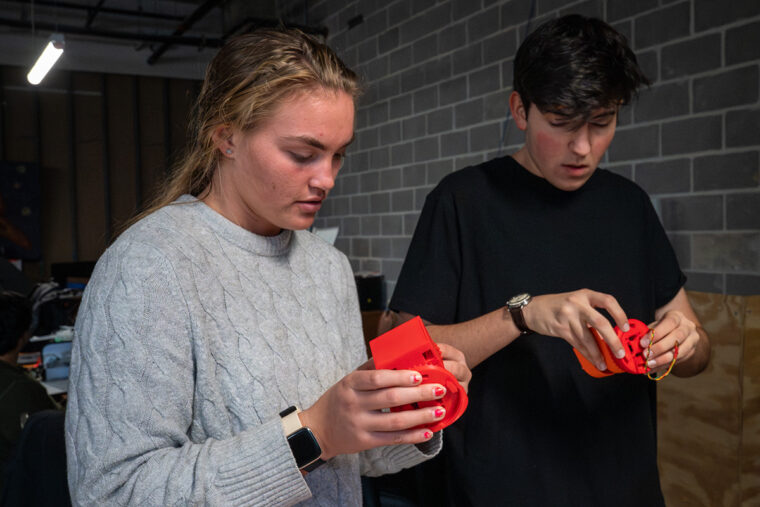
SWARM’s robots — essentially four-inch cubes of 3D-printed plastic — aren’t ready for such real-world tasks. Right now, the team is focused on getting the robots to autonomously shapeshift to navigate simple obstacles. But SWARM’s work today could lead to future discoveries.
“There’s a lot that we’re doing here that hasn’t been done before, which is one of the most exciting things about this project,” Theiler said. “We want to make our work open source and accessible so that anyone with a 3D printer and some resources can create their own system. We think that will speed up modular robotics research.”
Theiler joined SWARM as a first-year student and calls it his “dream project” because it has allowed him to explore his interest in emergent properties, i.e. systems that can accomplish much more than the total of their components. He calls SWARM a robotics playground.
“Most robots have a single function, like a robotic arm or a rover. But modular robotics allows us to challenge ideas about what it means for something to be a robot,” Theiler said. “We’re not really building the finished product. We are building something that can theoretically be very general and can shapeshift into meeting whatever application you require at that moment.”
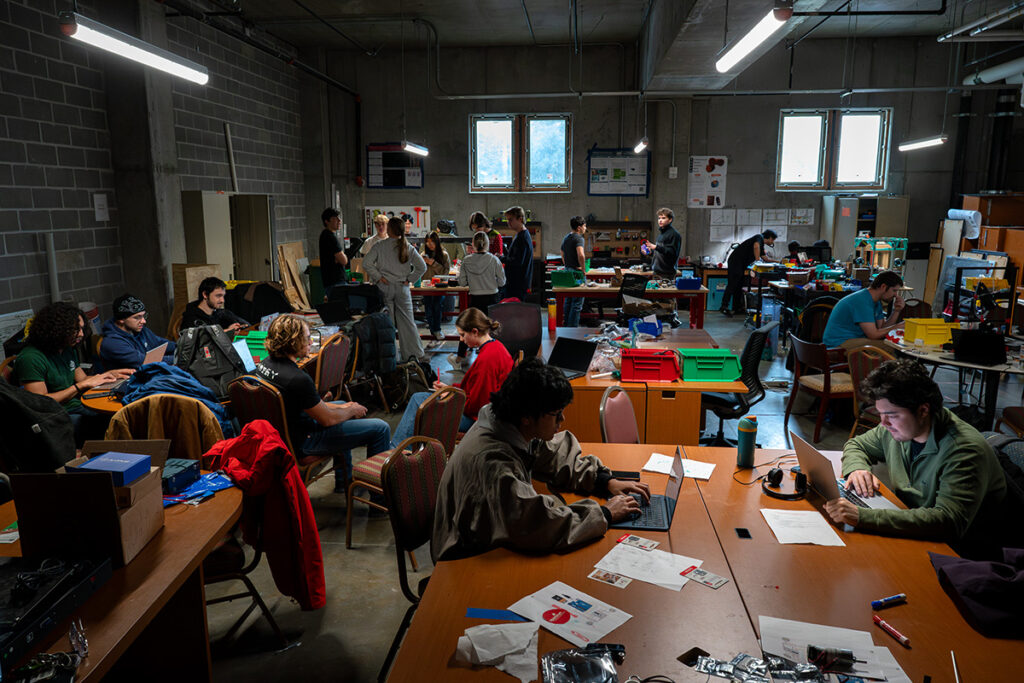
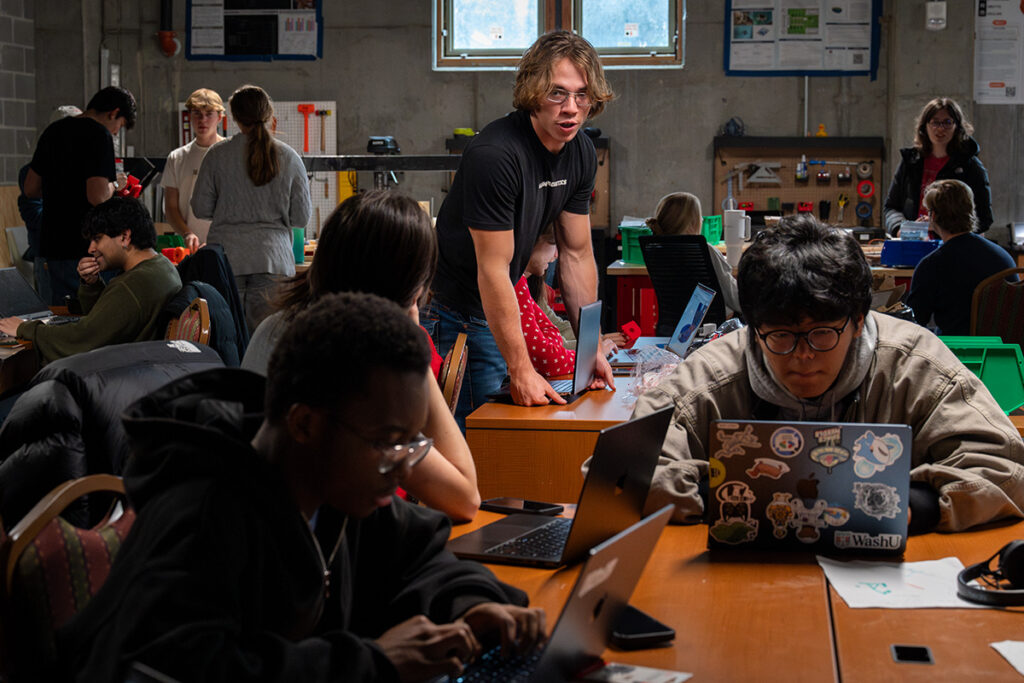
Just as the robots collaborate to build something greater, so too do the members of SWARM. The mechanical, electrical and software teams each play an essential role in building SWARM’s Transformer-like prototypes, said Christena Berry, a member of SWARM’s mechanical unit. She credits the club with teaching her how to go from an abstract idea to a tangible product.
“It’s truly a team effort. It’s not me just doing one specific thing,” said Berry, a junior studying mechanical engineering. “It’s coming every week being ready to contribute ideas and fix the issues that we have each week and help with whatever somebody may be struggling on.”
WashU Robotics President Chris Brusie said club alumni have leveraged the lessons learned on their projects to land prestigious jobs at companies such as Tesla and Google. One alumnus, who mastered wiring printed circuit boards, got a job wiring circuit boards for Ford Motor Co.; another, who created software solutions for his project, was accepted into one of the top PhD robotics research programs in the country, he said.
“Here, students actually get to build things and be hands-on and work on a project that goes over a few years on a big team,” said Brusie, a junior studying electrical and systems engineering. “These are really important experiences you can’t always get in a classroom.”
One skill that SWARM members have mastered is prototyping. So far, they’ve built and tested more than 100 prototypes.
“You never get it on the first try,” said Harrison Felipe, a sophomore studying mechanical engineering and a member of SWARM’s mechanical unit. “I’ve learned iteration here more than anything. You try something, the first time you put it through rigorous testing and see a lot of flaws, and then work on solving them for the next prototype.”