In Brief
- A pregnancy nutrition program in Ecuador focused on locally available foods improved diet quality.
- The mothers’ improved diet was linked to greater growth in a key fetal brain region.
- Researchers say the approach offers a practical way to support maternal and infant health and the local economy.
A nutrition program for pregnant women inspired by ancestral dietary patterns and adapted to locally available foods in Ecuador increased growth in a key fetal brain region, according to a study led by researchers at Washington University in St. Louis. The study appears in the Sept. 8 issue of the Proceedings of the National Academy of Sciences.
The Children’s Discovery Institute, a partnership with St. Louis Children’s Hospital, St. Louis Children’s Hospital Foundation and WashU Medicine, funded the work.
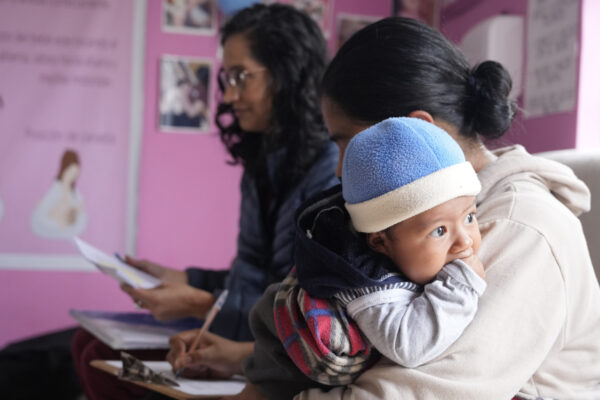
The trial, called Mikhuna, included 215 healthy pregnant women living in two low-resource communities on the outskirts of Quito, Ecuador. Researchers randomly assigned 111 women to an intervention group and 104 to a control group receiving standard prenatal care. From about 12 weeks of pregnancy until birth, women in the intervention group received weekly deliveries of eggs, fish, fruits and vegetables, along with guidance on eating a more diverse diet and limiting ultraprocessed foods.
The program drew on evidence about human diets across evolution while adapting those broad nutritional principles to the Ecuadorian context, including local foods and nutritional needs. Researchers tracked maternal diet and health along with socioeconomic and demographic factors that could influence the findings. They collected data throughout pregnancy and again two weeks after birth.
By late pregnancy, the intervention group had significantly improved dietary diversity. Ultrasound imaging also showed greater fetal brain growth in that group, with the strongest finding in the gangliothalamic ovoid, or GTO, a deep-brain region involved in movement, sensory processing and thinking and reasoning.
“Mikhuna” means “nourish” in Kichwa, an Indigenous language spoken in Ecuador. The trial grew out of decades of research led by WashU’s Lora L. Iannotti on nutrition and malnutrition from conception through age 2. Iannotti is the Lauren and Lee Fixel Distinguished Professor at WashU Bursky School of Public Health and leads the E3 Nutrition Lab, which examines nutrition through the interconnected lenses of equity, environment and evolution.
Poor nutrition during this critical period can lead to stunting, a form of chronic malnutrition that impairs children’s growth and development and affects 22.5% of children globally. Stunting is associated with increased risks of disease and death, reduced schooling and lifetime earnings and health consequences that can extend across generations. Poor-quality diets also can cause “hidden hunger” — nutrient deficiencies even when calorie intake is adequate.
“The consequences of being undernourished in that period can be irreparable,” Iannotti said. “If nutrition is compromised by poor-quality diet, infectious disease or otherwise during the first 1,000 days of life, children will likely never reach their full genetic potential.”
Ecuador also illustrates the complexity of modern malnutrition. Stunting remains persistently high even as overweight and obesity also are more prevalent, and deficiencies in essential nutrients remain widespread. More than a decade ago, researchers found that over 13% of Ecuadorian households experienced some combination of stunting, overweight, anemia and zinc deficiency.
Nutrients such as iron and zinc play important roles in fetal brain development, but much less is known about how a mother’s diet shapes the developing brain.
An evolutionary lens
Most maternal nutrition programs in low-resource settings focus on individual nutrients, supplements or fortified foods. Established approaches such as Mediterranean diets may rely on foods that aren’t culturally appropriate, locally available or sustainable in many parts of the world. Mikhuna took a different approach and offers lessons that also could apply in other regions.
Researchers applied evidence of dietary patterns across human evolution, analyses of nutritional gaps among pregnant women in the region and more than a decade of research to design a whole-food intervention that women could realistically follow using locally and sustainably sourced foods.
The evolutionary framework starts with a simple premise: Human diets historically included a wider variety of foods than many modern diets, which increasingly rely on carbohydrate-based staples and ultraprocessed foods. Paleolithic diets — reflecting gatherer-hunter-fisher diets from roughly 2.5 million years ago until the emergence of agriculture about 10,000 years ago — varied by environment. In general, they provided more protein and fats from animal-source foods, fewer carbohydrates and more micronutrients and fiber from a variety of plants.
Mikhuna integrated those broad nutritional principles. The Mikhuna food basket combined eight eggs and 500 grams of fish each week with a rotating selection of fruits, vegetables, herbs and spices. The mix incorporated native foods such as naranjilla and mora, an Andean blackberry, and was sourced from farms using agroecological practices. The goal was an approach that could expand sustainably while strengthening local food systems.
At the end of the program, 74.5% of women in the Mikhuna group met the minimum threshold for a varied diet, compared with 55.8% in the control group. They reported eating an average of 14 distinct foods a day, compared with nine in the control group, although consumption of rice and ultraprocessed foods remained high in both groups.
Inside the developing brain
Researchers used portable ultrasound at 21 and 35 weeks of pregnancy to examine fetal brain growth, including deeper brain structures not typically measured during routine prenatal imaging.
From 21 to 35 weeks, growth in the GTO was 0.15 centimeters greater among fetuses in the Mikhuna group compared with the control group, a statistically significant finding even after adjustment for multiple comparisons.
Fish, a key part of the diet, contains fatty acids important to brain development, but the study cannot isolate the effects of individual foods or nutrients.
Researchers also reported two findings that did not remain statistically significant after adjustment for multiple comparisons: 0.19 centimeters greater growth in the corpus callosum, the brain’s largest white-matter tract, and 0.10 centimeters less femur growth in the Mikhuna group. Researchers found no differences in dairy consumption or reported supplement use that might explain the femur finding. Newborn length and weight did not differ significantly between groups. Researchers said the findings warrant further study.
Iannotti collaborated with Jennifer Nicholas, MD, a pediatric radiologist at Cincinnati Children’s Hospital Medical Center, to develop the study’s fetal brain-imaging approach. WashU Medicine researchers Manu S. Goyal, MD, a professor of radiology, and Marcus E. Raichle, MD, the Alan A. and Edith L. Wolff Distinguished Professor of Medicine, also helped design the imaging protocol.
As a relatively low-cost, noninvasive tool, portable ultrasound could offer a practical way to study fetal brain development in low-resource settings.
“We’re looking at what I would consider to be the biological mechanism, or the pathway,” Iannotti said. “But what we really care about is the child’s actual functional development.”
From research to public health practice
The researchers partnered with Ecuador’s Ministry of Health from the outset, conducting Mikhuna in ministry clinics and sharing the approach and findings with health officials throughout the study.
The approach builds on Iannotti’s previous research in Ecuador. In a previous trial, her team provided one egg a day beginning when infants were 6 months old. That approach reduced stunting by 47% in the intervention group and helped prompt Ecuador’s Ministry of Health to change its national recommendations on when eggs should be introduced to babies.
Mikhuna moved that work earlier, into pregnancy, while expanding from a single food to an overall dietary pattern and directly examining fetal development.
The team is now working with partners in Ecuador to translate the Mikhuna findings into a national pregnancy nutrition program involving government and the private sector. The broader goal, Iannotti said, is to understand how healthy diets can be adapted to local contexts in ways that support human health without compromising the ecosystems and food systems that sustain them.
Some information for this story was provided by Claire Gauen, senior periodicals editor at WashU Magazine.