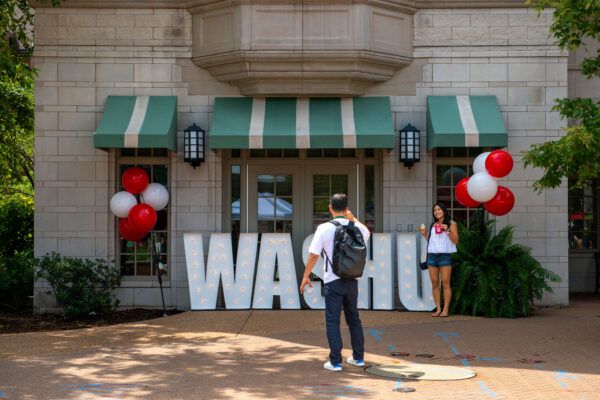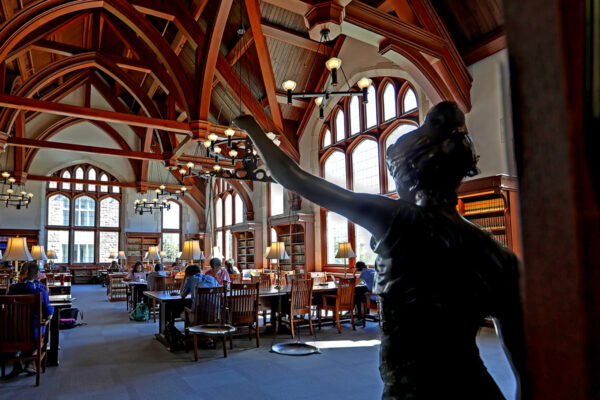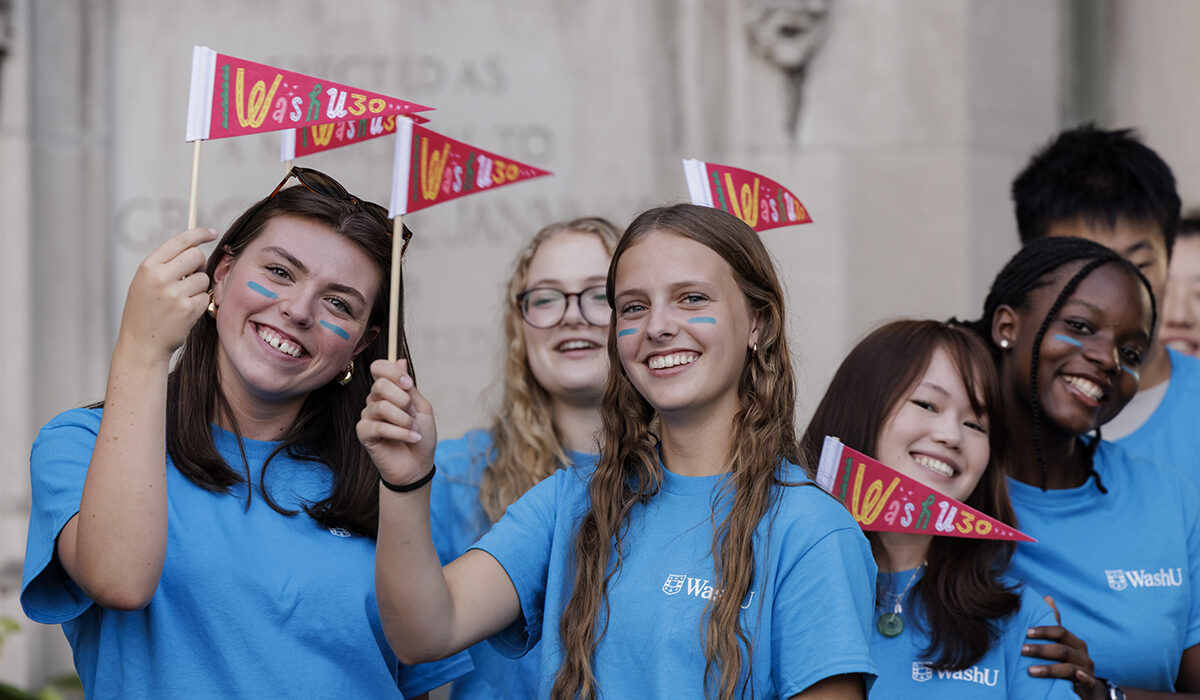
Last year, WashU Undergraduate Admissions continued to expand recruitment efforts, visiting more than 1,400 high schools, hosting some 530 information sessions welcoming 10,000 prospective students on campus tours and sending 28 million emails. The hard work paid off: 1,942 of the globe’s top students chose to join the WashU Class of 2030.
But in a moment when the public is questioning the value of a university degree, there is more to do, said Ronné Turner, vice provost of enrollment management.
“Now is the time to double down and help people understand that higher education is important and that institutions like WashU that provide rigorous academics and a supportive environment are doing a wonderful job serving students,” Turner said.
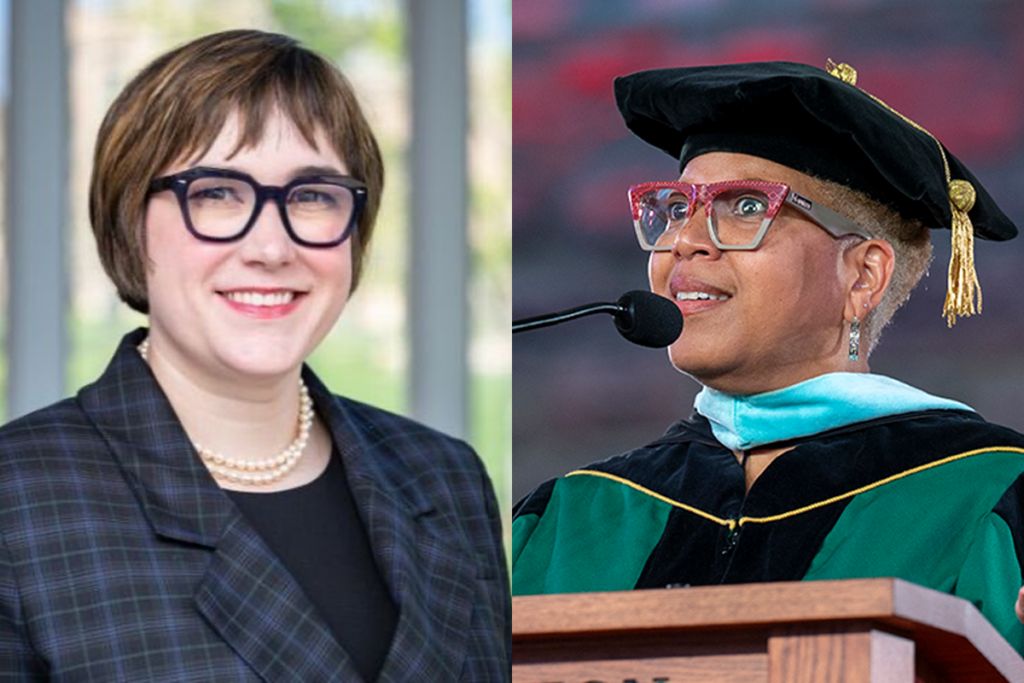
Here, Turner and Grace Chapin James, assistant vice provost for undergraduate admissions, explain how WashU has managed to maintain its international student population, what’s next for the test-optional policy and why the university decided to introduce an early-action option for the new admissions cycle.
At a time when many schools are seeing international enrollments decline, WashU is enrolling more international students this year. Is that a surprise?
James: That is a delightful surprise. It’s fantastic that so many international students still see WashU as the school they want to attend. A lot of institutions have found it challenging to sustain their international student population, but we are actively engaged in international student recruitment.
Turner: The support we have received from the Office for International Students and Scholars and Geet Vanaik (OISS executive director) also has been exceptional. We understood from Geet that there would be challenges with students getting visas, and so we worked really closely with her team to get information out earlier to students. We also had a healthy number of students apply and receive admission through the early-decision process so they had a longer lead time to apply for visas.
What were some of the interests and priorities of this new class and their families?
James: It’s really exciting to see how many students are interested in the Public Health & Society program in Arts & Sciences. It’s still a new program, but a lot of students say they want to major or minor in the program. Another big change is the number of students and families interested in learning what’s happening with WashU and AI (artificial intelligence). And so we’ve been communicating about the robust resources and opportunities here. And more and more, families are paying attention to career. Because the Center for Career Engagement does such a good job of collecting outcomes data for every major, we are able to give them really good information. Our students — whether they major in the arts or finance or political science or history — are finding good jobs. For us, it has been great to have this data to point families to because it proves what’s possible with a WashU education no matter what you study.
WashU is still test-optional, but 63% of students submitted their scores, an increase of 4%. Why is that, and what is the future of our testing policy?
Turner: As more of our peers require test scores, students have become accustomed to sharing scores. In terms of our own testing policy, I expect we will make an announcement within this year. There are two components that we are looking at. One is the student success data for the Class of 2025, the first class that graduated with the test-optional policy. We are looking not only at first-year GPA, but their outcomes. Are they getting jobs in their field? Getting into medical school? Graduate school? The other piece of the decision is what is happening in the higher education world around us. What are our peers doing? What are the expectations about testing?
What’s this class like?
Turner: This class is doing some really interesting things. There’s a student from rural Oregon who led a poison awareness program in an elementary school, a student who produces American Sign Language song interpretation videos, a student who teaches English to pediatric cancer patients. The list goes on and on. It was incredible to see them all together for the first time at Convocation and to witness that sea of possibilities. It was just the very best thing.
The admission process for the Class of 2031 is changing, including the introduction of early action — meaning that students can apply early to WashU but, unlike early decision, need not commit until spring.
James: A lot of students have been asking for this option. Early action still gets the student their admission decision earlier, but it allows the flexibility to apply to other schools. Early decision (ED) is still what we would consider to be the ultimate signal from a student that they are committed to coming to WashU.
How will early action impact applications?
Turner: Will some students who would have applied early choose to apply early action? Maybe. Will some students who really want to be here continue to apply ED I and ED II? Absolutely. Will students who would have applied regular decision move to early action? Probably. We don’t know what the numbers are going to be or how it’s going to play out. Nor do we know who we’re going to admit from early action. We need to see what the pool is like.
WashU now also will consider demonstrated interest. What does that look like?
Turner: A visit to campus is a great way to learn about WashU and answer the question, ‘Can I see myself here?’ But there are a lot of ways to learn more about WashU. Our team is visiting high schools all over the country and all over the world. We do virtual information sessions and Bear chats. We believe if students have the opportunity to research and learn and explore WashU, they’re going to grow to love us.
WashU also has eliminated its optional second essay. Did the widespread use of AI factor into that decision?
James: Not at all. Our applicants are still required to complete the Common App personal statement and to submit an essay stating what they want to study at WashU and why. The reason we eliminated the optional essay is that we were not getting a lot of new information relative to what else was already in their application. For a lot of students, it felt burdensome and stressful.
It’s been three years since the Supreme Court restricted race as a factor in admissions. How has the decision impacted our holistic admissions process?
James: We evaluate students in the context of their high school and in the context of their environment. Every student we admit to WashU is taking on the greatest challenges available to them academically and has made a good case why WashU is a great place for them to continue that work. What that looks like from student to student and environment to environment is something that we train our team on. Every student that we admit is meritorious.
Turner: I want to be clear: We are following the law. We are working very closely with the university’s general counsel and everything we do aligns with the guidance that our general counsel gives us. We have continued to succeed in recruiting talented students with diverse perspectives, experiences and backgrounds by being everywhere. Our team is all over the United States, all over the world, sharing that message and our institutional values — that we care about freedom of speech and dialogue across differences, that we are a welcoming and collaborative community.