In a major advance applying insights from quantum physics to the inner workings of biology, a team of WashU researchers has successfully implanted quantum sensors in living cells to measure shifts in magnetism and temperature.
The measurements could offer new insights into the efficiency of cellular metabolism in health and disease.
“We were able to accurately measure quantum-level properties within our nanodiamond sensors in living cells,” said Shakil Kashem, a graduate student in physics in Arts & Sciences at Washington University in St. Louis and co-lead author of a preprint published in bioRxiv. The other lead author is Stella Varnum, a recent WashU immunology PhD graduate.
The measurements focused on mitochondria, the energy-producing organelles within cells. “This approach could help us better understand mitochondrial function in health and in diseases linked to mitochondrial dysfunction, such as heart failure, Type 2 diabetes and metabolic diseases.”
Kashem presented the research March 16 at the 2026 annual meeting of the American Physical Society.
Co-senior authors of the paper include Kashem’s adviser, Chong Zu, an assistant professor of physics; Shankar Mukherji, also an assistant professor of physics; and Jonathan Brestoff, an associate professor of pathology and immunology at WashU Medicine. Other key contributors include physics graduate student Changyu Yao and David Piston, the Edward J. Mallinckrodt, Jr. Professor, head of cell biology and physiology at WashU Medicine and co-director of the Center for Quantum Leaps.
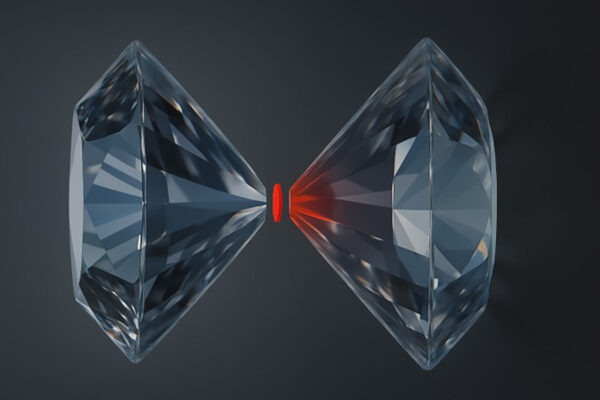
To achieve the unprecedented measurements, the team harnessed the quantum powers of nanodiamonds. Each diamond was blasted with nitrogen ions that knocked carbon atoms from the crystal lattice. The resulting vacancies trap electrons that are extremely sensitive to their surroundings, including changes in temperature and fluctuations in magnetic fields.
To insert the diamonds into living mouse cells, the team enlisted help from biology. “We used macrophages, immune system cells that eat bacteria,” said Mukherji, who specializes in cellular functions. “When we mixed nanodiamonds with macrophages in a test tube, the macrophages quickly consumed them, placing the sensors inside the cells.”
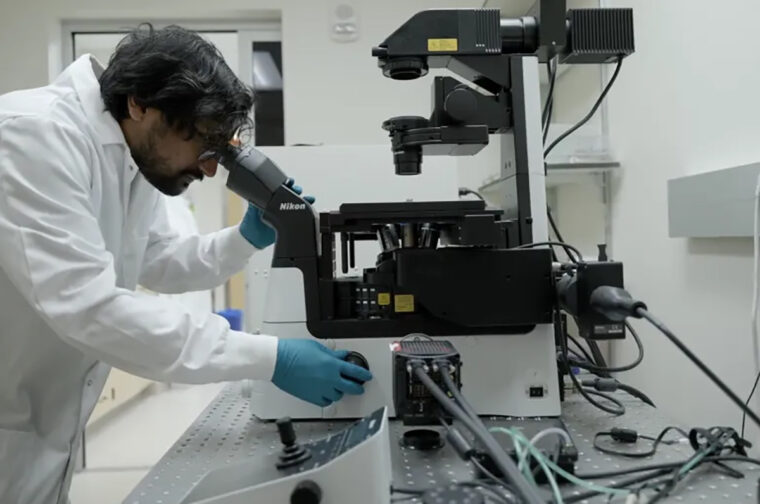
The researchers then used a special microscope to track how the electrons within the diamond responded to their new environment. As predicted, the quantum biosensors detected subtle shifts in magnetism and temperature driven by mitochondria — the cell’s energy powerhouses. “The really exciting thing is that we could measure both magnetism and temperature in the same sample,” Mukherji said.
Zu, Mukherji and Brestoff are fellows of WashU’s Center for Quantum Leaps, which provided funding for the study. Additional funding came from the National Institutes of Health (NIH) and the National Science Foundation, including the NSF Linking Quantum Sensing Technologies across Disciplines (LinQ) research traineeship program and an Expand-QISE award to Zu. Supported by LinQ, Varnum spent a year working with Zu and Mukherji on quantum sensing in biological systems.
Several chemical reactions inside mitochondria can influence temperature and magnetism. For example, the organelles create and transport iron-containing compounds, a process that produces extremely small magnetic fluctuations. “We’re measuring the magnetic noise that reflects metabolism inside the cell,” Kashem said.
Scientists have long tried to measure these signals inside cells, but many techniques can disrupt cellular function.
In his lab, Brestoff had tried unsuccessfully to measure temperature changes inside cells using near-infrared cameras. In a casual conversation with a mutual colleague at a St. Louis playground, Zu heard about that project and its many frustrations.
“I reached out to Jonathan (Brestoff) to tell him about our nanodiamonds, and the collaboration was born,” Zu said. “We’ve been trying to introduce these sensors to a range of experts outside of physics. We’re looking for people who can embrace this quantum leap.”
The study goes beyond a simple proof of concept, Kashem said. It revealed previously unknown nuances in mitochondrial metabolism that could point researchers toward new lines of inquiry.
“Our findings suggest that the movement of iron-containing molecules seems to play an important role in metabolism,” he said. “We want to create a new technique for measuring mitochondrial health, which could lead to novel therapies.”
Future progress with biosensors will depend on collaboration across multiple disciplines — the kind that made this study possible.
“It takes physicists to build and optimize the sensing platform, engineers to design the microscope, and biologists to interpret the results,” Kashem said. “Fortunately, we have all of that expertise here at WashU.”
Originally published on the Ampersand website