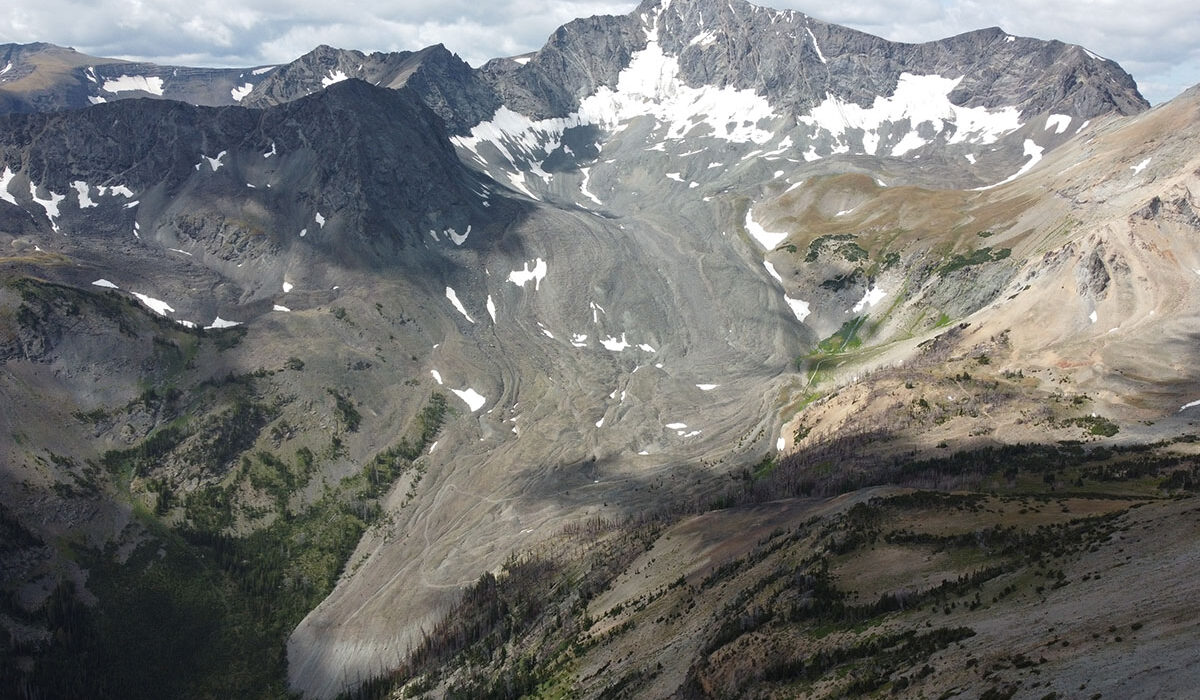
The glacier located near Sunlight Peak, Wyo., has been its icy self since the Yellowstone region’s last major glaciation occurred some 20,000 years ago. The bulk of Sunlight’s ice has remained ensconced in its northern Rocky Mountain keep for many thousands of years. But that is now changing, according to research from scientists at Washington University in St. Louis.
According to a study published in a special issue of the Annals of Glaciology, the Sunlight glacier system is melting up to 50 centimeters a year, with between 5 and 20 meters of total ice left in place. This means some areas of the glacier could be ice-free within a decade or less. Other thicker areas will keep ice through the century, and the surrounding permafrost could last a couple more centuries.
The new estimates were determined by a multi-institution team led by Tyler Meng, a postdoctoral researcher in the radar geophysics lab of Roger Michaelides, an assistant professor of earth, environmental and planetary sciences in Art & Sciences at WashU.
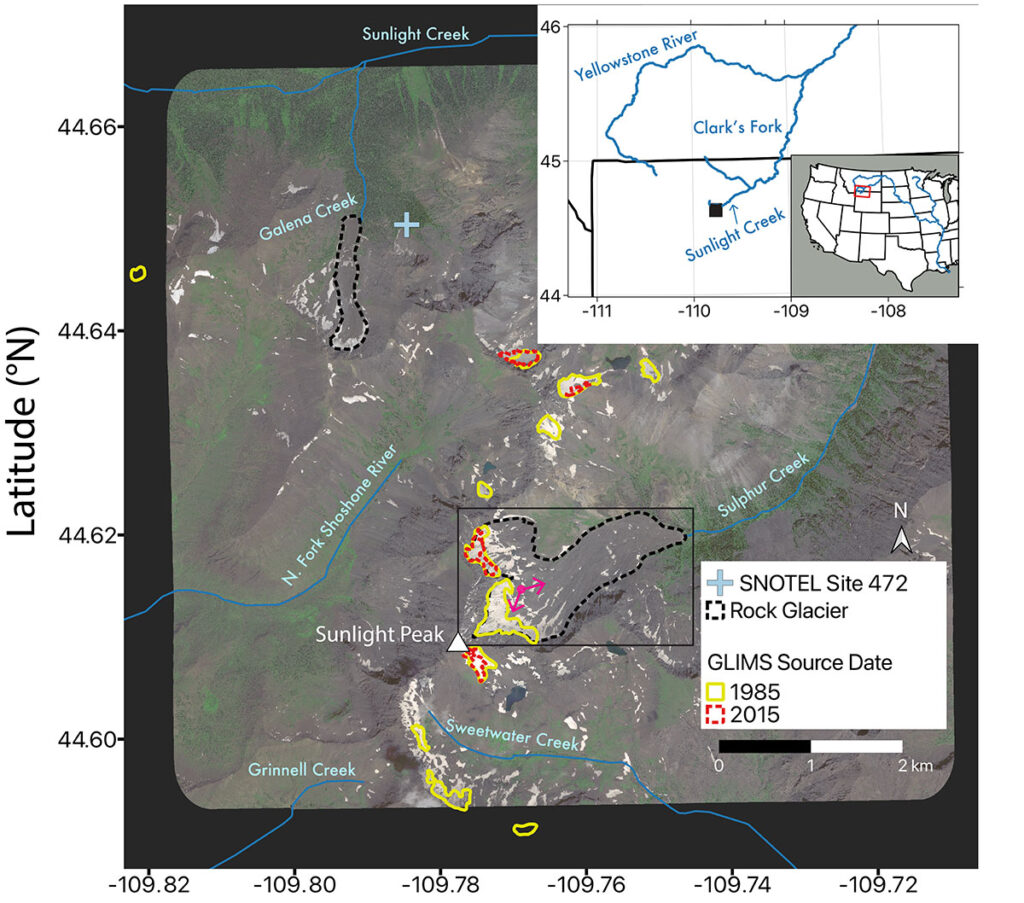
Meng noted that this research is the product of multiple generations of researchers observing and measuring the glacier, including crucial photos of the ice sheet snapped in 1960s by esteemed geologist Noel Potter Jr., a co-author on the paper.
The team deployed geophysical instruments, processed satellite data and developed new methodology to gather more than 100 years’ worth of documentation about Sunlight’s life — and its eventual death.
Ice sheets shift and twitch with the seasons and centuries, melting and feeding the river systems and watersheds across the continent, including the Missouri River in St. Louis, for example.
In the case of the Sunlight glacier, it’s useful to document one glacier’s fate and the impacts to natural and human ecosystems, Meng and Michaelides noted. But the research also stands as a template to help understand what may be happening to many other glacial systems around the world.
“These features are more local than people think, and they do have measurable changes on the local environment,” Michaelides said.
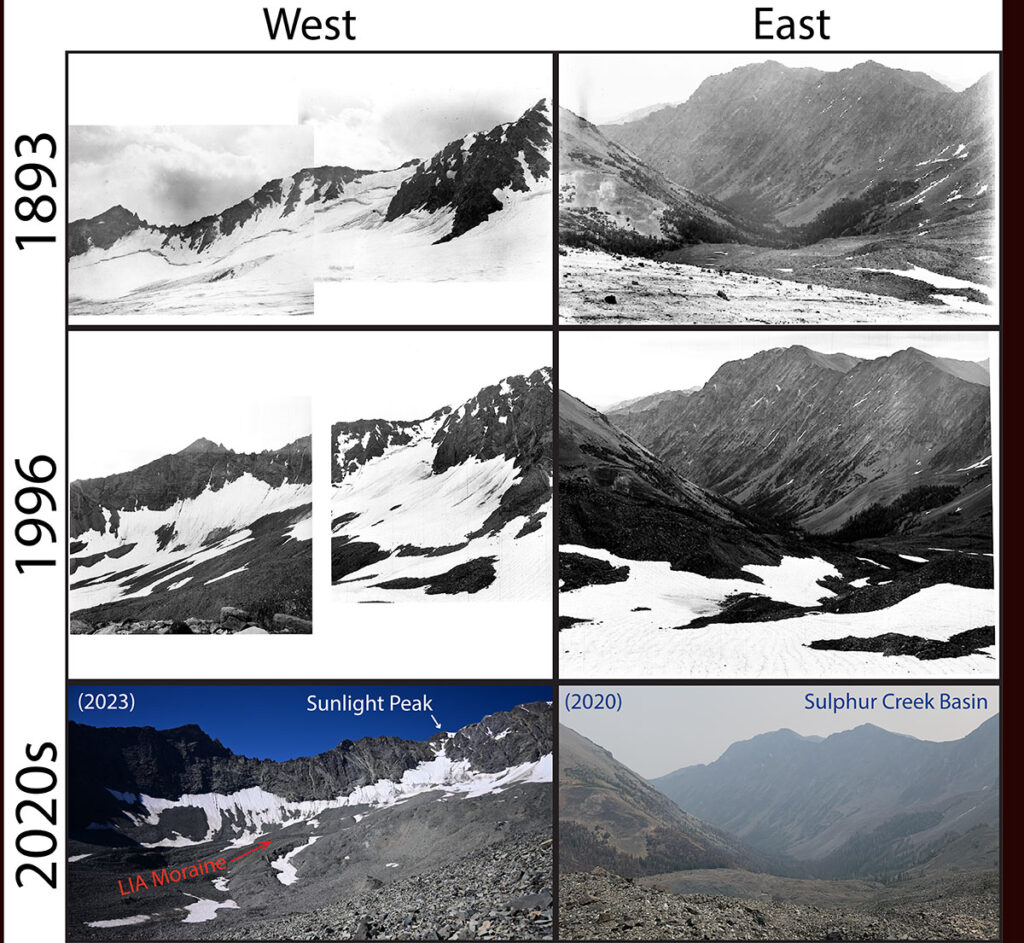
Cultures have long developed around alpine life, including tourist industries flourishing to this day. The first photo of the Sunlight glacier included in the new study was taken by the U.S. Geological Survey in 1893. Scientists like Meng have been dutifully watching the glacier, measuring it and gathering data ever since.
In this region of the Absaroka Mountains, “there will still be ground ice for centuries to come despite locked-in global warming,” Meng said. But things won’t stay frozen like that across the entire range. “In some of these areas where there’s exposed ice, especially susceptible slopes, the ice has already completely disappeared. There are only a few decades for those areas of thinnest ice remaining.”
In addition to providing measurements and historical context, Meng’s study demonstrates new methods to measure glacier systems by combining high-resolution photogrammetric surface measurements collected by drones and microwave remote sensing data collected by Synthetic Aperture Radar (SAR) imaging satellites.
With this combined methodology, Meng and his team were able to derive surface velocity measurements of melt over time, which means more accurate estimates for how much time remains for icy regions all around the world.
Measuring melt
Meng’s own introduction to Sunlight happened during his PhD work studying subsurface ice buried under rockfall debris at the University of Arizona. His ongoing work is a group effort to both document the loss of a notable glacier and identify steps for others studying glacier loss over time.
“We’ve been developing multidisciplinary methods for this study site and a few others,” Meng said. “More survey results are in the pipeline.”
The research includes field measurements and satellite remote sensing, which can continuously collect data, “enabling the monitoring of these features that are an important and overlooked part of the cryosphere,” Michaelides said. He added that these glaciers can serve as a canary in the coal mine, helping scientists and other observers to prepare for and adapt to climate change.
It can be surreal and abstract to monitor the loss of planetary features that can last millions of years, but won’t.
Meng can recall a time early in his research when he realized that this glacier was really going fast. It happened when he saw data indicating only 4 meters of ice left on a particular section. “I was surprised it was that thin,” he said.
Then it hit him: “This is an area that’s melting rapidly,” Meng said.
In addition to the loss of high-mountain water resources that have persisted for centuries, glacial melt can lead to safety issues with destabilized slopes and more hazardous conditions. These types of conditions must be closely monitored for landslides, Meng said, noting how a community in the Alps was recently buried in a landslide. Fortunately, in that case, local officials were keeping a close eye on conditions and the village was evacuated.
The news of this particular melting glacier will come as no surprise for the people living around Sunlight and other mountain regions of western North America. They can see the snow pack retreating, the mounds of snow shrinking into the rock face every year, on top of the significant “snow drought” the region has been experiencing for the past decade.
“The locals notice it,” Meng said. “The change in the landscape is a big factor. How people will interact with the land over time is going to change.”
Meng TM, Potter N, Aguilar RJ, et al. The Sun is setting for the historic Sunlight Glacier, Absaroka Mountains, Wyoming, USA. Annals of Glaciology. Published online 2026:1-23. DOI:10.1017/aog.2026.10041
Research is supported by the Resources for Exploration Science of Our Cosmic Environment (RESOURCE) project supported by NASA’s Solar System Exploration 358 and the Research Virtual Institute (SSERVI). Additional analysis was conducted with funding from the NASA 359 Surface Topography and Vegetation (STV) mission supported by the Decadal Survey Incubation (DSI) 360 361 program.