What is the life cycle of a building?
Each year, in the United States, new home construction accounts for 50 million tons of carbon emissions. The majority stem from harvesting, manufacturing and transporting building materials — from lumber and masonry to glass and tile to roofing and mechanical systems.
But what happens at the end of the cycle? When a building is no longer inhabitable or needed, what happens to all the energy invested in those materials?
“It’s demolished,” Hongxi Yin said. “It goes to the landfill.”
Yin, an expert on sustainable construction, is the InCEES professor in advanced building systems and architectural design in the Sam Fox School of Design & Visual Arts at Washington University in St. Louis. Over the last decade, he has led a series of research studios exploring ways to improve building efficiency, supply chains and construction processes.
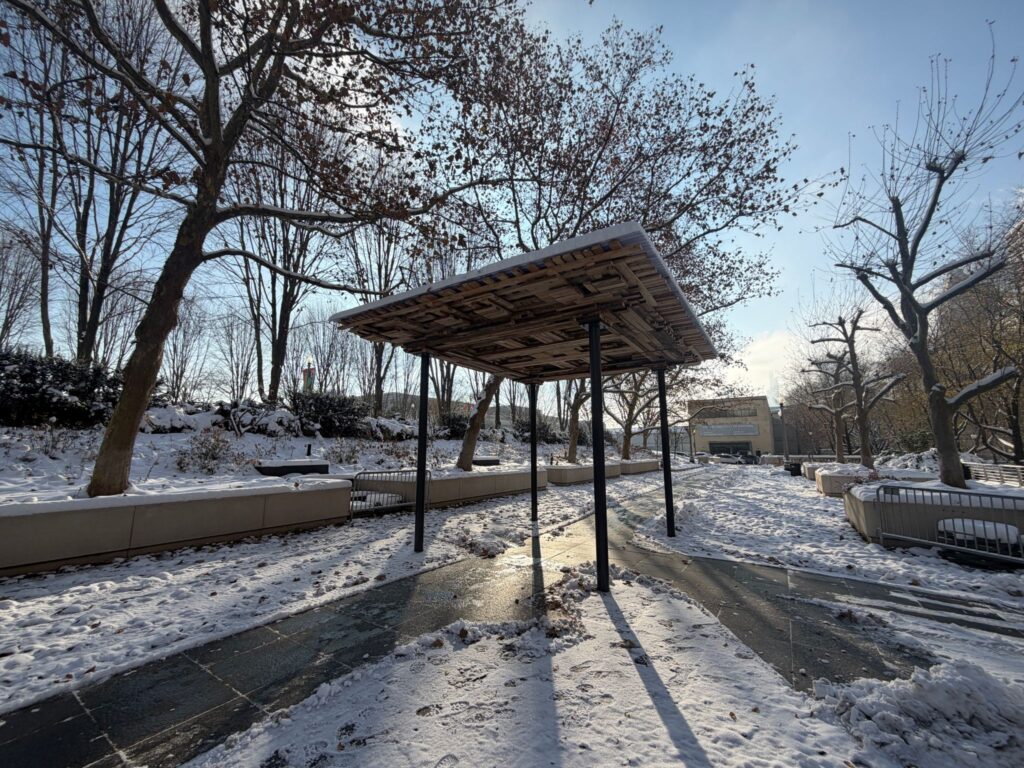
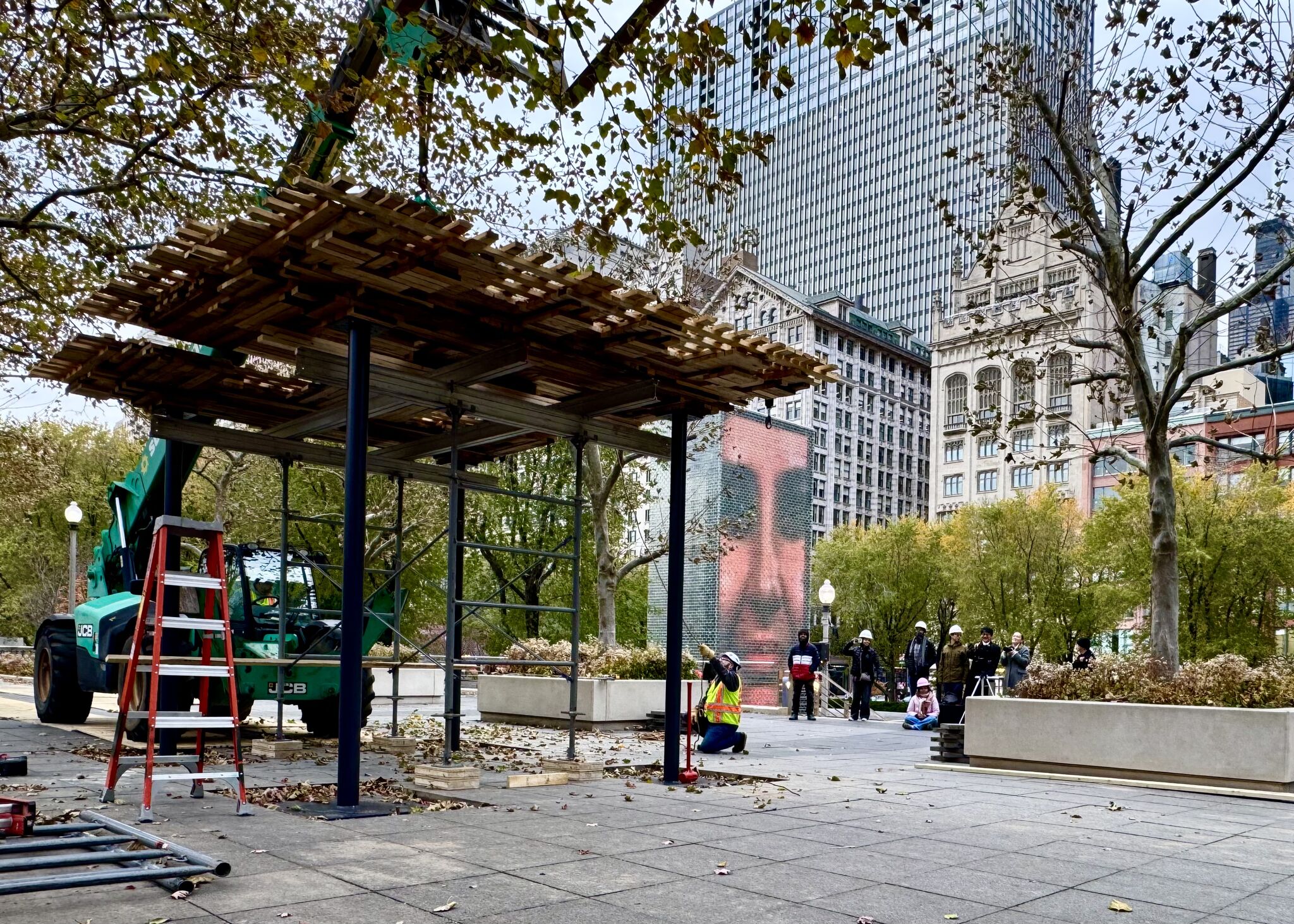
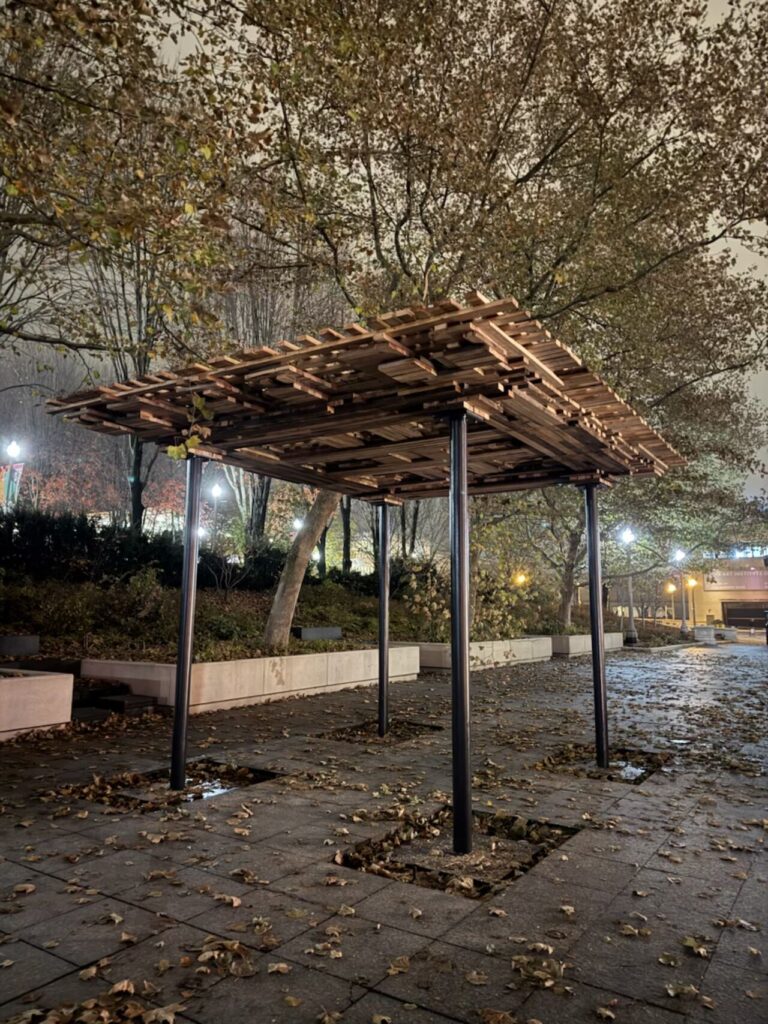
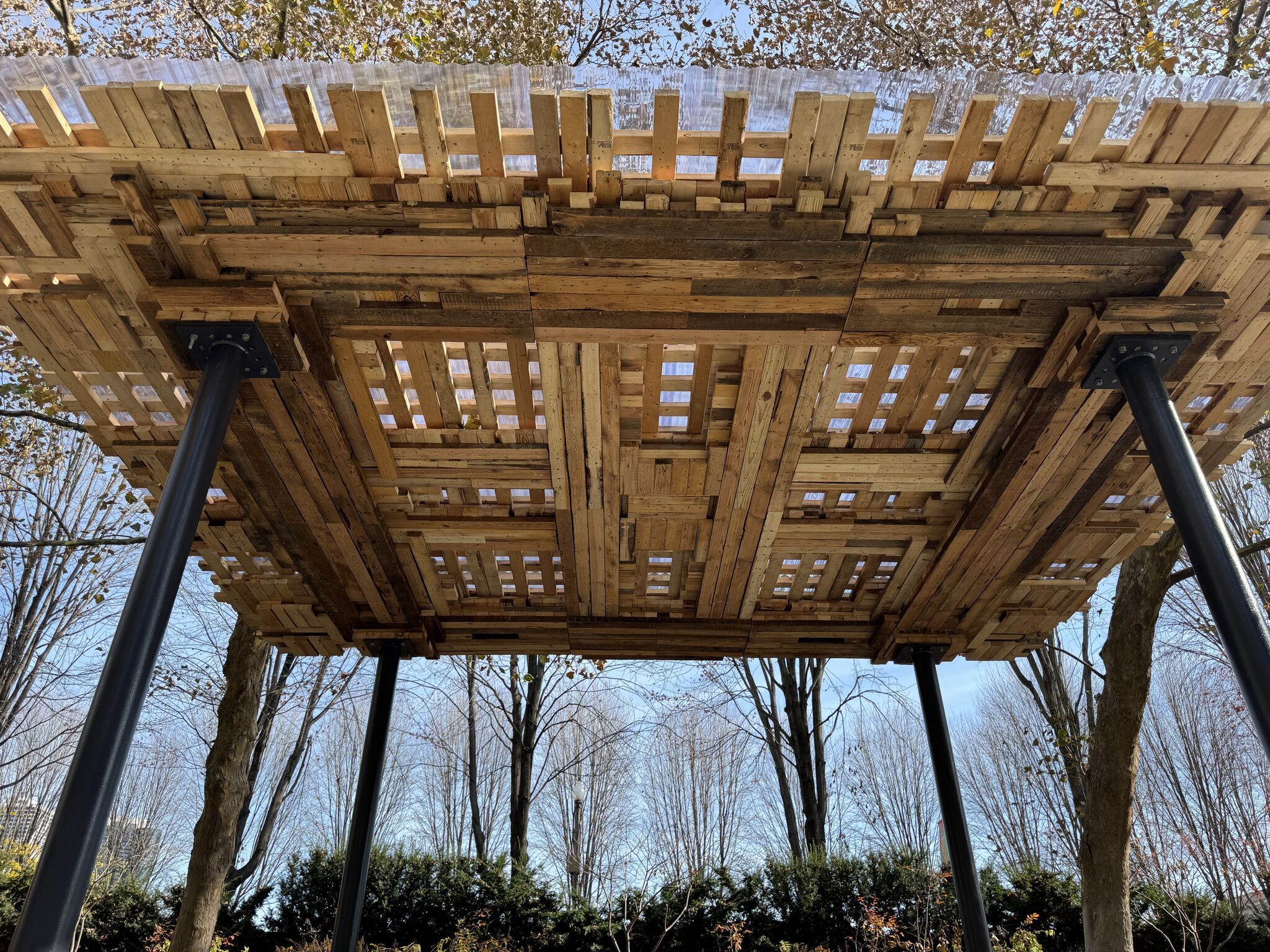
Recently, Yin and Sam Fox School students partnered with SOM, the iconic Chicago architectural firm, to research, design and construct a temporary pavilion for the Chicago Architecture Biennial. On view through late February in Millennium Park, just steps from Anish Kapoor’s beloved “Cloud Gate” (aka “The Bean”), the project is built entirely from salvaged materials.
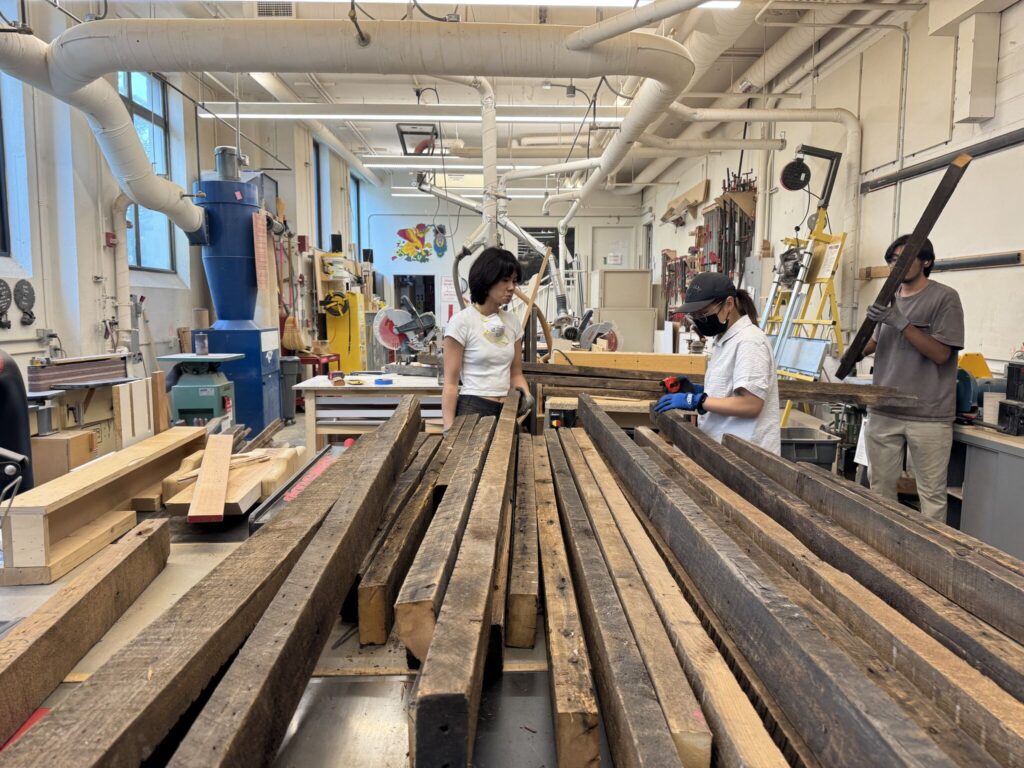
Chad Henry, director of research and innovation for the Sam Fox School, said that within the construction industry, architectural reuse remains a niche practice. “It’s a craft,” he said. “It’s a small team going in.”
But the benefits, Yin and Henry agreed, are potentially scalable. To create the pavilion, titled “Re-SPLAM (Reclaimed Spatial Laminated Timber),” WashU and SOM forged a series of industry partnerships — with Rebuilding Exchange, Norcon Inc., the Mid-America Carpenters Regional Council and Simpson Strong-Tie, among others. The aim was to demonstrate how material reuse, combined with innovative structural design, can provide an economical, low-carbon alternative to conventional construction.
“This is not something architects can do on their own,” Yin said. “It’s going to require collaboration — with skilled labor, with manufacturers, with policymakers, with developers and financers.”
Added Henry: “There are many viable components that have real value. The entire system needs to be rethought.”
A big job
The United States has more than 140 million residential buildings. Nearly half were built before 1980. Very few meet contemporary green building standards.
“The United States is a young country,” Yin said. “But compared to China or Japan, the infrastructure is old. I tell my students, ‘You’re going to have a big job.’”
Buildings are getting more efficient. Yin pointed out that since 1975, when the U.S. enacted its first national building energy codes in response to the 1973 oil embargo, net energy usage has dropped by half. But completely eliminating building-related carbon dioxide emissions by 2050, as the International Union of Architects World Congress has pledged, will require new strategies.
Reuse could play a significant role, especially when it comes to embodied carbon. Unlike operational carbon, which refers to energy consumed through daily use, embodied carbon refers to energy used in initial construction. Every board recycled is a board that saves front-end emissions.
“A reclaimed two-by-four can work just as well as a new two-by-four,” Henry said.

Urban mining
In December, Yin hosted a two-day conference on “Urban Mining and the Circular Economy in Construction.” Funded by the National Science Foundation, the event included remarks from WashU Chancellor Andrew D. Martin and St. Louis Mayor Cara Spencer. More than two dozen speakers and panelists from across industry, academia and public policy discussed the promise of, and barriers facing, architectural reuse.
One critical issue is evaluation. When can a dilapidated structure be saved, and when should it be replaced? Who makes that decision?
“The greenest building is the one that’s already built,” Spencer reminded the room. In St. Louis, “we have a lot of them.”
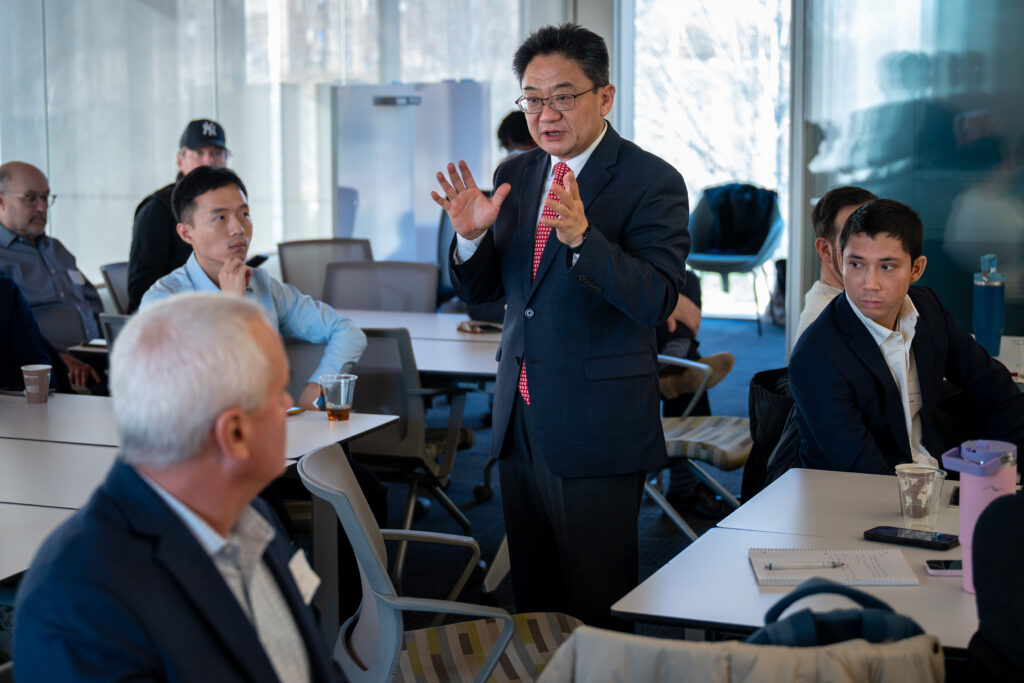
If a building is deconstructed, what elements can safely and efficiently be salvaged? Aki Ishida, director of the Sam Fox School’s College and Graduate School of Architecture, noted that today, when architectural salvage exists, it tends to prioritize distinctive elements such as mantles, stained glass windows and exterior ornament. “But most architectural waste comes from common materials,” she continued. “How can we see these components as more useful?”
Felix Heisel, of Cornell University, and Ming Qu, of Purdue University, noted that less than 1% of decommissioned buildings are comprehensively deconstructed. Why? It’s expensive; it’s time-consuming; the logistics are complex. Demolition, in contrast, is “dirt cheap.”
But things are improving. Municipalities and professional organizations are beginning to require deconstruction audits, construction waste management plans and mandatory reuse components. New laser-based and artificial intelligence-assisted tools are in development that could identify, evaluate and grade salvaged lumber. Implemented at scale, such tools could go a long way toward getting reclaimed materials back into the supply chain.
Drawing the roadmap
Since arriving at WashU in 2015, Yin has led collaborative and interdisciplinary research studios on energy, the environment and sustainability. He served as faculty adviser for CRETE House (Solar Decathlon 2017) and LOTUS House (Solar Decathlon China 2018). He led design of SMOOTH House (2022), a prototype occupational therapy office.
CRETE and LOTUS houses were net-zero energy buildings, meaning that 100% of energy needs were met on site. Although SMOOTH House remains unbuilt, Yin estimates that in less than three years, it would have generated enough excess power to offset all construction emissions — thus achieving true net-zero whole-life carbon.
Re-SPLAM, with its canopy of reclaimed two-by-fours, marks a new phase. Over the course of three semesters, Yin and students researched, planned and built a series of scale models. For the final iteration, designed and engineered by SOM, students took the lead on material procurement. Each piece of wood was digitally scanned, catalogued and, through a process of computation design, optimally placed.
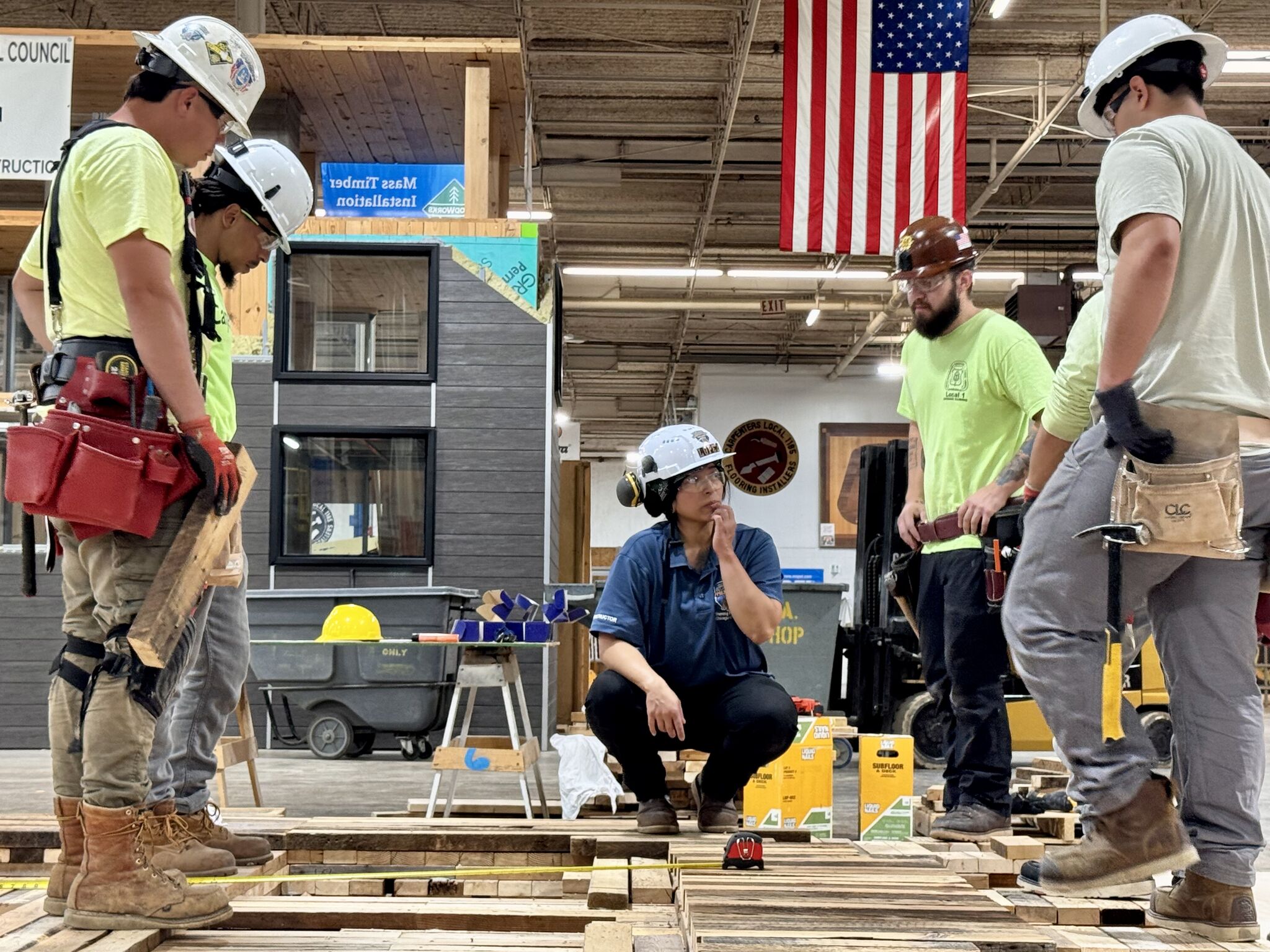
Installed in Millennium Park, Re-SPLAM is almost uncannily strong. In structural simulation testing, it surpassed Chicago snow load requirements, making it a potential alternative to steel or concrete. Further, by actively removing material from the waste stream, and through efficient off-site assembly at a Mid-America Carpenters training center, the pavilion’s construction sequestered more carbon than it released.
“That’s the trend,” Yin said. “We’ve pushed the research from high embodied carbon to medium, low, zero and now negative carbon.” If the architecture profession is going to reach its sustainability goals, “reuse will be key.”
“This is an important, complex and systematic issue,” Yin continued. “To move forward, we have to define the gaps.” Where are the cultural and technological barriers? Can public policy reshape financial incentives? How do we quantify the benefits?
Creating a truly circular supply chain will be the work of decades, Yin concluded. But academic research, and public-facing projects like Re-SPLAM, “help provide the roadmap.”