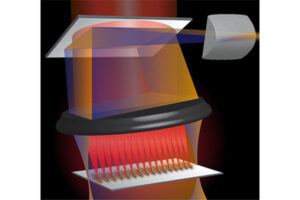
The National Institutes of Health (NIH) has awarded a $2.1 million four-year grant for cardiac optogenetics research led by Chao Zhou, associate professor of biomedical engineering at the McKelvey School of Engineering.
When a group violently attacks a government institution, in an effort to change the lawful governmental order, it is insurrection, says a law expert on the U.S. Constitution at Washington University in St. Louis.
The Teaching Center and the Learning Center at Washington University in St. Louis have joined together as one academic unit known as the Center for Teaching and Learning.
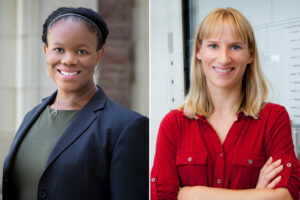
Princess Imoukhuede, associate professor, has been named director of diversity initiatives for the McKelvey School of Engineering. In addition, Jessica Wagenseil, associate professor, has been appointed vice dean for faculty advancement at the school, and she will serve as associate chair of the McKelvey Faculty Committee on Diversity, Equity and Inclusion.
New research from Washington University in St. Louis reveals the core structure of the light-harvesting antenna of cyanobacteria — including features that both collect energy and block excess light absorption. Orange carotenoid protein plays a key protective role, according to Haijun Liu, research scientist in chemistry in Arts & Sciences at Washington University in St. Louis.
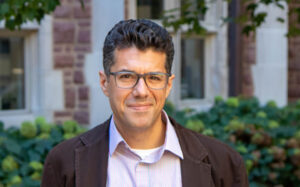
Jeffrey Zacks, associate chair and professor of psychological and brain sciences in Arts & Sciences, and of radiology at the School of Medicine, received the Mid-career Award from the Psychonomic Society.
To celebrate 2020 seems absurd, even wrong — and yet, perhaps necessary. In 2020, members of the Washington University in St. Louis community made new discoveries and friendships; accomplished incredible feats in teaching and learning; welcomed amazing new students; and said goodbye to one of the greatest leaders in university history.
Nominations are being accepted for Washington University in St. Louis’ annual Faculty Achievement Awards, known as the Arthur Holly Compton Faculty Achievement Award and the Carl and Gerty Cori Faculty Achievement Award.
Researchers at Washington University School of Medicine have found that there is no benefit in providing supplemental oxygen to mothers during labor and delivery, a decades-long and common practice. Infants born to women who received supplemental oxygen fared no better or no worse than those born to women who had similar labor experiences but breathed room air.