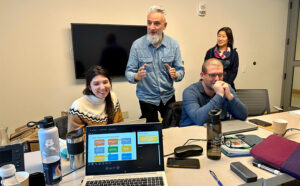
Rodrigo Reis, a professor of public health and interim co-dean of the Brown School, recently led a three-day writing retreat for public health scholars as part of The Lancet series on physical activity and public health.
People who have had COVID-19 are at increased risk of developing gastrointestinal (GI) disorders within a year after infection, according to an analysis of federal health data by researchers at the School of Medicine and the Veterans Affairs St. Louis Health Care system.
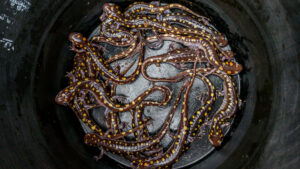
Scientists at Tyson Research Center are carefully tracking the timing of salamander breeding as part of a larger research effort examining the impacts of climate change on amphibians and plants.
Julie-Ellen Acosta has been named assistant vice chancellor for the Office of Human Resources at Washington University in St. Louis. Acosta will oversee the Applied Leadership and Learning and Development teams. Her new role took effect March 1.
The Washington University Police Department has completed training through the nonprofit KultureCity to recognize and support people experiencing sensory overload situations during police interactions. WUPD vehicles are now equipped with sensory bags containing noise-canceling headphones, fidget tools and more.
Christopher J. Dy, MD, an associate professor of orthopedic surgery at the School of Medicine, is the recipient of the 2023 Kappa Delta Young Investigator Award for his research on brachial plexus injuries.
The Goldman Sachs Group is considering a sale of its consumer banking business, but regulations will mean it can’t simply return to being an investment bank, said Andrew Tuch, an expert on financial and securities regulation in the School of Law.
For older adults with clinical depression that has not responded to standard treatments, adding the drug aripiprazole to an antidepressant they’re already taking is more effective than switching from one antidepressant to another, according to a study led by the School of Medicine.
George C. Hatch, who taught in the Department of History in Arts & Sciences for more than 30 years, died Feb. 25, 2023, at Barnes-Jewish Hospital in St. Louis. He was 85.