Episode overview
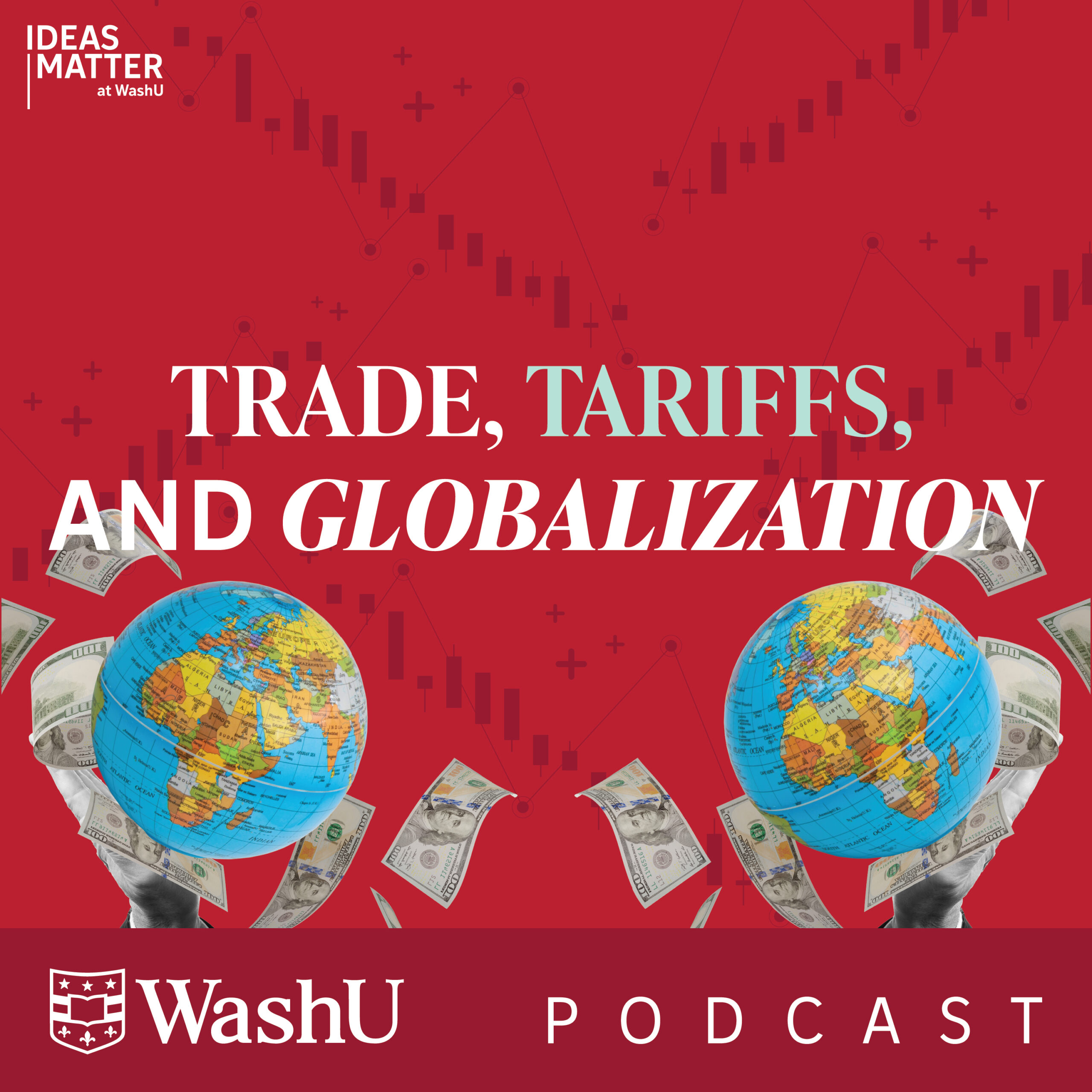
What role do tariffs play in today’s global economy and how could tariffs shape the future of international trade? The University of Chicago’s Robert Gulotty, an expert in international relations and political economy, joins WashU’s Sandro Galea to discuss how systems of trade could contribute to global cooperation in the 21st century.
Transcript
[Sandro Galea] Welcome to Ideas Matter, a podcast hosted by WashU. I am Sandro Galea, vice provost of interdisciplinary initiatives and dean of Public Health at WashU. When William McKinley served in the House of Representatives, the future president was the architect of the Tariff Act of 1890, which raised the average duty on imports to about 50%. The tariff was controversial, shaping the congressional election of that year, which McKinley’s party lost, in part because of opposition to the tariff.
For a long time, this historical episode could seem almost quaint, a relic of when tariffs were hotly debated, a time which could seem quite distant from our own. That is, of course, until recently. President Trump’s revival of tariffs as an economic and political tool has placed them back at the center of the public debate. Tariff proponents tout their ability to reshore manufacturing and strengthen American supply chains in a time of geopolitical uncertainty.
But is the economic disruption tariffs can cause worth it? The tariff debate is in many ways a proxy for the broader conversation about free trade and globalization. Over the last half century or so, free trade has made goods cheaper and raised the standards of living for many. But it has also arguably hollowed out American industry, created left-behind communities, and undercut our capacity to make things here in America. How can we shape a sustainable globalized future that builds a strong economic foundation for all? Can tariffs play a role in helping us do so? How can systems of trade strengthen ties of global cooperation to maintain prosperity and peace in the 21st century? To discuss all this, I am joined by Professor Robert Gulotty. He’s an associate professor in the Department of Political Science at the University of Chicago. He’s the author of Narrowing the Channel: The Politics of Regulatory Protection in International Trade. I am delighted to be speaking with him today. Professor Gulotty welcome.
[Robert Gulotty] Thank you for having me.
[Sandro Galea] So let’s start with a big picture question. So how has global trade evolved in the past few decades or so, and what are the key factors that have driven these changes?
[Robert Gulotty] So I’ll lay it out in sort of two large buckets. The first is the economic changes that have occurred in the last few decades, and then the political changes. So from an economic standpoint, we’re all familiar with globalization, the rise of large multinationals, and the spread of global supply chains. But there are three changes that have happened since 2008 that are worth mentioning to start off our conversation. First, after 2008, there’s been a slowdown in the rise of trade. Prior to 2008, in the 90s and early part of the 2000s, there was basically, for every 1% increase in GDP growth, there was 2% increase in trade. So trade was double what the growth rate was.
After 2008, that growth rate has basically equalized. So now the amount of trade that’s increasing is equal to the amount of GDP that’s increasing. That’s not to say that globalization is reversing by any stretch of imagination, but the global share of GDP that is made up by trade is plateaued. So we’re still globalizing, but we’re not at that rapid pace that we saw before 2008. The second thing that has changed in the last few decades is a change in how China has dominated.
China’s internal reforms that enabled it to enter the global trading markets in the 90s and then early 2000s have transformed their economy. So now their share of global manufacturing output went from something like 7% in 2000 to 28% by 2020. That means every manufactured good, about a third of them are produced in China.
That’s also changing at the same time that China’s composition has changed so that now China’s further, we’ll say, they moved up the value chain. So more of the goods that they export are actually getting a lot of their value from within China. Whereas before 2008, a lot of those goods that China was exporting, embedded in it was a lot of American and Western value. Think of the designs, the R & D, the marketing, all the things that make money from trade. A lot of that was actually resounding to countries outside of China. But now that China has developed the capacity to do those things, it’s increasingly becoming national to that country. The third major economic change is something that’s continued from the past. That’s basically the rise of these superstar multinational firms. Now IP, branding, management, finances are called headquarter services. They’re really important as a share of the value that is associated with international trade. So it’s no longer just raw goods, but who’s deciding how to design those goods? Who’s trying to market those goods? And those are all headquartered services that are provided by multinationals. So a very small set of firms are dominating international trade. So those are the three big economic changes that happened in the last two decades or so. But from a political standpoint, you see a very different story. First, the main political story for the past couple of decades is that the United States has withdrawn its leadership from the global trade regime. There’s a bipartisan anti-trade consensus in the United States under both the Democratic and Republican administrations, particularly Trump. But it began even under Obama’s late term with the collapse of the Trans-Pacific Partnership. There’s basically been a kind of Washington consensus that all of the efforts that the U.S. made to establish a global trade regime and global trade world that’s kind of globalized went too far and that we need to retrench. So that’s a major change and that’s true only in the last few decades.
The second major political change that in my opinion is that a lot of the most salient U.S. exports, it’s not that the U.S. doesn’t export anything, it’s not that the U.S. doesn’t manufacture anything, but they’re very concentrated. This is related to the economic changes. But like let’s take a product like soybeans, which is very important for U.S. exports as we saw with the trade war with China. Fewer than 1% of U.S. workers work in farming. People aren’t exposed to these industries the same way that they were before, which fundamentally changes the nature of the politics around these questions. The export sector is not widespread, like people don’t recognize it as being part of the American project. And the third, and this is probably the most pressing right now, is the securitization of trade.
So in the past, the U.S., because it was the leader of the global order, it sidelined security issues or it saw exports as part of its security project. But today, because of the withdrawal of global leadership, the change in the bipartisan consensus against trade, there’s sort of a new emergent security claims coming around trade issues. So you can see this with the Trump administration, but you can see it before that as well, where countries including the United States are reaching to security justifications for tariffs.
That’s a fundamental change from how the general agreement on tariffs and trade was imagined, how the WTO was imagined, these sort of liberal rules-based orders, because it’s very difficult to come up with a limiting principle, a rule that describes when and how you can use security claims. So that’s the third major change, and I think we could discuss any of those things.
[Sandro Galea] That was a terrific summary, actually, of where we’ve been headed. Let me just focus on globalization as a concept for a second, because I feel like globalization is one of those words that becomes political football. So the critique of globalization in the U.S. is that it has led to a hollowing out of domestic industry. So how correct is that? Is that critique overstated, or is that right?
[Robert Gulotty] On the one hand, surely the fact that a third of manufacturing is now occurring in China, of the globe, is a sign that the U.S. is not remaining competitive. But there’s a question of like, why is the United States not remaining competitive in these sectors? And part of that is because there are alternative industries that are more productive in the United States that people are switching to. So the rise of services and digital technologies are going to come at the expense of other more traditional industrial practices. There’s technological changes that are going to enable that to happen. So to say that like how much of it is because of globalization or not, it’s mixed up with the fact that globalization facilitates technological adaptation and productivity improvements. And so it’s sort of natural that you’d see both a shift away from the old industries into the new industries with the same time as the rise of globalization. That’s not to say that globalization can’t be directly connected to closure of factories, to the harm that happens in communities. And like I said earlier, there’s sort of a concentrated benefit to globalization in the sense that very few firms are the ones that are doing most of the trading.
But in terms of the consequences for manufacturing in the United States, it’s a little less obvious how to disentangle the forces that enable global trade, the forces that enable fast movement of goods and services across borders like communication technology and transportation technology, distinguishing those from the forces that also just lead to transitions in the economy. For example, steel in the 20th century was a major employer in the United States and all over the world.
But as steel became hundreds or even a thousand times more efficient, of course, those factories don’t, we don’t need as many people working in those factories. And so they contract. Now, is that contraction facilitated by trade? Yes, because at the same time, the U.S. is adopting these new technologies. Other countries are as well. And there’s now a robust global market for steel, well, there was until very recently. So like it’s sort of tied into the same dynamic.
All of this is to say there are industrial transitions that can be very painful for people and painful for communities that are forced to come up with new ways of working and living. But at an aggregate level, the United States is still manufacturing. They’re manufacturing more than they ever have in the past. They’re still producing soybeans. They’re producing more soybeans than they ever have in the past. There’s like growth happening. It’s just that the composition has shifted away from manufacturing and away from particular parts of the country which have been, as you said, left behind.
[Sandro Galea] So let’s now hone in on tariffs for a second, which really has been a topic of much political conversation from when President Trump on the campaign trail called the tariffs a very beautiful word. So talk us through the role tariffs have historically played in the economic history of this country and how have they helped the country’s economic health and how have they harmed it?
[Robert Gulotty] So when the United States was founded, it was a small country in the sense that there weren’t that many people living here and it was an export-oriented economy, but it was also an economy without the sort of infrastructure for taxation that we have today. So the main form of federal revenue came from border taxes or tariffs. And so when McKinley and previous generations of politicians were fighting about the tariff, in part what they were fighting about was just like how much, what should the size of the federal government be? How much revenue should we be taking in?
So that notion of tariffs as a source of revenue was a really important feature of the first half of American history. Around the Civil War, things began to change. And by the time of the emergence of the 1900s, we were shifting to an income tax and other kinds of taxes that made it so that tariffs were less like the sole source of federal revenue. And that allowed the U.S. to think about negotiating tariffs of other countries.
So it hasn’t really played the same role in the 1900s as it did in the 1800s where the 1800s it was really like the way that the federal government financed itself. Now of course the federal government is much smaller than it is now but that’s where the money came from, that and land sales. So in the 20th century, the role of tariffs shifted from a tool to raise revenues where the question was like, what is the optimal tax rate to a world of protection, where particular industries demanded higher prices for their products. And so they wanted less competition from abroad. And then it became a distributive fight between some people who wanted higher products for themselves and be able to sell at higher markups versus consumers of those goods, who didn’t want to have to pay higher prices for those goods. So now it’s a distributive fight between different groups. In that sort of world, tariffs became a political football. It became a tool for parties to hand out favors to one group or another group. That’s always been part of the process, but really got heightened in the 1930s, to the point that industries were getting protection, one might say in excess. Like average applied tariffs were at very high, we’re talking about like 40% or 50%, tariffs, which were beginning to disrupt global trade actually. So during the 1930s, we discovered at the onset of the Great Depression that the U.S. policy of allowing Congress to allocate tariffs to help their constituents and to aid their allies, had this negative consequence for the nation.
So the Democrats argued on that basis that we needed a different ground for trade policy, and that’s to internationalize it. So there was this moment in the 1930s where there was a debate about how to do that exactly, but the Democratic Party, which has long opposed tariffs because of their historical connections to the South and exporting, they decided to delegate the Article 1 constitutional power of Congress away from where the Constitution allocated the authority to raise revenues toward the president to enable him to negotiate tariffs internationally. So ever since 1934, with the Reciprocal Trade Agreements Act, tariffs went from a source of revenue and a source of bargaining between groups within the society to an international relations problem. Now tariffs become a bargaining chip, a tool to open up other markets. It’s used in the course of signing trade deals, in the course of bilateral agreements, like you can think of NAFTA or the US-Canada agreement before NAFTA and then into a multilateral system where many countries meet together to negotiate and trade tariff concessions with each other in the general agreement terms of trade. So that’s the world that existed that we still basically exist in now formed in the moment of the Great Depression and feeling like the sort of log rolling that was occurring in Congress led to too much protection. It led to an inability to have a stable trade system. And so the shift to a stability, to a more internationalist perspective coincided with the Great Depression, which allowed the Democrats to take power and then solidify those gains and create a new system which involved a lot of delegation to the president. So now the president basically uses it as a foreign policy tool and alongside all the other foreign policy tools of the executive.
[Sandro Galea] So let me go on from there for a second, because for those of us who are non-experts in this field, it almost seems puzzling that we should not know the answer. Do tariffs actually improve things domestically or not? It seems like it’s something that we should know. Guide us through why it’s so complicated to know that and what are the intended and unintended consequences of tariffs as best as we know.
[Robert Gulotty] So fundamentally, a tariff is a tax. And taxes have the consequence of raising the prices of the goods that taxes are applied to, which means that people who produce those goods can sell them at a higher price or they can charge a higher markup. Typically speaking, that benefits the producers of those goods. And so if you’re just asking like, do steel producers benefit from a tariff on steel? And the answer is yes. The question is, first, that of course comes at the expense of some consumers and you might wonder if there were more efficient ways of achieving that end and the answer is yes. Fundamentally the problem with tariffs is not that it takes money from people who consume goods and hands it to producers, any tax does that. The fundamental problem of tariffs is that it distorts the decisions made by both consumers and producers away from what they would have bought otherwise. So I was building a reconstruction project, I had to buy some sinks in the anticipation of the Trump Liberation Day tariffs. What did I do? I bought a bunch of sinks prior to the reconstruction project that were just sitting around, sinks, for months in my house. That was inefficient. I wouldn’t have done that if I hadn’t anticipated that the price of sinks would rise. That sort of inefficiency, the distortions that happen when people make choices to avoid these taxes, that’s the problem. It’s not that I have to pay more and the sink producers get a little bit more profit or something like that. The problem is that all these choices are being distorted. We can think of all the changes of products go through just to avoid a tariff. Like the fact that vans can enter the United States at a different rate if they have a cargo door or if they don’t leads to different designs of vehicles that would never be designed in the absence of those tariffs and those are the kinds of distortions that are the problem with tariffs.
It’s not the fact that we take money from consumers and hand it to producers, although you could have a problem with that too. And I, as a consumer, don’t particularly appreciate it, but we could achieve that end with more efficient domestic taxes if we were trying to do that. That’s the economic story.
[Sandro Galea] So let’s talk a little bit about the current administration, because of course we’re having this conversation. And the topic is interesting, always is, but because this has been a central part of the Trump administration platform, it has been a little bit difficult to keep up with the tariffs, not tariffs changing all the time. Guide us through what you think the administration’s been trying to achieve with these moves and what’s, from where you sit as an expert in this, what are the likely near- and long-term effects of their current approach to tariffs?
[Robert Gulotty] So for one thing, when the second Trump administration was coming into power, they had two broad groups within the expert class that they were drawing on. One believed in a high uniform tariff to try to basically decouple the United States from globalization. They basically thought the United States was too exposed to global markets. We’ve given up too much in the course of the 20th century, and we need to reverse that and become a more isolationist nation. That’s one group of people and they believe in things like industrial policy and they’re quite new to the Republican Party. Many of used to be Democrats, but they’re like now siding with Trump believing that this is a way to achieve their protectionist ends. There’s another group of people, this is more traditional within the Republican Party, who saw the tariffs as a negotiating tool, a tool that you could use to extract concessions from foreign partners who have treated us badly in the past. They’re the ideas that not that trade is bad, but we need to rebalance that trade more in America’s interests. And a high tariff on a particular country can extract all sorts of benefits from them.
Trump’s intuitions kind of waver between these two, and that’s created a lot of the uncertainty that we have when it comes to the tariff schedule. Is he siding with the group that just wants a 15% tariff against everyone, or does he want the freedom to be able to raise a 200% tariff sometimes and not all the time? And that sort of fundamental uncertainty continues to play out as he hasn’t really taken a position on this sort of larger question.
Now, at the same time, all of this uncertainty that is introduced by his wavering also benefits the first group who believes the U.S. should decouple because uncertainty destroys the possibility for trade. If you think about what are the main challenges with international trade is that you have to put your goods on a boat and then it leaves for a long time and you don’t get paid until it’s sold later. That creates this need to have like investment in the future.
International trade doesn’t work very well if you don’t know what price your products are going to be sold at the point it’s sold. And a tariff that gets put in place randomly makes it very difficult for you to plan or invest in international trade. And so few firms are able to do that that it concentrates the set of firms that are acting in this area. So the fact that Trump is able to come up with so much uncertainty in the policy space has the effect of a uniform tariff on the whole world because it’s basically depressing international trade on its own. So there’s sort of a side benefit of the sort of uncertainty that he’s introducing if you’re a protectionist. Now, there are other issues going on here, and I think the most important one in the recent news is that at no point over the course of the second Trump administration, or even back to the first administration, did the Trump administration attempt to legislate tariffs. Now, Article 1 of the Constitution, even though there’s a lot of powers delegated to presidents, still says Congress has the power to raise taxes, including tariffs. And at no point did he turn to Congress and try to persuade his Republican colleagues and the people within the House that it would be a good idea to back his trade program. And that’s left him with these powers that were delegated to the president for the purposes of negotiation in the 20th century. Those tools are allocated in a way that they’re designed to be temporary. They’re designed to address discrete problems.
They’re not designed to do the kinds of long-term industrial policy that he’s trying to achieve with those tools. So that’s a problem rooted in decision or a lack of support within the Republican party for this whole protectionist trade program. And it’s left a lot more uncertainty than would otherwise be the case in a world in which things were building a consensus around a topic and then passing legislation.
[Sandro Galea] So it’s hard not to listen to you and not have very much confidence in tariffs to achieve their stated aim. So let’s suppose for a second that you are a president and you care very much about restoring the manufacturing base to the country. And let’s say that, listening to what you’re saying, tariffs are not likely to do that in a way you might think. So what else could you do? How else would you turn around what is a declining sector that matters to you in the administrative branch?
[Robert Gulotty] Absolutely. I think this is a really important question and one that the Biden administration struggled with, although the Biden administration also wasn’t that enthusiastic about international trade. They adopted a different strategy fundamentally, which is industrial policy, that is, targeted subsidies to the manufacturing sector in an attempt to reorient the industrial activities toward sectors they thought would be good for the future. Electrical vehicles, solar panels, the green transition. That was an attempt to try to marry their other interests in climate mitigation and adaptation with this sort of desire to support American manufacturing. There the idea is spend subsidies, the subsidies are then taken from the general tax base and aren’t as distortionary as a tariff, and then target them to the sectors you want to advance in manufacturing.
I understand what they were trying to do. And I think from a political perspective, marrying, you know, the green interests and the sort of industrial interests makes a lot of sense for passing legislation and for getting people excited within the Democratic party. I think there were a lot of challenges with actually convincing even the Democratic party to go that far. So I’m not saying that they, there are easy political solutions to this problem, but fundamentally the challenges we face in manufacturing are the challenges we face in the rest of society. That is, improving our infrastructure, ensuring that places can have access to transportation networks, making sure that roads and bridges are working properly, making sure that there’s an educated workforce that can contribute to these manufacturing sectors.
Yeah. So industrial policy is really tough, but there are some things that seem to have been successful in the past: A broad-based education system in the United States. A lot of internal mobility across places so that people can find work where there is work to be had. A housing system that doesn’t force people to be stuck in regions that are in decline. These are things that could be addressed, but they’re very difficult, of course, but they could be addressed through concerted federal effort.
[Sandro Galea] What do you think about other regulation as a protective influence in place of or perhaps with tariffs?
[Robert Gulotty] Well, to some degree, I already mentioned one of them, which is the uncertainty associated with policy is sort of like a non-tariff barrier, a barrier to trade that happens not through legislated taxes, but through other policy instruments. I wrote a book about the use of, what are termed in the lingo, regulatory barriers to trade. Regulatory barriers to trade are licensing agreements, standards, health safety requirements, things that have legitimate purpose but are also used to try to exclude foreign producers. So if you think of like, all eggs have to be sold in cartons of 13, let’s say, there’s no particular reason that has to happen but maybe there’s a cultural attachment to the number 13 and it excludes foreign producers or forces them to repackage all of their eggs and that gives your domestic producers an advantage. That’s the kind of thing I’m talking about. Now these regulatory barriers to trade. One of the interesting things about them is that very much like uncertainty, it benefits the largest firms. They’re the ones who have the lawyers that can demonstrate compliance with the safety or health standard. They’re the ones that are able to reformat their production processes in each market so that they meet the local requirements. And so it’s very distortionary in terms of the composition of trade, and it decreases the shared sort of collective involvement in trade when these barriers are put in place. But I think one of the things that has happened under this current administration is a recognition that there are benefits to having transactional relationships between the government and individual firms. And so I see this as being an easy area for Trump to switch to now that the Supreme Court has recognized that the powers of the president are limited when it comes to raising emergency tariffs under a security pretense.
[Sandro Galea] So where do you see all this going? President Trump came into power with tariffs having been a large part of his platform. He followed through on that. To his credit, he sort of did what he said he was going to do. It has resulted in a lot of uncertainty, a lot of instability. And then there had been a number of reversals of tariffs that were initially imposed and then unimposed. I know it’s next to impossible to predict, but what do you think will happen for the rest of this administration and then what do you see a next administration doing building on this or perhaps going in a totally different direction.
[Robert Gulotty] Well, one possibility and the one I just alluded to is that given that he’s very unlikely to legislate tariffs, he’s very unlikely to get Congress on board with tariffs. He doesn’t have a consensus within the Republican party and he’s very unlikely to get Democrats on board with anything like that if they take over the House, which they seem primed to do. This is all to say he is going have to look for other policy instruments. And one of the most obvious ones and the easiest ones to go to would be to wield the regulatory power of the federal government to strike individual coercive regulations against firms to try to extract concessions not just from other states, but from other individual producers. It’ll be very difficult to prevent him from doing that. I think Article 1 does constrain tariff setting, but it does constrain all regulation and so I think that will be a natural place for Trump to go, adopting basically arbitrary rules and standards to extract concessions from foreign countries.
[Sandro Galea] So it’s an unsettled time and we are in this moment of, I mean there’s certainly quite a bit of extracting concessions from countries going on. What in this moment gives you hope?
[Robert Gulotty, long pause] Fundamentally, despite all of his efforts to try to decouple the United States from the world, it hasn’t worked. The United States continues to be engaged in the world. Our people continue to try to travel and continue to try to buy foreign goods. It just, it turns out that it’s harder to change the practices of a country like this than it is to disrupt them temporarily.
I have hope that as the United States continues to be a player, maybe on a more equal playing field with the rest of the world, that other countries will be able to take more of a leadership role in establishing institutions that enable countries to hash out their differences in a peaceful way.
The World Trade Organization, the General Agreements and Terms of Trade, really originates in U.S. leadership. Therefore, it depended on U.S. leadership to succeed. And we haven’t seen a successful negotiation out of the World Trade Organization since it was founded in the Uruguay Round in 1994. The Doha Round, which started under Bush, went nowhere.
So it seems like we need an alternative to an American-led trade system. And because of the complete withdrawal of the United States from those areas, other countries are beginning to step up, including Europe, Japan, and others.
[Sandro Galea] Well, I will note that there was a long pause as you were thinking about what gives you hope, but actually what gives you hope is reassuring to those of us who are outside of your field. I am Sandro Galea and I have been speaking with Professor Robert Gulotty about trade, tariffs and globalization. Thank you, Professor Gulotty for joining us. And thank you to everybody who joined us for this ideas matter. I look forward to continuing the conversation.
[Robert Gulotty] You’re welcome. Thank you for having me.