When Peter Kastor was a graduate student, he came upon a collection of records written in President Thomas Jefferson’s hand.
Rather than lofty musings on the state of the nation, the slips of paper contained individual Senate nominations for federal offices like secretary of the navy and St. Louis revenue collector. In the days before HR departments and layers of internal management, this task fell to the highest office in the land.

Kastor, now the Samuel K. Eddy Endowed Professor in Arts & Sciences, kept his fascination with the inner workings of early American government. With support from the Humanities Digital Workshop in Arts & Sciences and numerous students, he compiled data from federal registries, personal correspondence, tax district records and more. The culmination of 20 years of meticulous record-scouring is now available online.
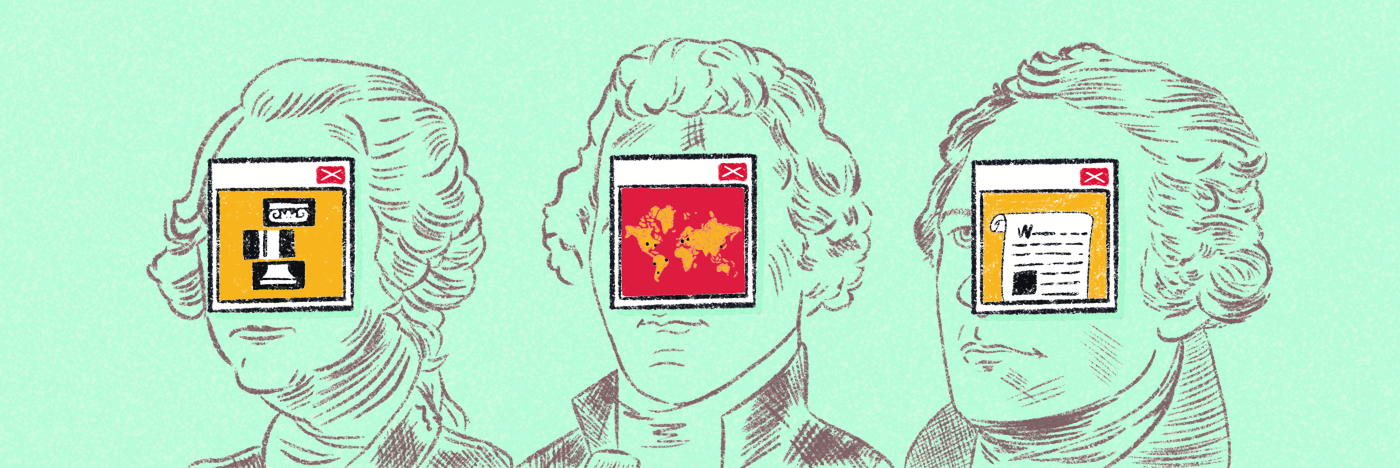
The project, “Creating a Federal Government, 1789–1829,” details the names and appointments of more than 37,000 early federal employees, revealing the true scope of government in the country’s early decades. The project also contains an interactive map connecting these people to almost 2,000 locations in the U.S. and around the world, as well as reader-friendly analyses of the site’s main themes.
“When you visit the website, the first thing you learn is that the founding fathers were real people grappling with running big and unruly organizations.”
“When you visit the website, the first thing you learn is that the founding fathers were real people grappling with running big and unruly organizations,” Kastor says. “They had to deal with hiring and onboarding and training and getting people to do their jobs and disciplining them when they didn’t.
“You also learn that the creation of our nation was done by thousands of people — men and women who in their own little provinces were trying to do their jobs. And every one of them, on a day-to-day basis, was interpreting what the Constitution meant in its earliest years.”
Their stories extend through all levels of the federal government. Some rose high and fast, like Henry Dearborn, a former member of the House of Representatives who served as a U.S. marshal, secretary of war, minister to Portugal and senior officer in the United States Army. Dearborn also served a brief stint as customs collector in Boston, where one of his subordinates was Thomas Melville, the grandfather of novelist Herman Melville. Rather than pursuing a varied career, Thomas Melville spent 40 years as a customs official in Boston. Presidential administrations came and went, but Melville remained in the same place, enforcing U.S. commercial policies.
When Kastor first envisioned this project 20 years ago, he had no idea that it would come to fruition at a cultural moment when public debates rage about the purpose of federal government and the intentions of the founding fathers. As the country celebrates its 250th anniversary, he hopes that the archive’s detailed, realistic picture of those early decades can add nuance to ongoing conversations.
“Our desire to find in the founding founders exactly what we want to support our contemporary policies is not only an exercise in frustration; it’s misleading,” he says. “We need to see the founding era in its own time and on its own terms. I often say that the federal government was much larger, more elaborate and more powerful than many conservatives believe. It was also far smaller and more limited than many liberals would want.”
One constant across the nation’s 250-year history? The very nature of the debate and the push and pull among priorities on the federal stage.
“Every founder I studied came into office talking about economy and retrenchment,” Kastor says. “But every one left office with a government larger than they planned because circumstances demanded it.”