On a dreary winter’s day in 1546, a grumpy Michelangelo Buonarroti and a dapper Giorgio Vasari waded through dirty Roman streets, past the rising skeleton of St. Peter’s Cathedral, to meet Tiziano Vecellio, the Venetian painter universally known as Titian.
A guest of Pope Paul III, Titian was perhaps the only living artist to match Michelangelo’s renown. And a debt was owed. In 1529, threatened by political assassination in his native Florence, Michelangelo fled to Venice. The republic, and Titian, welcomed him with honor.
Sixteen years later, it was time to repay the courtesy.
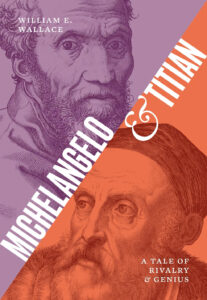
“They were the two most famous artists in the world,” wrote William Wallace in his new book, “Michelangelo & Titian: A Tale of Rivalry & Genius” (Princeton University Press). “And they knew it.”
Climbing a slight hill, Michelangelo and Vasari arrived at Titian’s quarters in the Vatican Belvedere. Conversation was polite. Vasari praised a portrait of Pope Paul. Michelangelo concurred but worried at Titian’s psychological acuity. The aged pontiff, intelligent eyes glittering, looks sideways at one bowing grandson while the favored heir stands tall behind him.
Leaving the palazetto, Vasari later reported, Michelangelo said that Titian’s expressive style and colors pleased him greatly.
“Too bad,” Michelangelo added, “the Venetians never learned to draw.”
Figural innovation
Wallace, the Barbara Murphy Bryant Distinguished Professor of Art History in Arts & Sciences at Washington University in St. Louis, is one of the nation’s foremost experts on Michelangelo. Over the course of eight previous books, Wallace has explored Michelangelo’s life, works and studio practices, and the artist’s often complicated relations with patrons, friends and business associates.
“Michelangelo & Titian” highlights a mutual admiration, and simmering competition, that unfolded over decades. “Their relationship was distant and mostly indirect,” Wallace wrote. “That does not mean, however, that it was not rich and meaningful, and mutually beneficial.”
Historians have long sought to demonstrate what Titian, the younger artist, might have learned from Michelangelo. For example, the central figures in Titian’s breakout work, “The Jealous Husband” — from a cycle of frescoes celebrating the life and miracles of St. Anthony — bear a striking resemblance to Adam and Eve in Michelangelo’s “Fall of Man” on the ceiling of the Sistine Chapel.
Indeed, Wallace wrote, the resemblance “has been repeated so often as to have become a generally accepted truism — an early instance of Titian adopting a figural invention from the old master.”
Yet “Jealous Husband” was painted in 1510. The Sistine ceiling was unveiled in 1511. Travel from Venice to Rome was arduous and expensive. Centuries before photography, what could young Titian have seen of Michelangelo’s work?
Wallace similarly dismissed supposed links between the bound, muscular St. Sebastian in Titian’s “Resurrection” altarpiece (1519-22) and Michelangelo’s “Rebellious Slave” (c. 1513). “Michelangelo was so reticent about the sculpture that even informed persons close to the artist knew little about it,” Wallace writes. And Titian had previously painted Sebastian, arms pinned behind his back, in the San Marco altarpiece (c. 1511-12).
In short, “Titian forged his own path to artistic success,” Wallace wrote. “We need not trace every nude to Michelangelo.”
A gauntlet
Conversely, Wallace argues that Michelangelo was deeply influenced by the Venetian’s mastery of color, narrative and pictorial design.
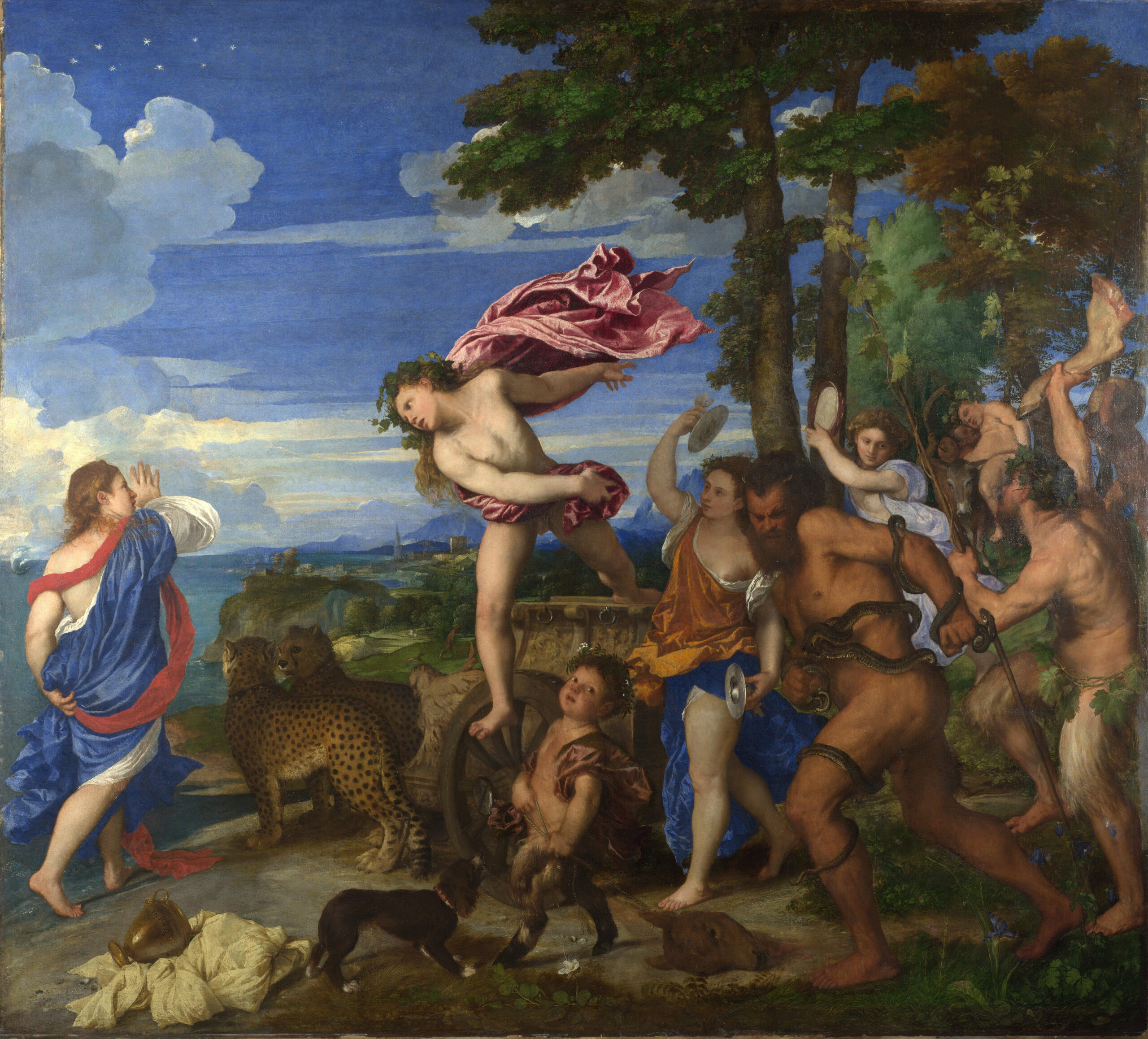
In 1529, while overseeing fortifications for the Republic of Florence, Michelangelo sought military assistance from Duke Alfonso d’Este in Ferrara. An enthusiastic collector, Alfonso proudly showed several works by Titian. Among these were three mythological scenes, including the iconic “Bacchus and Ariadne” (c. 1525), and a portrait of the duke himself, one hand resting on a cannon.
That cannon, ironically, had been cast from Michelangelo’s destroyed sculpture of Pope Julius II. The large bronze, completed in 1508, was pulled down and melted just three years later. Thus, Wallace observed, before Michelangelo and Titian ever met, “their lives had become inadvertently entwined by a manipulative duke.”
But it was Titian’s use of mythology, especially the Bacchus, that stuck with Michelangelo. Badgered by Alfonso into a commission, Michelangelo returned to Florence and painted his own mythological scene. “Leda” (1530) depicts the Spartan queen entwined with the Roman god Juno, who has disguised himself as a swan. It was a savvy choice. Their daughter Helen would play a central role in the downfall of Troy, from which Alfonso’s family claimed descent.
“Alfonso was the catalyst,” Wallace wrote, “Titian the challenge, ‘Leda’ the result.”
Alfonso never got the painting. His promised military aid never arrived. The Republic of Florence fell. After escaping to Venice, Michelangelo eventually returned to Rome, bringing the Leda with him. Later, when Alfonso demanded the picture, Michelangelo sent it to France.
But for Titian, the gauntlet had been thrown.
Provocations and concerns
Titian and Michelangelo lived in different cities but shared friends, acquaintances and patrons. Gossip traveled faster than art.
Titian may not have seen the Leda, but he certainly would have heard of it, and perhaps even viewed copies. When Michelangelo and Vasari arrived at the Vatican Belvedere, Titian’s riposte was waiting. In “Danaë” (c. 1544-45), he too depicts a reclining nude, visited by Juno, here disguised as a shower of golden coins.
Perhaps this explains Michelangelo’s gibe about drawing. “Was he genuinely commenting on style or practice,” Wallace wrote, “or might he have been piqued by Titian’s Danaë in a manner that he refrained from admitting?
“Titian was not blind to Michelangelo’s provocation,” Wallace added, “nor was Michelangelo blind to Titian’s obvious counter-challenge.”
Titian spent six months in Rome. Did he and Michelangelo meet again? There are suggestive hints, but history does not record it. Yet their artistic competition — sly, unacknowledged, productive — continued.
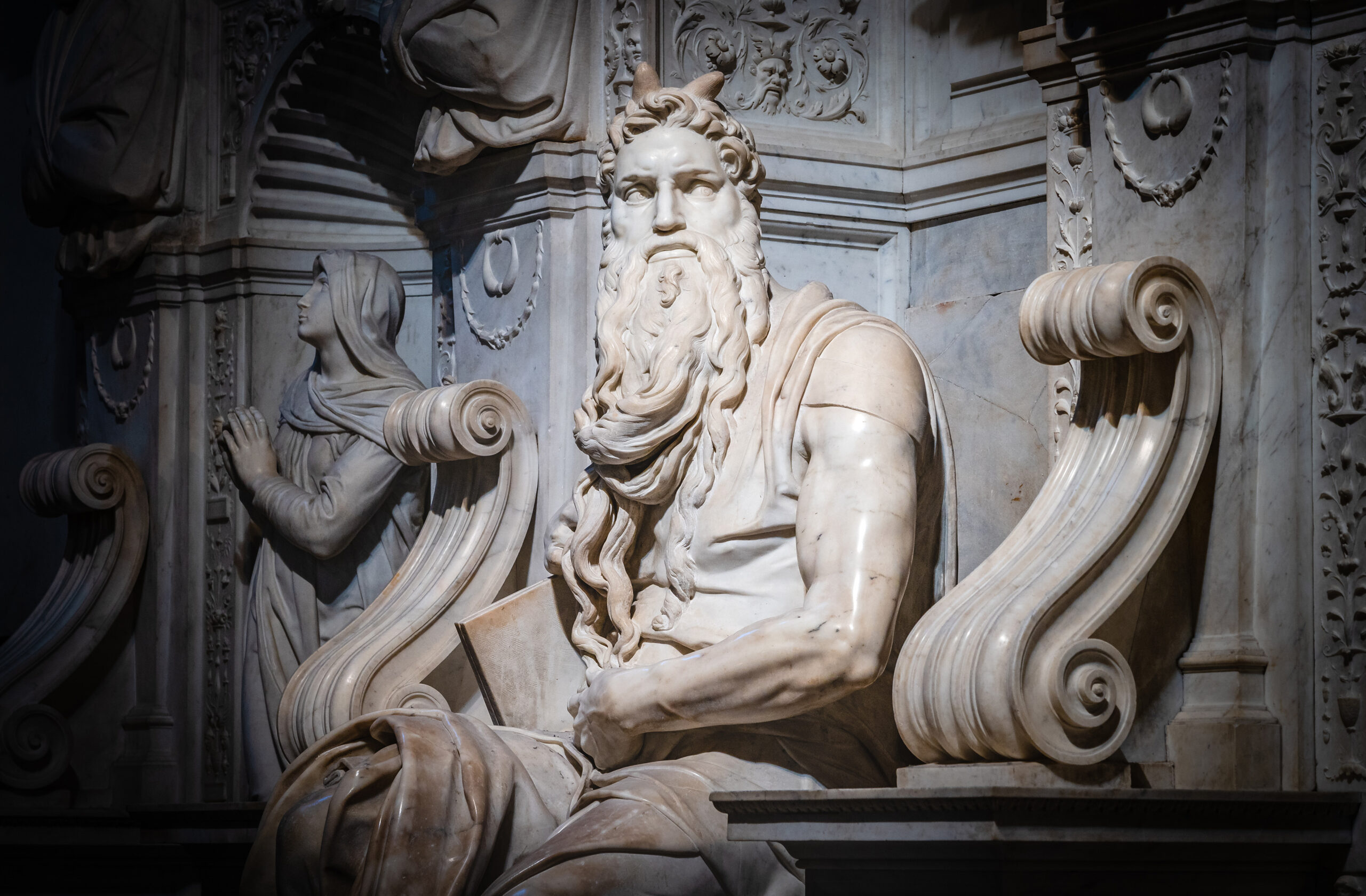
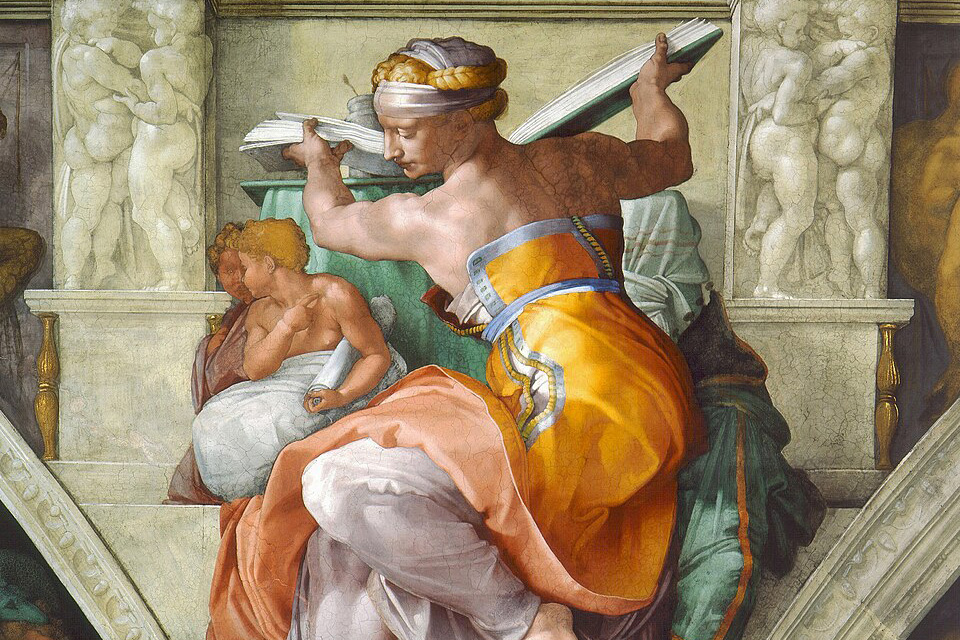
Titian’s portrait of the Doge Andrea Gritti (c. 1546-50), a patron of both artists, strongly recalls Michelangelo’s Moses, from the tomb of Pope Julius II (1506/45). “David and Goliath” (c. 1550s), which Michelangelo designed with the young painter Daniele da Volterra, echoes the murder in Titian’s “St. Peter Martyr” (1528-29). Titian’s “Venus and the Lute Player” (c. 1565-70) cleverly transforms the Sistine ceiling’s Libyan Sibyl.
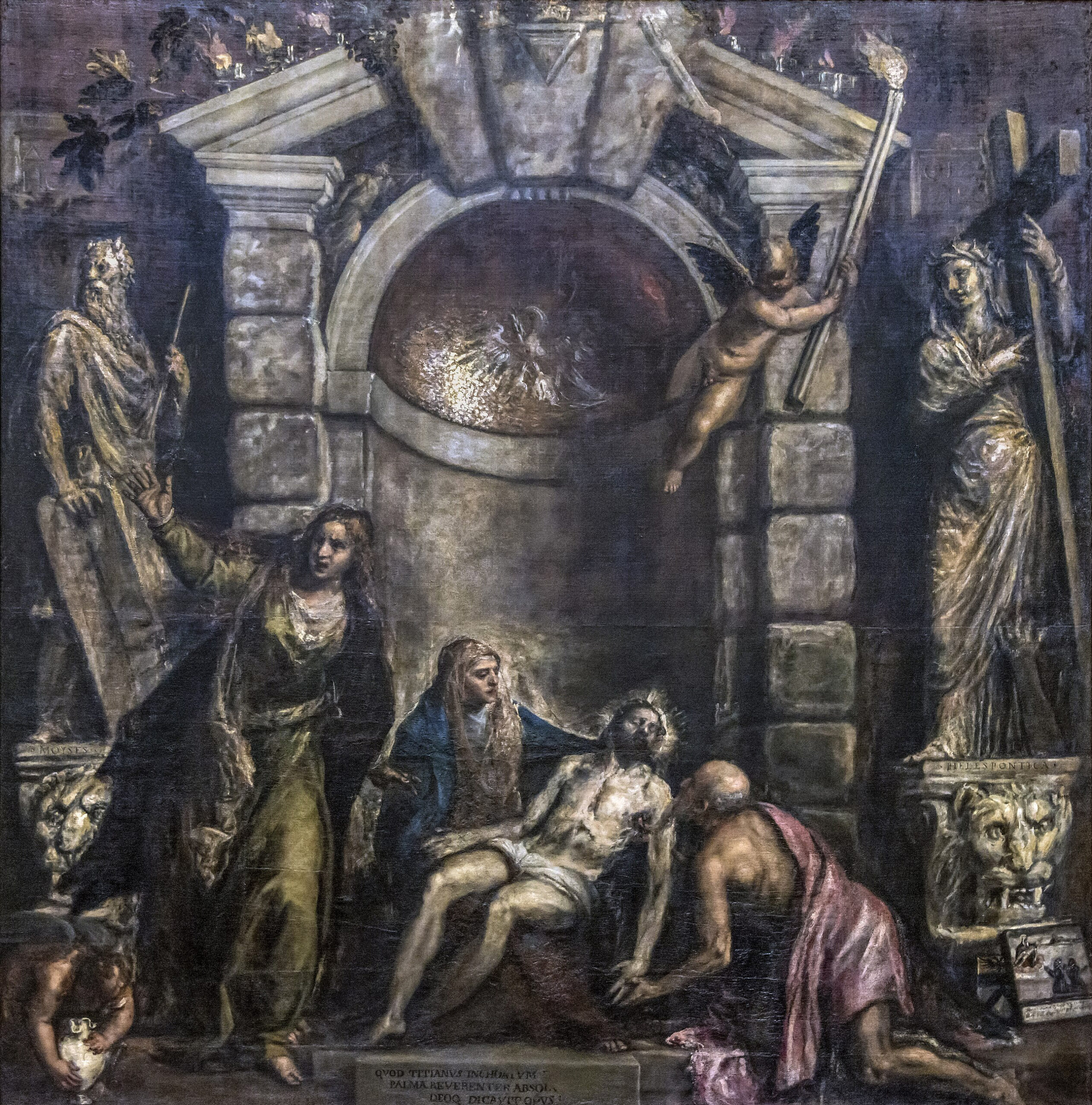
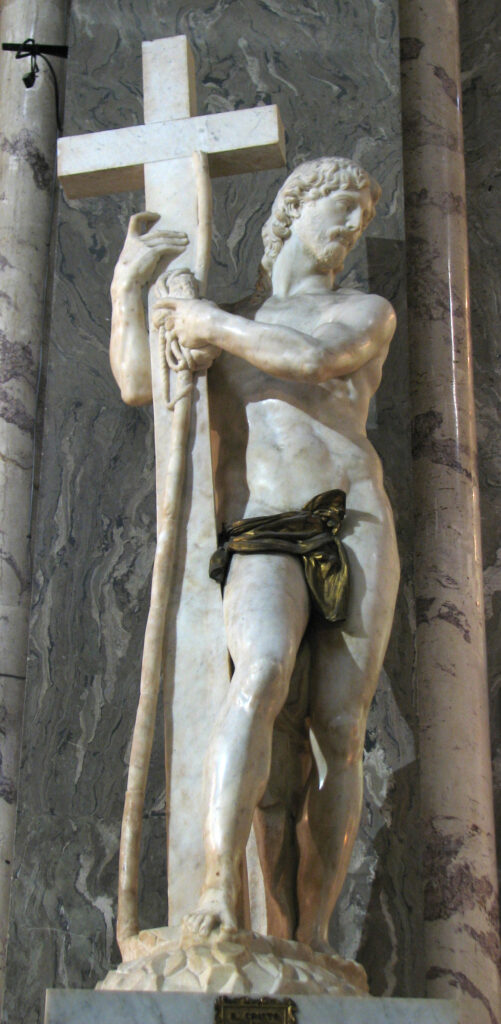
Michelangelo died in 1564. A decade later, Titian began his epic “Pietà” (c. 1575-76). As in Michelangelo’s sculpture of the same subject, a seated Mary gently cradles her son’s broken body. At right stands the Hellespontic Sibyl, a priestess of the ancient world who, according to legend, prophesized the crucifixion. In a pose borrowed from Michelangelo’s “The Risen Christ” (1519-21), she embraces the cross.
Before leaving Rome. Titian had acquired a plaster cast of “The Risen Christ.” For 30 years it stood in his Venice studio, a challenge and inspiration.
Now, with the artist in his 80s, “the question of rivalry had subsided,” Wallace concluded. “In painting his epitaph, Titian confronted their shared concerns about death and salvation, legacy and immortality.”
Wallace will discuss “Michelangelo & Titian” at 6 p.m. Wednesday, Feb. 11, at Left Bank Books. Joining him will be Claudia Swan, the Mark Steinberg Weil Professor in Art History in Arts & Sciences. For more information, visit left-bank.com.