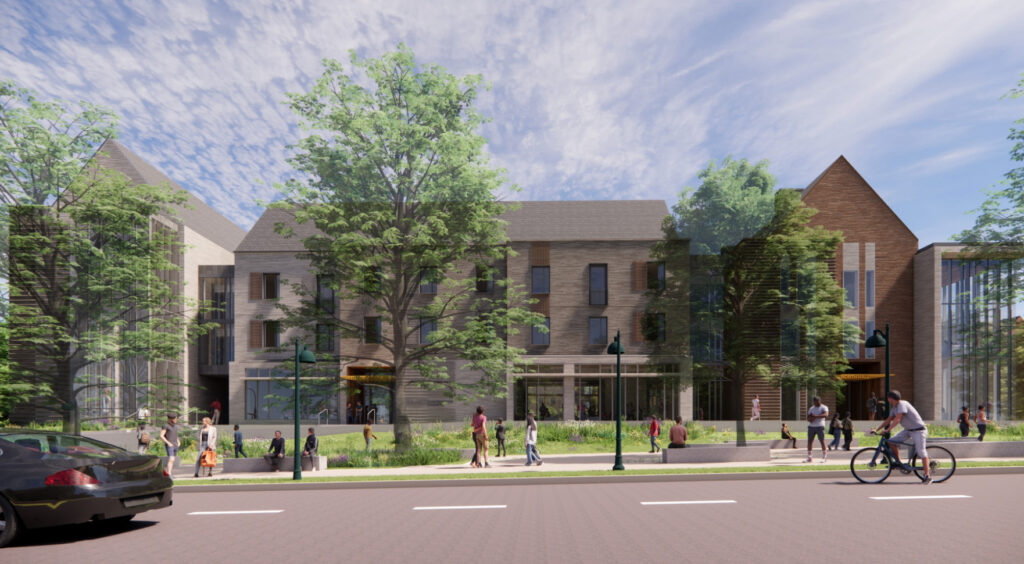
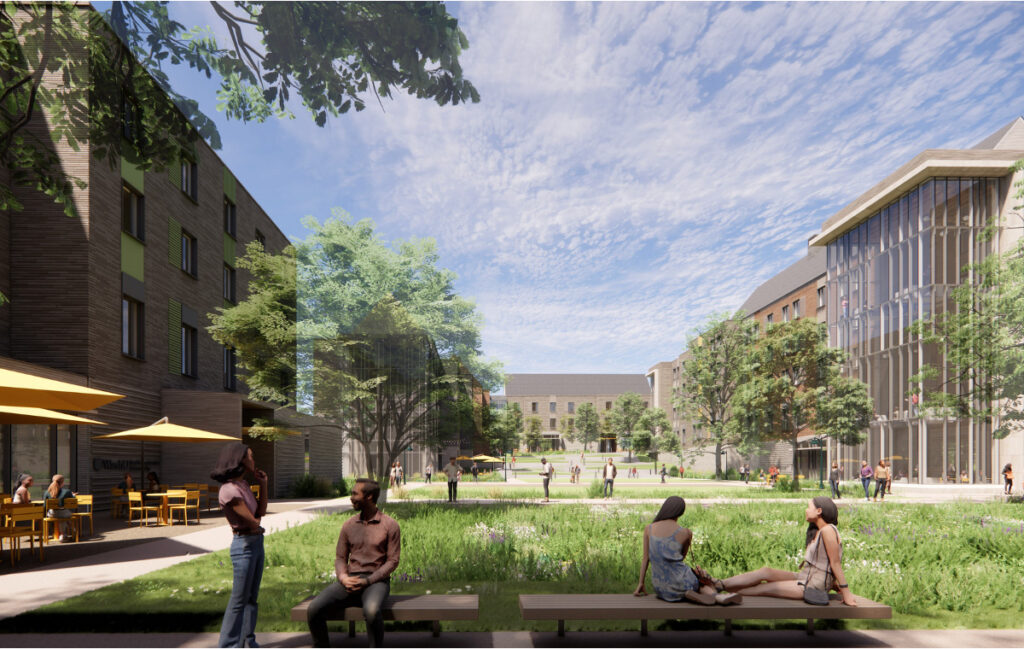
New residential housing on the South 40 will accommodate 300 first-year students, 300 sophomores and 18 resident advisors and features expansive communal areas. The design team is Studio Ma and Trivers; Clayco will serve as general contractor. (Image: Studio Ma)
As part of its ongoing mission to strengthen the undergraduate experience, WashU plans to build a new South 40 residence hall along Forsyth Boulevard. The new building will accommodate 600 first-year students and sophomores and feature a large courtyard and multipurpose room for events and gathering. Construction is anticipated to start this summer and is expected to be complete in time for the 2028-29 academic year.
Anna Gonzalez, vice chancellor for student affairs, said the new residence hall will meet growing student demand to live on the South 40 and allow for the eventual replacement of older residence halls. The new residence hall also enables the university to bring together all first-year and sophomore students on the South 40, a longtime priority.
“This will be a game changer in terms of building that sense of belonging and connectedness, which is critical for student retention and success,” Gonzalez said. “We know that what often connects students is that residential community experience. Creating a community on the South 40 for every undergraduate during their pivotal early years will strengthen that WashU bond.”
The new Washington University in St. Louis building will be located between the Stix House and the Underpass. The site is currently occupied by Blewett Hall, the Gaylord Music Library, Tietjens Hall, the Alumni House and a parking lot. The Department of Music in Arts & Sciences will move classrooms, labs, offices and practice spaces to new locations on the Danforth Campus; the Gaylord collection will move to Olin Library and West Campus.
The new building will span in height from three to five floors. Each residential floor will offer a mix of first-year doubles with communal restrooms featuring private showers and stalls and sophomore singles with private restrooms. Shared amenities include large study rooms, laundry facilities, TV lounges and kitchens as well as an expansive courtyard. The new multipurpose room will serve as a convenient venue for large programs, lectures and events.
“We’re trying to create an intermingling between first-years and sophomores and create opportunities for students to get out of their rooms and engage with one another,” said Sheryl Mauricio, associate vice chancellor for student affairs and director of residential life. “In addition, the building also will serve as a sort of crossroads between the South 40 and the Danforth Campus, where students can participate in programs closer to their home.”
Gonzalez said housing fees will cover the full cost of the project. The new rooms will be priced at South 40 “modern” rates.
With demand for on-campus housing mounting, now is the right time to build the new residence hall, Mauricio said. As of 2024, WashU requires all first-year and sophomore students to live in university housing. Currently, 95% of students request to live on the South 40, which today can only accommodate about 90% of such requests. There is also a high demand from juniors and seniors for housing in the Village and Millbrook Apartments.
“Every year that you wait to build a new building, it gets more expensive due to the rising cost of construction,” Mauricio said. “We knew we would eventually have to build this building given the demand and growth in enrollment. So we did a lot of financial planning and careful design work to control costs.”
Gonzalez said the university is undergoing a strategic facilities planning process to determine when older residence halls will be replaced. In the meantime, WashU plans to expand dining services on the South 40 and in the Danforth University Center to meet the needs of the additional students.
The new residence hall, in addition to the Neil S. Hirsch Center, future home to the alumni welcome center and Center for Career Engagement at Forsyth and Skinker boulevards, builds on WashU’s reputation for creative, community-driven design, Gonzalez said.
“We are seeing a continuation of the development of the best campus in America,” Gonzalez said. “The university is doing this in a way that’s being responsible with the resource moment that we’re in and creating flexibility that allows us to continue to provide a great undergraduate residential experience — today and in the future.”
WashU is working with Clayton on the project, which adheres to the city’s overlay zoning requirements, to study safety improvements to the intersection at Forsyth Boulevard and Wallace Drive to accommodate increased pedestrian traffic. The university will continue to collaborate with elected officials and neighbors throughout the project approval process.