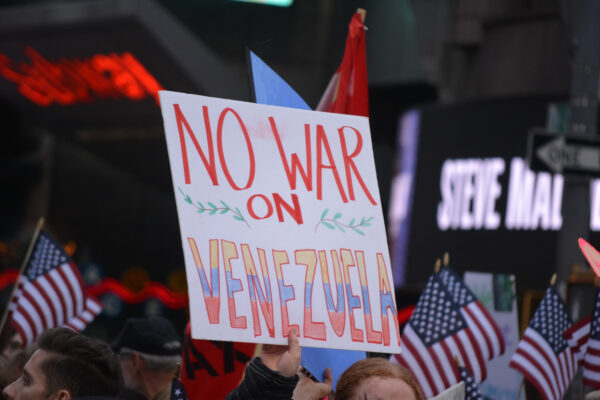
World leaders were stunned to learn of the U.S. military operation against Venezuela in the early morning hours of Jan. 3 that resulted in the capture of President Nicolás Maduro and his wife, Cilia Flores.

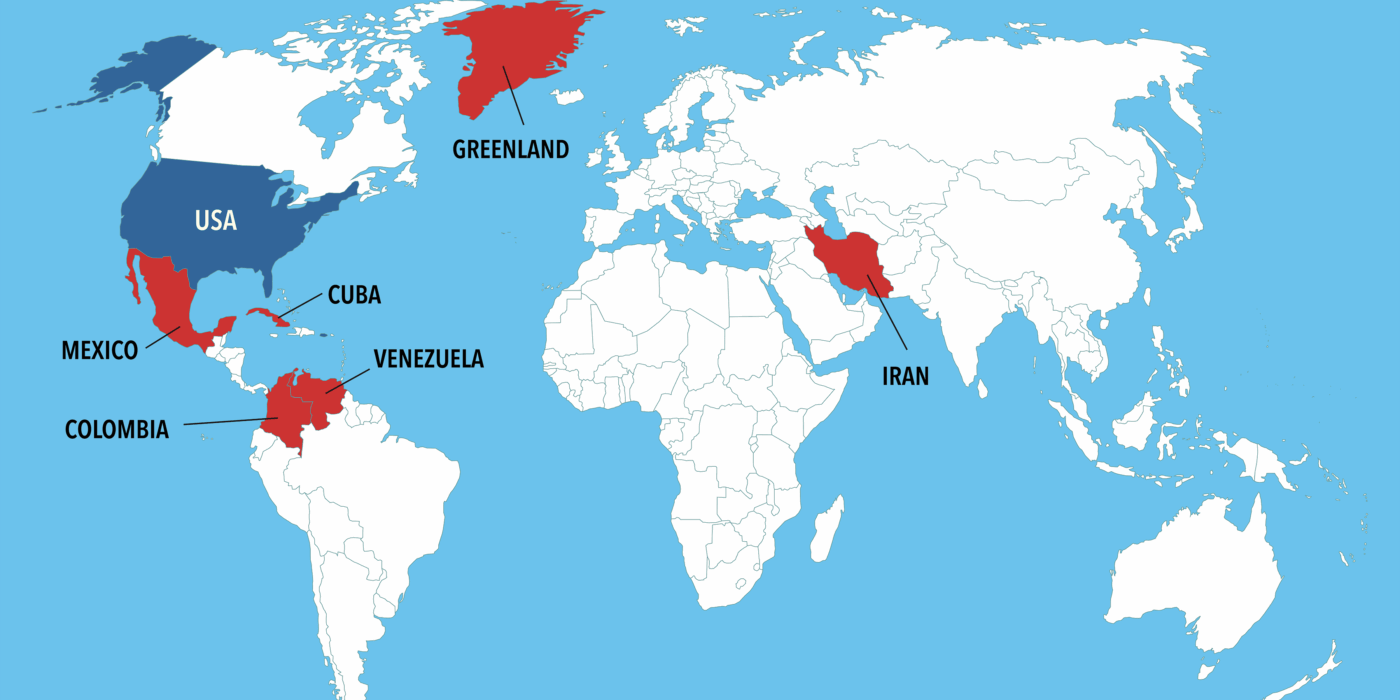
The unfolding crisis in Venezuela, as well as President Donald Trump’s subsequent threats to countries including Greenland, Colombia, Mexico and Iran, have called into question the legality of his military actions; the stability of Venezuela, the region and the world; and the future of international alliances and democratic norms.
These actions could also embolden U.S. adversaries, according to David Carter, a professor of political science in Arts & Sciences at Washington University in St. Louis and an expert on international relations and territorial conflict. Carter’s 2021 paper, published in International Organization, examined the history of territorial claims over the last 200 years, finding evidence that global instability and crisis creates prime opportunities for revisionist states to make territorial claims.
Below, Carter discusses global reaction to the U.S. operation in Venezuela, the future of U.S. foreign relations and how adversaries could benefit from a break in legal norms.
World leaders divided, cautious about future
‘The reaction from Russia and China has predictably been negative, although both likely view this as a useful precedent for their own interest in regime/leader change in places like Taiwan.’
David Carter
The U.S. attack on Caracas has polarized relations with the U.S. throughout the Western Hemisphere in the short term, Carter said. Leaders of Brazil, Chile, Colombia, Mexico and others quickly condemned the operation. This includes leaders who were already quite hostile to the Trump administration, such as Gustavo Petro of Colombia, and countries like Mexico, whose President Claudia Sheinbaum had been able to cooperate with Trump to some degree. At the same time, leaders who had close relations with the Trump administration prior to the attack, such as Javier Milei of Argentina, responded positively to the attack, he said.
One thing is certain, though: “The operation that removed Maduro has served to frighten leaders in Latin America who do not want to experience a similar fate to Maduro,” Carter said. “This could make it easier for Trump to compel changes in policy or rhetoric in the short-term, although it is hard to say how this will play out weeks or months from now.”
By comparison, the reaction of European allies has been relatively muted despite their opposition to the attack. According to Carter, many of these leaders are more worried about Trump administration policy relative to NATO and the war in Ukraine.
“Provoking Trump by too stridently criticizing an operation that has already occurred has few benefits and might provoke a response from the president,” Carter explained.
“The reaction from Russia and China has predictably been negative, although both likely view this as a useful precedent for their own interest in regime/leader change in places like Taiwan,” he added.
U.S. global reputation called into question
For generations, the U.S. has positioned itself as the standard-bearer for democracy, free-market capitalism and human rights around the world. Will Trump’s actions in Venezuela harm the country’s position on those issues? The situation, Carter explained, is complex.
“Maduro has an atrocious human rights record, was not elected in a free and fair democratic election — which led key European countries like France, the U.K. and Germany to demand he step down — and also leads a regime that had aggressively expropriated foreign oil company assets,” Carter said. “Thus, I do not think it is fair to view removing Maduro as universally harming the U.S. position on these issues.
“That being the case, the legal basis for removing Maduro is on very poor ground and it is not consistent with democracy to remove a country’s leader and demand compliance from the existing government, stating that ‘we are going to run things for a while.’”
“Thus, on the balance I think it harms the U.S.’s reputation despite the Maduro regime being quite odious. Strategically, the worry is that this provides a justification or blueprint for adversaries like Russia to remove leaders they do not like.”
Military action, threats call international alliances, global stability into question
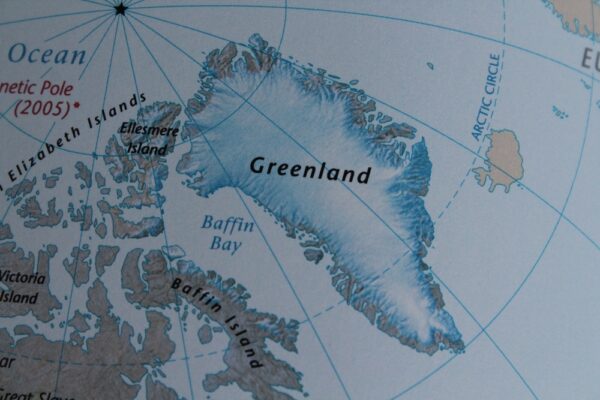
Immediately following Maduro’s capture, Trump renewed his threats of annexing Greenland and threatened Mexico, Colombia and Cuba. Despite efforts by officials such as Secretary of State Marco Rubio to downplay Trump’s rhetoric, Carter said all threats issued by the president of the United States should be taken seriously.
‘NATO is finished if the U.S. moves to seize Greenland.’
David Carter
“Trump has shown himself quite willing to undertake risky military actions to follow up on threats, even when there are serious risks or obvious potential downsides. Before the capture of Maduro, Trump authorized the assassination of Qasem Soleimani, an Iranian military officer, in 2020, as well as an attack on Iranian nuclear facilities last June,” Carter said.
“The administration is clearly willing to use force when there are significant and unwanted costs that might result. It is hard to imagine that the operational success of Operation Absolute Resolve does not increase Trump’s interest in similar operations elsewhere, although it is doubtful that something akin to OAR would be possible in these other cases.”
These threats have put world leaders on edge, especially as they relate to Greenland, an autonomous territory of Denmark.
“NATO is finished if the U.S. moves to seize Greenland,” Carter said. “Denmark is a member and an attack by the leading member of the alliance on another member state would devastate the institution. I cannot imagine the alliance invoking Article V against the U.S.”
Expect future conflicts to arise
Even in a best-case scenario in which President Trump does not follow through on the threats he has made and the situation in Venezuela is quickly mediated, Carter’s research suggests more conflicts will arise.
“Crises and instability that involve major powers tend to generate downstream spikes in conflict between and within states,” he said. “An example here is Azerbaijan taking advantage of Russia’s war in Ukraine to take disputed territory in 2023. Russia was much less able to intervene on Armenia’s behalf to prevent these territorial changes as it was fully engaged in Ukraine.”