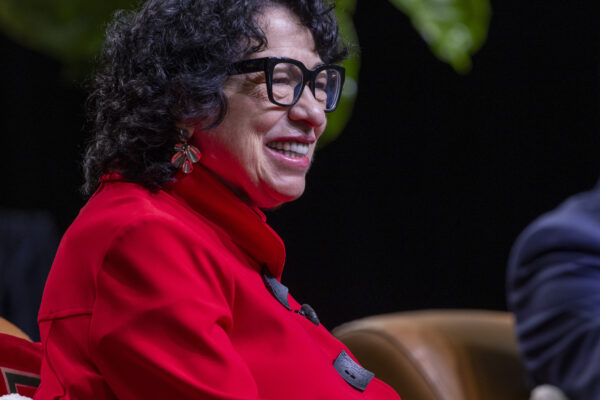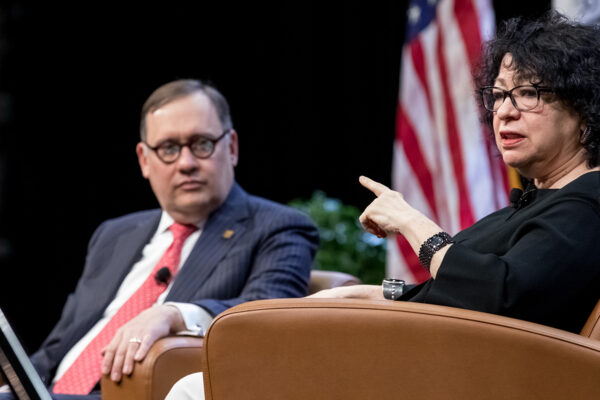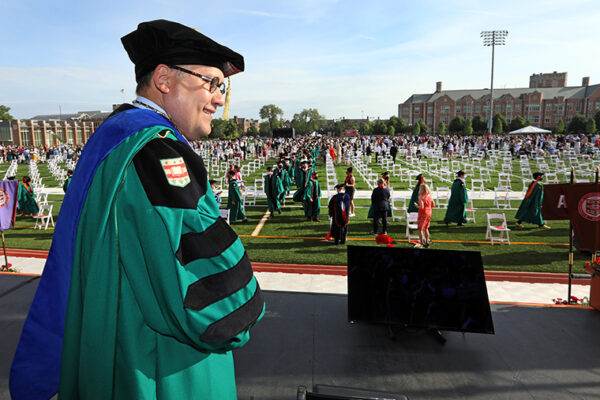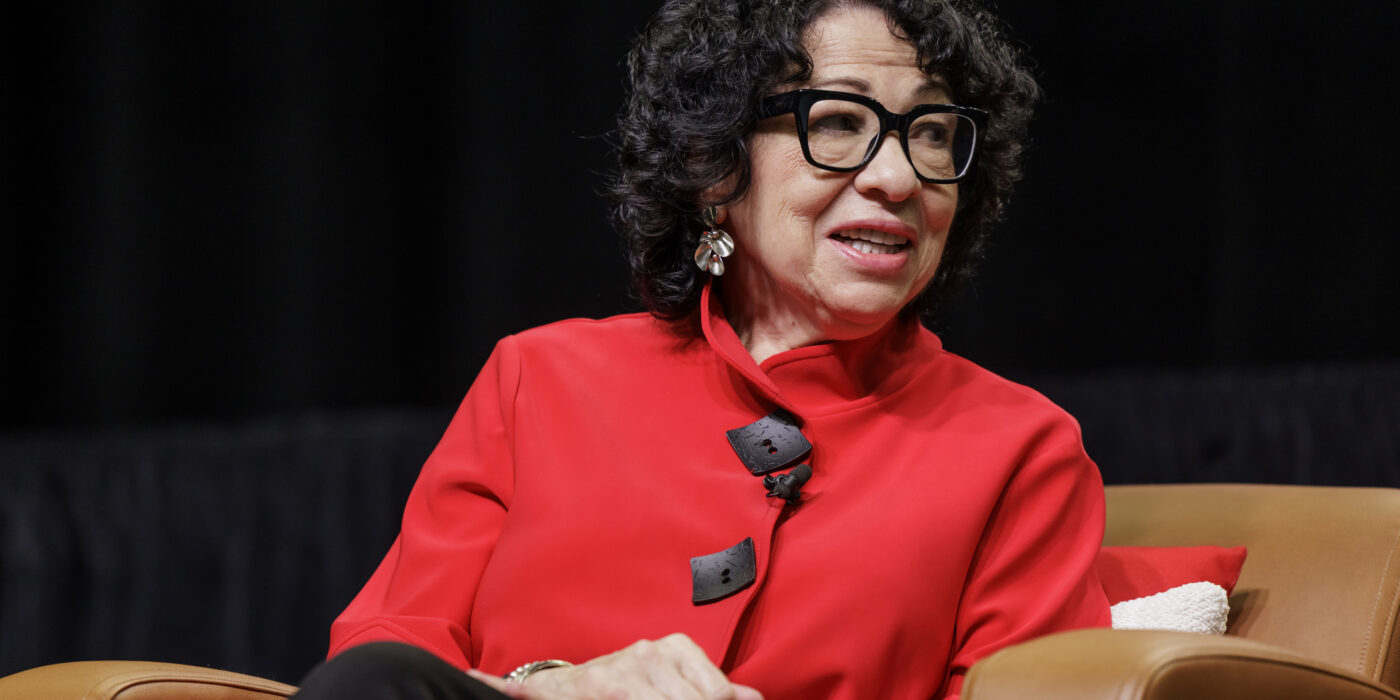
U.S Supreme Court Justice Sonia Sotomayor reflected on family, friendship and her hope for the future during a “fireside chat” Sept. 10 with Chancellor Andrew D. Martin at Washington University in St. Louis.
Justice Sotomayor began the evening by reading a few passages from her children’s book “Just Shine! How to Be a Better You,” which tells the story of her mother, Celina Báez Sotomayor, who worked for years as a low-paid nurse in New York City.
Their early relationship was strained, as her father’s alcoholism left Justice Sotomayor feeling abandoned by her mother. In time, she forgave her, and the two became very close.
“Anything you see good in me, she gave to me,” Justice Sotomayor said. “I wrote this book in the hope that we can make a better world if we show love in positive ways.”
Forgiveness, she added, is a lesson she continues to work on.
“Forgiveness is still hardest for me,” she said. “My mother was always forgiving people. I’m still working on it.”
Asked how she applies the ideas of love and forgiveness in her work life at the Supreme Court, Justice Sotomayor said she does her best to listen to people, even those with whom she vehemently disagrees.
“In every person, there is something good,” she said.
Sotomayor spoke about how she and conservative Justice Clarence Thomas disagree on nearly everything.
“But Clarence Thomas knows the name of virtually every employee in the building, and he cares so deeply that he knows when someone is suffering — when a parent has died, when a child is sick,” she said. “Not a lot of people do that.”
“Now you’re going to say to me, ‘How could he believe what he believes?’ Well, I can’t answer. I think most of the time he’s wrong,” she said. “But when my stepfather died, the first flowers that arrived at my mother’s home were from Clarence Thomas.”
When she was asked what gave her hope during this difficult period in history, Sotomayor referenced the famous Dred Scott case, which was initially tried in St. Louis Circuit Court.
“You live in the town of one of the most infamous decisions in Supreme Court history, the Dred Scott case,” she said. “He took his case to the Supreme Court twice. He lost.”
While Scott did not live to see it, his case and others like it helped lead to the end of slavery in the United States.
“We have an obligation to pick up that mantle and continue the fight,” Justice Sotomayor said. “We have heroes among us, and every one of us has the capacity, in small or big ways, to be heroes. That’s what gives me hope.”