Startup companies built on Washington University in St. Louis discoveries attracted a record $1.7 billion in private-sector investment over the past year, accelerating the commercialization of WashU innovations into life-changing diagnostics, therapeutics and medical devices. Among those innovations are a blood test to diagnose Alzheimer’s disease; immunotherapies to treat aggressive blood cancers; and an artificial intelligence (AI)-based breast-cancer prediction tool.
The significant investments from venture capital and private equity firms show that investors are paying close attention to WashU-born technologies. Such funding goes directly to the startups — the independent companies formed from WashU intellectual property — and is crucial to advancing new treatments and technologies toward Food and Drug Administration (FDA) approval and commercialization, where they will have a tangible benefit in people’s lives.
“The $1.7 billion invested in WashU startups represents something far more than an impressive number — it reflects growing confidence that our science can translate into real-world solutions that improve patients’ lives in St. Louis and far beyond,” said David H. Perlmutter, MD, executive vice chancellor for medical affairs, the Spencer T. and Ann W. Olin Distinguished Professor and the George and Carol Bauer Dean of WashU Medicine. “We’ve always been recognized as a top-tier research institution, attracting faculty who willingly take on the toughest questions and never give up in their search for answers. What’s exciting is that our efforts to help faculty start new companies and license technologies are accelerating that work, transforming discoveries into innovations that have the power to deliver the greatest good for society.”
Indeed, commercialization activity at WashU is surging, with WashU Medicine faculty leading the way in neurosciences, imaging and cancer. Such successes inspire investors to partner with WashU startups to move technologies forward. In fiscal year 2025, faculty disclosed 268 inventions, received 68 U.S. patents and launched six new startups. Licensing revenue also generated $17 million in income that WashU invested back into its research programs.
In addition, since December 2024, five WashU Medicine startups were acquired by or merged with larger companies that can provide additional financial resources to accelerate development of WashU technologies and reach patients faster.
These achievements reflect WashU’s ambitious vision for commercialization, championed by Perlmutter. Over the past five years, WashU has put new resources into its Office of Technology Management (OTM) and fostered opportunities to ensure critical discoveries from the labs go on to benefit the world.
“Our growing culture of entrepreneurship fosters curiosity-driven research with ambitious translational goals and generates strong connections to industry, investors and the St. Louis biotech ecosystem,” Perlmutter added. “We also are working on ways to further enhance innovation and commercialization with the added benefits of re-investing the revenue that comes back into both basic and translational research. I call this the virtuous cycle of translational research.”
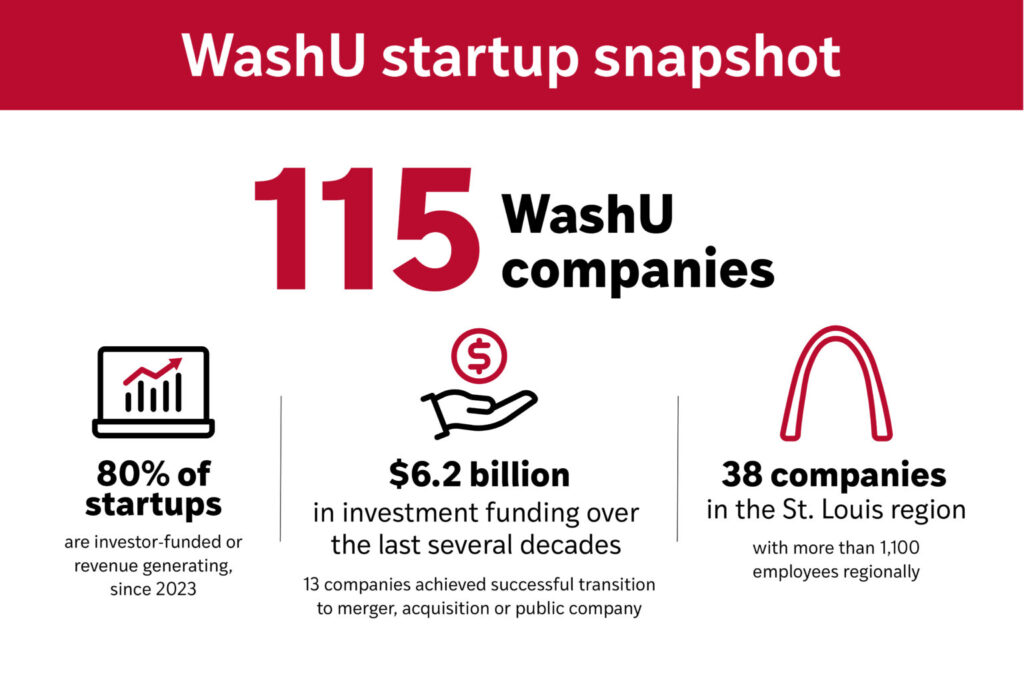
Over the past several decades, WashU startups have garnered more than $6 billion in private-sector investment, resulting in more than 30 university-developed technologies now available on the market. For instance, products that emerged from discoveries in WashU labs now are helping patients regain meaningful arm and hand function after a stroke and are aiding the repair of wounds after surgery or resulting from a chronic condition. Many of these innovations were advanced through exclusive licensing agreements that grant companies the sole rights to further develop and commercialize WashU discoveries — evidence that WashU research is not only scientifically rigorous but also a strong foundation for building successful new companies, said Nichole R. Mercier, PhD, assistant vice chancellor and managing director of OTM. “WashU is launching high-caliber companies, and investors are taking notice,” she added.
Ranked No. 2 among U.S. medical schools in funding from the National Institutes of Health (NIH), WashU Medicine is widely recognized for its groundbreaking science. But because NIH funding largely supports basic science, universities must rely on biomedical companies — and private-sector investments into those companies — to provide the financial resources necessary to move key discoveries all the way through FDA approval. Such companies raise the capital needed to validate early-stage technologies, conduct clinical trials and advance new technologies through the regulatory pathway, which can take years or even decades.
Growing impact across St. Louis region
Beyond advancing patient care, WashU’s startups are fueling economic growth in the region, attracting scientific talent and quality jobs. Of the current 115 WashU startups, 38 active companies are firmly rooted in the St. Louis region, employing more than 1,100 people, including researchers.
One such company is C2N Diagnostics, co-founded by WashU Medicine neurologists David M. Holtzman, MD, the Barbara Burton and Reuben M. Morriss III Distinguished Professor of Neurology, and Randall J. Bateman, MD, the Charles F. and Joanne Knight Distinguished Professor of Neurology. The company is commercially advancing blood tests to diagnose Alzheimer’s and other neurodegenerative diseases, which were initially developed in Holtzman’s and Bateman’s labs, and recently announced it is expanding and moving its headquarters — and 98 employees — to St. Louis’ Cortex Innovation District, a 200-acre campus adjacent to WashU Medicine and a premier destination for pioneering biotech and life science companies.
“Entrepreneurial momentum is building at WashU and has a major impact on the region,” said Doug E. Frantz, PhD, WashU’s vice chancellor for innovation and commercialization, who joined the university a year ago to develop strategic partnerships with industry and further enhance commercialization efforts. “The rising number of patents, licenses and startups over the last decade is a clear indicator of the exciting advancements to come. Investors are taking notice of WashU startups’ potential, ensuring a bright and dynamic future for our innovations and the local economy.”

Eight active WashU startups received significant investor funding over the past year.
WUGEN
Immunotherapy to treat aggressive leukemias and lymphomas
WashU Innovators
John DiPersio, MD, PhD
Todd Fehniger, MD, PhD
CARDIOWISE
Machine-learning platform for cardiac imaging and diagnosis
WashU Innovators
Michael Pasque, MD
Brian Cupps, PhD
DEEPSIGHT TECHNOLOGY
Ultrasound technologies to guide minimally invasive procedures
WashU Innovator
Lan Yang, PhD
PAIRIDEX
Detection of residual leukemia after treatment
WashU Innovator
Andrew Young, MD, PhD
C2N DIAGNOSTICS
Blood test to diagnose Alzheimer’s disease
WashU Innovators
Randall Bateman, MD
David Holtzman, MD
ARMOR MEDICAL INC.
Warning system for obstetric hemorrhage
WashU Innovators
Christine O’Brien, PhD
Leo Shmuylovic, MD, PhD
DROPLET BIOSCIENCES
Lymph-based biopsy to improve cancer care
WashU Innovators
Aadel Chaudhuri, MD, PhD
Jose Zevallos, MD
SENTIAR
3D visualization of patient anatomy
WashU Innovators
Jennifer Silva, MD
Jonathan Silva, PhD
Investment behind innovation
WashU’s OTM supports faculty through every stage of commercialization, helping to protect intellectual property, license technologies and launch startups. Strategic investments from WashU have expanded the office’s entrepreneurial education programs and business development resources, helping drive WashU’s recent growth in commercialization activity.
The office’s new ventures team, launched in 2022, coaches faculty on investor pitching to secure funding to successfully launch startups and strengthen the soft skills needed to build strong partnerships with investors. OTM also offers a Quick Start License, a streamlined agreement vetted by venture capital firms and attorneys that eliminates upfront payments and minimizes fees, allowing startups to focus on development rather than prolonged legal negotiations around costs.
Such support complements a thriving regional ecosystem for biotech growth. One standout is the WashU Medicine startup Wugen, a biotech company co-founded in 2018 by John F. DiPersio, MD, PhD, the Virginia E. & Sam J. Golman Professor of Medicine, and Matthew L. Cooper, PhD, who was then a faculty member at WashU Medicine and is now chief scientific officer of Wugen. The company is developing an off-the-shelf “universal” CAR-T cell therapy to treat aggressive leukemias and lymphomas. Such an immunotherapy could be given to patients more quickly than traditional, custom-designed CAR-T cell therapies that are derived from a patient’s own cells and take a few weeks to create. Wugen also is headquartered in the Cortex Innovation District and employs 64 researchers and staff members.
Now, with a major infusion of investor funding in 2025, Wugen has launched a phase 2 trial of the cancer immunotherapy, a crucial step needed to move the treatment toward FDA approval. Findings from an early-stage clinical trial reported last year showed promising results — the therapy attacked cancer cells — with manageable side effects in patients with a rare type of leukemia who had limited treatment options elsewhere.
“We believe Wugen, born and bred in St. Louis, exemplifies the tremendous impact of the city’s thriving biotech ecosystem on young companies,” said DiPersio. “From idea generation to implementation, we credit WashU’s scientific diversity and rich expertise; collaboration across labs, departments and the local private sector; and local investors dedicated to the region’s economic growth.”
Another WashU startup drawing major investor support is DeepSight, which is a WashU McKelvey School of Engineering startup developing next-generation ultrasound technologies to improve the diagnosis and treatment of illness. For example, its NeedleVue solution is designed to guide physicians in performing targeted biopsies, injections, and other minimally invasive procedures through ultrasound-assisted tool guidance. WashU’s OTM has exclusively licensed patents to DeepSight, which received FDA clearance in 2025 to market its NeedleVue LC1 Ultrasound System to hospitals and physicians’ offices.
“OTM’s resources helped put DeepSight on the right track to turn our idea into reality,” said founder Lan Yang, PhD, the Edwin H. & Florence G. Skinner Professor of electrical and systems engineering at McKelvey Engineering. “Their guidance in preparing and securing the WashU patents that we licensed to DeepSight gave us a strong IP foundation as we began building the company.”

Five WashU Medicine startups were acquired by or merged with larger companies since December 2024, accelerating development of WashU-born technologies.
SAGE THERAPEUTICS
Medications for mood and psychiatric disorders
WashU Innovators
Douglas Covey, PhD
Steven Paul, MD
NEUROLUTIONS
Neurorehabilitation device for stroke patients
WashU Innovators
Eric Leuthardt, MD
Dan Moran, PhD
ACERA SURGICAL
Nanoscale materials to aid wound healing
WashU Innovator
Matthew MacEwan, MD, PhD
AMPTIFY
Game-based training for enhanced hearing
WashU Innovator
Nancy Tye-Murray, PhD
PROGNOSIA HEALTH
Breast cancer risk prediction software
WashU Innovators
Graham Colditz, MD, DrPH
Joy Jiang, PhD
Acquiring valuable assets
Many startups aim to merge with or be acquired by larger companies that have the infrastructure and financing to support regulatory approval, manufacturing and global distribution.
Last month, the healthcare company Solventum acquired Acera Surgical Inc., a WashU Medicine startup that has commercialized five FDA-approved products designed with nanoscale materials to aid regenerative wound repair. Surgeons nationwide use these products to treat surgical, traumatic and chronic wounds, including in patients undergoing cancer treatment or living with severe diabetes.
In another milestone, Prognosia Inc., a WashU Medicine startup founded in 2024, was acquired within a year by Lunit Inc., a global leader in developing AI-based technologies for cancer prevention and early detection. Prognosia was co-founded by WashU Medicine’s Graham A. Colditz, MD, DrPH, the Niess-Gain Professor of Surgery and associate director of prevention and control at Siteman Cancer Center, based at Barnes-Jewish Hospital and WashU Medicine, and Shu (Joy) Jiang, PhD, an associate professor of surgery in the Division of Public Health Sciences in the Department of Surgery. The company licensed Colditz and Jiang’s AI-powered software from WashU that estimates a woman’s five-year breast cancer risk based on images taken either at a single time point or from serial images from previous screening mammograms.
“Such deals demonstrate our ability to move innovations out of the lab and into the clinic and commercial development, showcasing the university’s role in driving innovation and industry growth,” Mercier said.
WashU is launching high-caliber companies because of the resources it is putting into commercialization. For example, WashU provided financial support through the university’s gap funding program, led by OTM, to help Prognosia obtain FDA Breakthrough Device designation before the company was acquired, expediting the review process for full market approval. The program provides funding for translational work to increase the chances of WashU technologies attracting industry partners to commercialize them.
Another notable success is Neurolutions Inc., a WashU Medicine startup commercializing the IpsiHand, a wearable device that helps people disabled by stroke regain meaningful control over arm and hand function. In April, the company merged with Kandu Health Inc., a health-care services company, bringing together complementary technologies and infrastructure to ultimately support stroke patients across the full continuum of care, from acute recovery to long-term rehabilitation.
The IpsiHand technology was developed by WashU Medicine’s Eric Leuthardt, MD, the Shi H. Huang Professor of Neurological Surgery, who cofounded Neurolutions with Daniel Moran, PhD, a professor of biomedical engineering at WashU’s McKelvey Engineering. Neurolutions received FDA market authorization in 2021 for the device, which uses brain-computer interface technology. The new company, Kandu Inc., combines Neurolutions’ medical device expertise with the AI-supported digital health solutions of Kandu Health.
“WashU is primed to lead in innovation with its exceptional talent, collaborative spirit and diverse scientific expertise,” said Leuthardt. “Now is our moment to make significant impact on human health globally, fueled by a thriving local biotech industry.”
About WashU Medicine
WashU Medicine is a global leader in academic medicine, including biomedical research, patient care and educational programs with more than 3,000 faculty. Its National Institutes of Health (NIH) research funding portfolio is the second largest among U.S. medical schools and has grown 83% since 2016. Together with institutional investment, WashU Medicine commits well over $1 billion annually to basic and clinical research innovation and training. Its faculty practice is consistently among the top five in the country, with more than 2,000 faculty physicians practicing at 130 locations. WashU Medicine physicians exclusively staff Barnes-Jewish and St. Louis Children’s hospitals — the academic hospitals of BJC HealthCare — and Siteman Cancer Center, a partnership between BJC HealthCare and WashU Medicine and the only National Cancer Institute-designated comprehensive cancer center in Missouri. WashU Medicine physicians also treat patients at BJC’s community hospitals in our region. With a storied history in MD/PhD training, WashU Medicine recently dedicated $100 million to scholarships and curriculum renewal for its medical students, and is home to top-notch training programs in every medical subspecialty as well as physical therapy, occupational therapy, and audiology and communications sciences.
Originally published on the WashU Medicine website