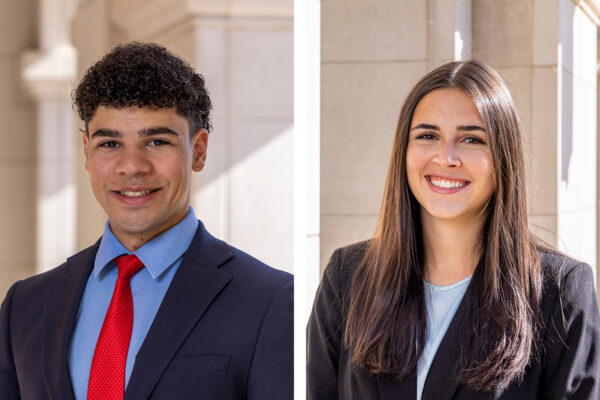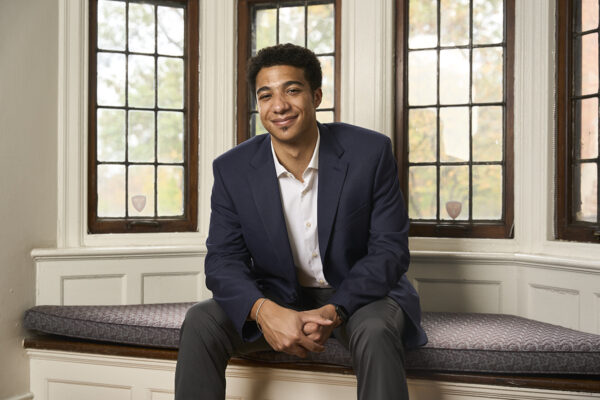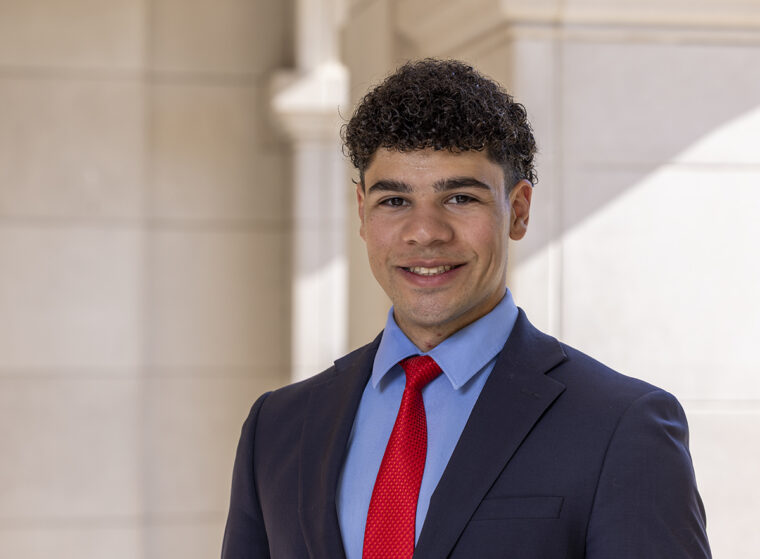
Washington University in St. Louis senior Omar Abdelmoity received one of the most selective scholarships in academia, the Marshall Scholarship, which provides American students the opportunity to study in the United Kingdom.
Abdelmoity plans to earn an advanced degree in evidence-based social intervention and policy evaluation at Oxford University and a second advanced degree in population health sciences at Cambridge University.
“Two years in the U.K. will be transformative: it will allow me to develop expertise that complements my U.S.-based training, establish enduring transatlantic collaborations and prepare for a career defined by both clinical innovation and systemic change,” Abdelmoity said. “The Marshall Scholarship will not just precede my medical career, it will shape its foundation, enabling me to unite research, policy and service in the pursuit of equity and inclusion.”
Abdelmoity, of the Kansas City suburb of Overland Park, Kan., is majoring in biology in Arts & Sciences. He was recently awarded the Goldwater Scholarship, a national award that honors young researchers, and was a Rhodes Scholarship finalist. Abdelmoity is WashU’s eighth Marshall Scholar and the first since 2021.
Abdelmoity is a Medicine & Society Scholar, an Ervin Scholar and Gephardt Institute Drs. Olsen & Marcus Civic Fellow. At WashU, he has conducted groundbreaking research about the progression of Alzheimer’s disease in individuals with Down syndrome. Ultimately, he hopes to earn his medical degree and support patients from underserved populations through research and policy advocacy.
“My career goal is not only to advance science but also to ensure that interventions reach the populations who need them most, whether that means designing upstream school-based prevention programs or developing biomarkers that accelerate diagnosis in historically excluded groups,” Abdelmoity said.
Chancellor Andrew D. Martin called Abdelmoity a committed scholar, mentor and leader.
“Omar’s academic record, admirable character, research experience and sense of purpose make him a perfect fit for the Marshall Scholarship,” Martin said. “I am excited to see how he leverages his experiences in the United Kingdom in his quest to address disparities in access to equitable care.”
Serving the forgotten
To Abdelmoity, the seemingly disparate issues of suicide among Black youth and Alzheimer’s disease among individuals with Down syndrome reveal an uncomfortable truth — our medical system still struggles to meet the needs of those most at risk.
“There are people who will say, ‘Oh, it is what it is.’ I can’t accept that,” Abdelmoity said. “From my place in the world, humanity’s pressing challenge is its inequitable health systems — gaps that determine who receives care, whose suffering is prevented and whose voices shape science.”
Abdelmoity began studying youth mental health in high school after two friends from his soccer club died by suicide. He soon learned that suicide disproportionately affected Black students like him. Abdelmoity joined the suicide prevention initiative Zero Reasons Why and developed a data-informed education program for middle school students that addressed the stigmas surrounding mental health and provided students coping strategies to support their own well-being as well as tools to help others in crisis. That work led to research opportunities at Children’s Mercy in Kansas City, Children’s Hospital of Philadelphia and the Washington, D.C., Department of Behavioral Health — and an invitation to speak at the White House about suicide prevention.
“Expanding from my community to the national stage reinforced the same truth — service is strongest when it combines data, lived experience and the voices of those most affected,” said Abdelmoity, who was named a Future Leader in Psychiatry Scholar by the American Psychiatric Association.
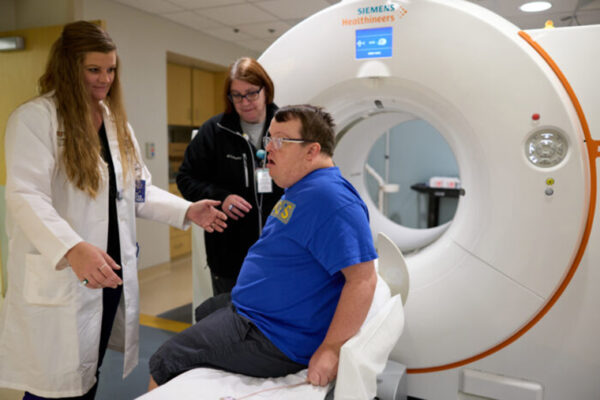
At WashU, Abdelmoity has pursued research to benefit another underserved population: individuals with Down syndrome. As a National Institutes of Health (NIH)-funded MARC U-STAR and NIH-STEP UP scholar in the Ances lab at WashU Medicine, Abdelmoity learned that people with Down syndrome are rarely included in clinical studies for Alzheimer’s disease despite suffering from the condition at a higher rate. He set out to study if Alzheimer’s progresses differently in this population and discovered that, yes, neurodegeneration often starts two decades before the onset of symptoms. Abdelmoity’s groundbreaking work was published in the Annals of Neurology and has led to new study protocols.
Beau Ances, MD, the Daniel J. Brennan Professor of Neurology at WashU Medicine, said Abdelmoity’s research demonstrates his care for the underserved.
“The progression of degrees would not only enhance Omar’s ability to conduct impactful research but also broaden his perspective on global health challenges and cross-cultural medical practices,” Ances wrote in his recommendation. “The Marshall Scholarship would thus be instrumental in helping Omar achieve his long-term academic and professional goals.”
Abdelmoity, a self-described science nerd, is taking his research one step further, partnering with a Spanish research institute to create the world’s largest APOE genotyped cohort of Down syndrome individuals to better understand the progression of Alzheimer’s disease in this population. The results of this novel study are to be published shortly, with Abdelmoity as first author.
“One of the first things Dr. Ances told me is that we do this work not to publish papers but to inform our patient care,” Abdelmoity said. “The flip side is true as well. When patients come in with something we don’t understand, that informs the next research question we work on in the lab. It’s a never-ending cycle, and I love it.”