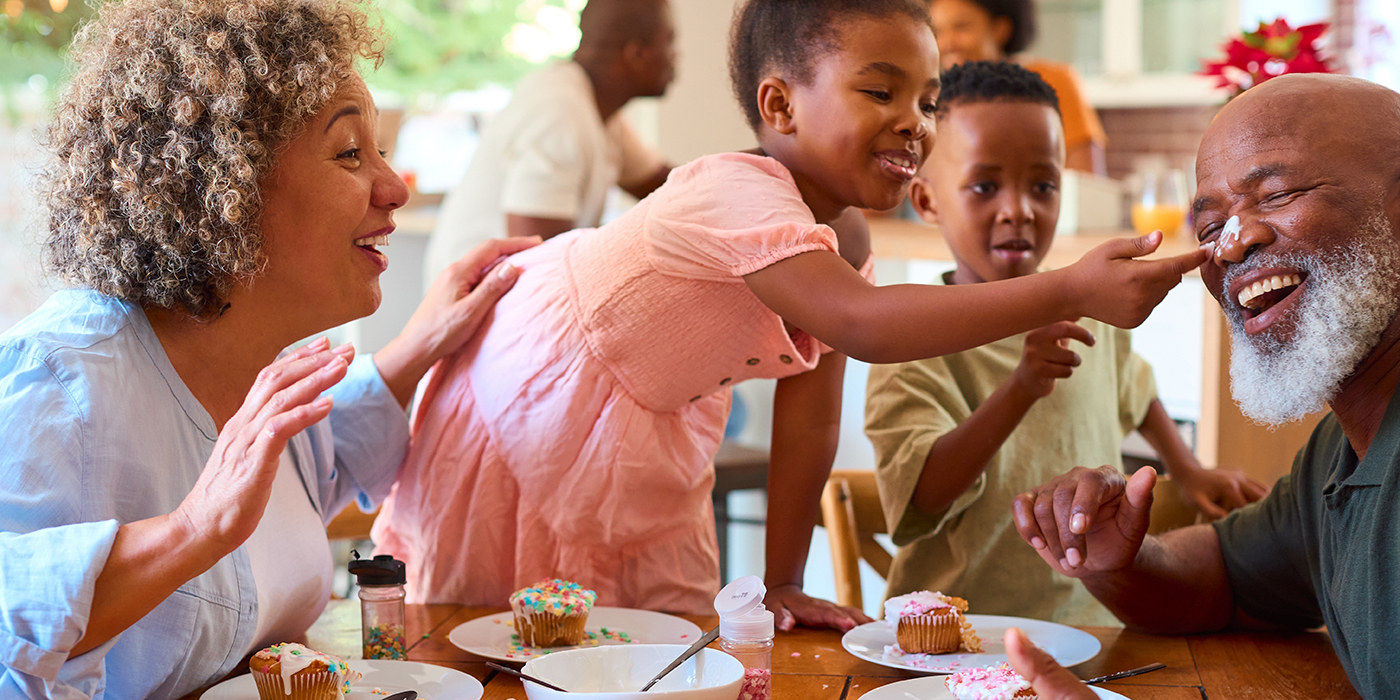
Researchers at Washington University in St. Louis are investigating the conversations that happen between grandparents and grandchildren in the St. Louis area.
The work builds off of the St. Louis Personality and Aging Network (SPAN) study, which started in 2007 with a group of about 1,600 participants in middle age and now follows 500 of them as they enter the grandparent years.
Although there’s evidence that intergenerational connections can benefit both young and elderly people, little work has been done looking at the content and quality of those connections. How do these conversations stack up in different cultures and genders, and how do they compare to previous generations? Mary Cox, a graduate student in psychological and brain sciences in Arts & Sciences, was also curious about how the vast cultural and technological changes of the 21st century factored into these conversations.
“Grandparents are more accessible (thanks to technology) even as people moved further away and generations don’t co-habitate anymore,” Cox said.
“Part of this project was to create a survey that was capturing what the grandparenting process was like,” said Patrick Hill, Cox’s adviser and a professor of psychological and brain sciences.
“Despite how important grandparenting is, this is one of the first studies to really ask what’s going on in these conversations,” Hill added.
The results, now published in the journal Research in Human Development, focused on examining the topics most frequently discussed with grandchildren and whether those main topics differed based on race (comparing Black and white grandparents) or gender (grandmothers versus grandfathers). Researchers also looked at topics associated with the grandparents’ sense of social contribution: whether they have positive feelings about the future and how they help shape the future.
The study also asked participants to contrast their conversations with grandchildren to what they talked about with their own grandparents (or if they talked at all). That’s where changing cultural and technological norms had the most notable effect. People live longer and have access to unprecedented communication technologies, so it was no surprise that researchers found this generation of grandparents are talking with grandchildren much more than previous generations.
No surprises were found with gender dynamics either: grandmothers tend to speak more with grandchildren than grandfathers, particularly on topics related to jobs, friends, social change and racism. This could be due to demographics, as women typically live longer than men, but women also tend to embrace the role of caretaker of family culture and history.
“Women are the keepers of these narratives and stories in their family,” Cox said.
The study also investigated cultural dynamics between white and Black families. Again, not surprisingly, Black participants discussed race, racism and identity more frequently than white grandparents. “The talk,” about how to survive in a world with institutional racism, is common in Black households, but not necessarily only coming from parents. Grandparents, as well as other elders in the community, play a role in passing on this knowledge and experience, according to the analysis.
But there is room for nuance here, Cox said. Just because their initial sweep of survey data shows a difference in discussions about racism doesn’t mean that white grandparents aren’t talking about social issues. They may define terms like “political” differently, and further research will sort that out.
The next step will involve digging deeper into those details and getting the grandchildren’s point of view.
“We only have one side of the story right now,” Hill said. “What we don’t know right now is how the grandchildren are thinking of these relationships.”
Cox said they want to understand how grandparents “shape younger generations’ view of the world and the way they interact with the world around them.”
Next steps will also include analyzing the directions these relationships take; do grandchildren more commonly reach out to grandparents, or vice versa? Researchers also will explore how that dynamic shapes the grandchild’s life outcomes longer term, she said.
The bottom line: there is work ahead to understand the benefits and impacts of being in community with older adults.
“The grandparenting role does seem to be salient in people’s lives, as this study is showing,” Hill said.
The research highlights the importance for both the older adult and the grandchild to invest in their well-being because the conversations benefit both parties, Cox said. All types of conversations are valuable, she stressed, even if not in person. Digital means of communication was the most common way the generations talked to each other.
“It’s just as beneficial to give older adults a call or give them a text,” Cox said.
Cox MA, Beatty-Wright JF, Wolk MW, Hill PL. Intergenerational Conversations and Social Well-Being: How Race and Gender Shape Grandparent-Grandchild Discussions. Research in Human Development. 1–15. https://doi.org/10.1080/15427609.2025.2586919
This research was supported by National Institutes of Health Grants [R01-AG045231], [R01 MH077840], and [R01-AG061162].