Despite the fact that the University had been picked to host three previous debates, Chief of University Police Don Strom did a little advance scouting when it came time to implement the security plan for this time around.
Strom and several of his security-detail colleagues headed to this campaign’s first presidential debate, at the University of Miami Sept. 30, to see how certain aspects were handled given tighter security requirements. Miami’s force numbered about 1,500 for the event.
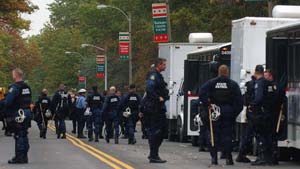
As it turns out, Strom and his colleagues were already ahead of the game.
“Miami, more than anything, validated the plan we had in place,” Strom said. “We went down there to review the techniques and strategies that they were using, particularly for the security outside of the debate venue.
“We walked away feeling confidant that we had covered all of the bases. We spent some time in the joint operations center, and we found the layout that we had developed for our operations center was probably better equipped for our needs. But we didn’t walk away slapping our heads saying, ‘Man, why didn’t we think of that?'”
There was no question — security at the 2004 debate was tighter than ever before.
With access cards featuring holograms, superimposed photos and a watermark of sorts, it was clear that counterfeiters would be hard-pressed to gain access. Access to the Athletic Complex could only be gained through metal detectors.
The perimeter around the debate site, including the parking lot in front of the Athletic Complex, was secured by a 8-foot fence and guarded by Secret Service agents and police officers.
The University security plan had been months in the making. Weekly planning sessions drew more than 100 area emergency personnel supervisors.
Factor in the number of Secret Service members in attendance, as well as members of police departments from various local districts, and the force for the Oct. 8 debate was one of the largest assembled on the University campus in a long time.
“I think we had somewhere in the neighborhood of 30 different agencies supporting us,” Strom said. “And that ranges from an agency that sent one person, to agencies that sent more than 10.
“We had the highway patrol, University City, St. Louis and Clayton police departments, and our biggest partner was the St. Louis County Police Department.”
The University has a history of working with local, state and federal law-enforcement officers, both with the previous debates and with various disaster-preparedness drills.
For the entire week of the debate, officers on bikes kept a watchful eye on the Hilltop Campus. Others were stationed at various checkpoints throughout the Hilltop.
An incident-command team, made up of police, firefighters and members of the Secret Service, used a Microsoft SharePoint-based portal modified by service provider Convergence Communications LLC.
By using the portal, 25 computers in the team’s headquarters at the Joint Operations Center in the Charles F. Knight Executive Education Center were able to send and receive information to several hundred police officers at various locations throughout the Hilltop.
This let security personnel exchange instant messages, share data and have joint access to a checklist of tasks that needed to be completed.
The system simplified the management of information flow between several different groups of people, as opposed to using the standard radios or walkie-talkies.
“We were much better prepared in 2004 than we were in 2000,” Strom said, “and that’s not to say we were unprepared then, but this time we had a much more detailed plan, also accounting for the contingencies that could surface since September 11.
“One of the things we did better was the joint operations center, which used technology that was not available in 2000 to help track the events and stay on top of anything that was happening.
“Quite frankly, and we’re not bragging, but there was really nothing that happened that we had not anticipated or felt we didn’t have a plan for, and that made us feel really good.”