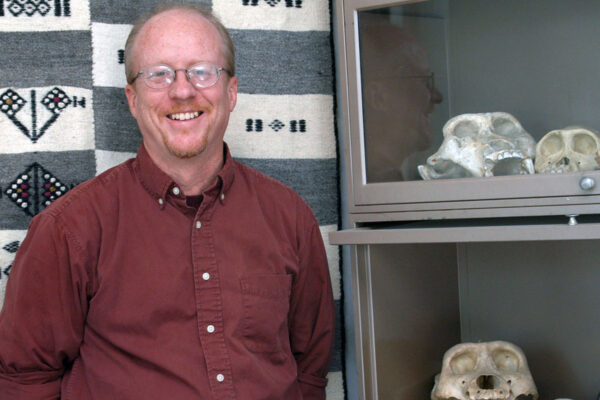
Rasmussen’s posthumous publication solves ancient monkey mystery
Nearly five years after his death, colleagues of Washington University in St. Louis anthropologist David “Tab” Rasmussen are recognizing his contributions by listing him as first author on a primate evolution paper published March 26 in the Proceedings of the National Academy of Sciences.

Washington University, St. Louis to host anthropology, human biology scientific meetings March 24-28
The importance of human milk in evolution and modern
health; biology and race in Ferguson; and the latest research on Cahokia
Mounds will be among the presentation topics as three major human
biology and anthropology professional groups converge in St. Louis for
their annual scientific meetings March 24-28.
Discovery of Neandertal trait in ancient skull raises new questions about human evolution
Re-examination of a circa 100,000-year-old archaic early human skull found 35 years ago in northern China has revealed the surprising presence of an inner-ear formation long thought to occur only in Neandertals.
Human, artificial intelligence join forces to pinpoint fossil locations
Traditionally, fossil-hunters often could only make educated guesses as to where fossils lie. The rest lay with chance. But thanks to a software model used by WUSTL professor Glenn Conroy, PhD, and researchers at Western Michigan University, fossil-hunters’ reliance on luck when finding fossils may be diminishing. Using artificial neural networks, Conroy and colleagues developed a computer model that can pinpoint productive fossil sites.
WUSTL geoarchaeologist stars in TV documentary about the Sahara
WUSTL geoarcheologist Jennifer Smith, Ph.D., is featured a History channel documentary that solves a series of geological mysteries about the Sahara’s past. The show, part of the “How the Earth Was Made” series, explains why there are marine fossils embedded in the blocks of stone from which the pyramids are made and drawings of people swimming are scratched into the walls of desert caves.
Species determination model is developed by graduate student
Stephanie Novak devised the “Archosaurian Morphospecies Concept” and presented its details at the Geological Society of America’s annual meeting.
WUSTL researchers make discoveries in first collaboration with Libyan scientists
Josh Smith in the Libyan desert.They’re back! Joshua Smith, Ph.D., assistant professor of earth and planetary sciences in Arts & Sciences, and D. Tab Rasmussen, Ph.D., professor of anthropology, both in Arts & Sciences, are stateside, teaching at Washington University after returning from what is thought to be the first-ever collaborative paleontological expedition between American and Libyan scientists. Smith and Rasmussen were in Libya for just three weeks in August of 2005. They were in the field for only 10 days, and they and their colleagues visited 13 new places that have produced Cretaceous-aged vertebrate fossils. They found fossils of sharks, bony fish, crocodiles and turtles.
Oldest cranial, dental and postcranial fossils of early Modern European humans confirmed
Where have you gone, Joe Neandertal?The human fossil evidence from the Mladec Caves in Moravia, Czech Republic, excavated more than 100 years ago, has been proven for the first time, through modern radiocarbon dating, to be the oldest cranial, dental and postcranial assemblage of early modern humans in Europe. A team of researchers from the Natural History Museum in Vienna, from the University of Vienna in Austria and from Washington University in St. Louis recently conducted the first successful direct dating of the material.
Dinosaur fossil record compiled, analyzed
A graduate student in earth and planetary sciences in Arts & Sciences at Washington University in St. Louis has combed the dinosaur fossil record from T. Rex to songbirds and has compiled the first quantitative analysis of the quality and congruence of that record.
New model for species determination presented
Image courtesy of Karin Peyer, 2001*Postosuchus*, the “alligator on stilts,’ was quite a mover in its day.How much different do the bones of similar animals have to be for the classification of a new species? That is the question that drove Stephanie Novak, a new doctoral candidate in the Department of Earth and Planetary Sciences in Arts & Sciences at Washington University in St. Louis, to develop a novel model to determine classification of a new species. Novak presented details of her model at the annual meeting of the Geological Society of America, held Nov.2-5 in Seattle.