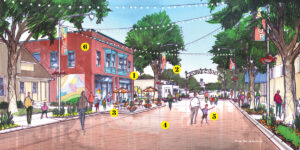
What would a truly intergenerational community look like? Three WashU scholars explain how a community can become more accessible for people of every age.
Alumna Andrea Grant remains committed to the institution that provided her with an exceptional education. She participates in events, serves in leadership roles, provides scholarships for promising A&S and law students, and much more.
Ronné P. Turner, vice provost for admissions and financial aid at Washington University in St. Louis, has been elected chair of the board of trustees of the College Board, a nonprofit organization that connects students to college success and opportunity.
In this video, artist Tim Portlock, chair of undergraduate art at the Sam Fox School, discusses his use of visual effects and 3D animation software, his new exhibition at the Contemporary Art Museum St. Louis and the state of the American dream.
Cancer cells can survive even after being hit with high doses of chemotherapy or radiation, but a School of Medicine team working to make treatment more effective is focusing on ways to tweak the inner machinery of cancer cells to make them more susceptible to dying.
Samantha A. Morris, assistant professor of developmental biology and of genetics at Washington University School of Medicine, has received the New York Stem Cell Foundation’s Robertson Stem Cell Investigator Award. The award recognizes outstanding early-career scientists and provides each $1.5 million over five years to support their research.
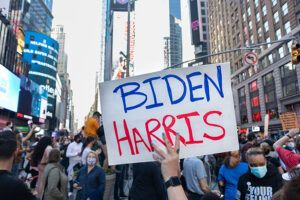
On Nov. 7, Joe Biden was declared the winner in Pennsylvania, making him president-elect of the United States. Yet it had been clear since Americans went to the polls Nov. 3 that Biden would win the popular vote. The days of uncertainty and drama were entirely due to the arcane and archaic mechanics of the Electoral College, says Rachel Brown, an assistant professor at Washington University in St. Louis.