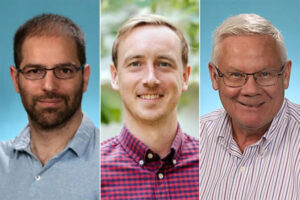
The Office of Postdoctoral Affairs presented outstanding mentor awards to Alexxai Kravitz, James Stroud and John Russell at the recent annual Postdoc Symposium.
The Sam Fox School will present its 93rd Annual Fashion Design Show April 30 in Holmes Lounge. One of the oldest such shows in the nation, the event will feature dozens of models wearing scores of outfits that explore themes of sustainability, accessibility, structure and more.
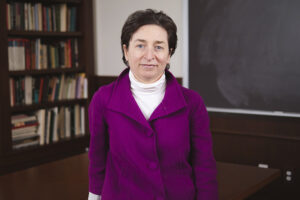
Corinna Treitel, chair and professor of history in Arts & Sciences, will co-direct an exploratory seminar at the Harvard Radcliffe Institute in June 2022. With Sari Altschuler, of Northeastern University, Treitel will guide a group of 12–15 leading scholars on a discussion about “Rethinking Health and the Humanities During and After COVID-19.”
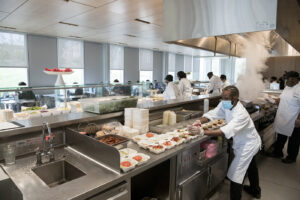
From reducing waste to cooking with local produce, Dining Services at Washington University in St. Louis is striving to make its offerings and operations more sustainable. This Earth Day, Andrew Watling, associate director of dining operations, shares five ways campus kitchens are making a difference.
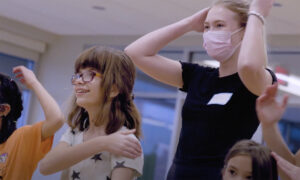
Washington University senior Addie Avery is a leader of Synapse, the student neuroscience club, which takes part in a program to help children with cerebral palsy build strength and flexibility while having fun.
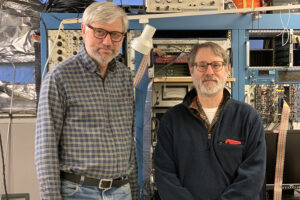
A team that includes Lee Sobotka and Robert Charity, both in Arts & Sciences, concluded that the role that neutrons play in the creation of carbon, considered the definitive building block of life, is much smaller than previously thought.
Stephen T. Oh, MD, PhD, associate professor of medicine and of pathology and immunology at the School of Medicine, received a five-year $2.46 million grant from the National Institutes of Health (NIH) for molecular hematology training.
Anika Walke and Geoff Ward, both in Arts & Sciences, won a grant from the Rubin and Gloria Feldman Family Education Institute to support their upcoming Studiolab graduate course “Memory for the Future: Theories and Practices of Critical Curation.”
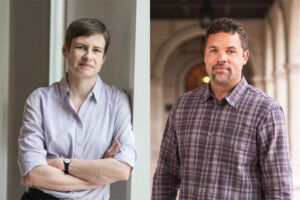
William B. McKinnon and Paul Byrne, both in Arts & Sciences at Washington University, played important roles in developing a report from the National Academies of Sciences, Engineering, and Medicine. It identifies scientific priorities and funding recommendations to maximize the advancement of planetary science in the next decade.