Alex Meshik, research professor of physics and a faculty fellow in the McDonnell Center for the Space Sciences in Arts & Sciences, won a $690,521 NASA grant.
Equalize, a mentoring program and pitch competition designed to support academic women entrepreneurs, takes place June 30. Register to attend the virtual event.
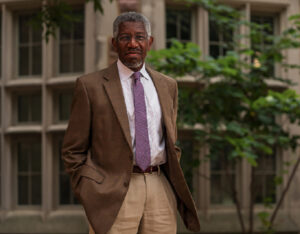
Gerald Early, the Merle King Professor of Modern Letters in Arts & Sciences, will serve as interim director of the Center for the Study of Race, Ethnicity & Equity at Washington University in St. Louis, effective July 1. Hedwig Lee and William Acree, both in Arts & Sciences, are stepping down as co-directors.
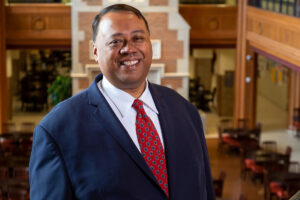
Stan Sweeney has been named executive director of campus life at Washington University following a national search, according to Anna Gonzalez, vice chancellor for student affairs. Sweeney formerly worked at Youngstown State University in Ohio.
The Organization for Human Brain Mapping has awarded its Glass Brain Award to Deanna Barch, of Arts & Sciences and the School of Medicine, in recognition of her influential work on the function of the human brain.
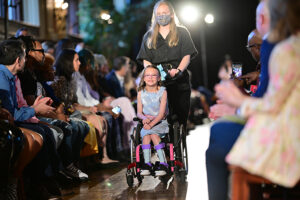
The student-run “Made to Model” initiative culminated in an unforgettable night for 15 St. Louis area kids with functional needs at the 93rd Annual Fashion Design Show in Holmes Lounge.
In the course ‘The Good Life Between Religion and Politics,’ students learn the importance of asking questions about what constitutes a well-lived life.
Researchers working with Jonathan Barnes, assistant professor of chemistry in Arts & Sciences, published new research showing how molecules with interlocking ring architectures can be functionalized and incorporated into three-dimensional polymer networks and materials.
A community-based rehabilitation program may be an effective way to provide services to people with disabilities even in places with conflict such as Afghanistan, finds a new study from the Brown School and the School of Medicine at Washington University.