Washington University in St. Louis Chancellor Mark S. Wrighton will speak in Denver June 13 about the critical role research universities play in creating positive economic growth. “Innovation and Entrepreneurship: How Research Universities FosterEconomic Development” is free and open to the public. The talk will take place at 8 a.m. Thursday, June 13, at the […]
Jeffrey I. Gordon, whose groundbreaking research has linked the trillions of microbes living in the gut to obesity and severe childhood malnutrition, will receive the 2013 Robert Koch Award, the leading international prize in microbiology.
Jeanne M. Nerbonne, PhD, the Alumni Endowed Professor of Molecular Biology and Pharmacology, has been named director of the Center for Cardiovascular Research.
Where a child lives makes a difference in how demographics and other factors influence algebra performance, and policies should take into account local variation, research from Washington University in St. Louis suggests. Here, a map illustrates the relationship between the percentage of students eligible for free or reduced-price lunches and Algebra I scores in Missouri school districts.
Senior Adam Putterman captured the 2013 NCAA Division III Singles National Championship with a 6-3, 6-1 victory over Mark Kahan of Amherst College May 25 at Stowe Stadium in Kalamazoo, Mich. The singles national championship is the second in school history.
For many older adults, the aging process seems to go hand-in-hand with an annoying increase in clumsiness. New research from Washington University in St. Louis suggests some of these reaching-and-grabbing difficulties may be caused by changes in the mental frame of reference that older adults use to visualize nearby objects.
Biomedical sensors using metal nanoparticles hold great promise for the early detection of disease. But the current class of sensors has little or no shelf life, and creating and using them is expensive. Srikanth Singamaneni, PhD, assistant professor of materials science in the School of Engineering & Applied Science, plans to develop a low-cost biosensor that is more stable, sensitive and specific with funds from a Faculty Early Career Development (CAREER) Award he has received from the National Science Foundation.
Thomas B. Ferguson, MD, professor emeritus of cardiothoracic surgery at Washington University School of Medicine in St. Louis, died Sunday, May 26, 2013, of complications following a heart valve procedure. He was 90.
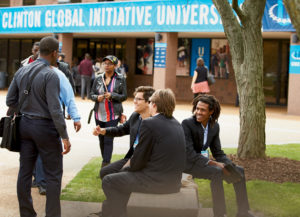
Clinton Global Initiative University students gathered at Washington University April 5–7 to fine-tune their plans for tackling some of society’s most urgent challenges.