It was bedlam at mission control when the first images of Pluto came down over the Deep Space Network. Not only were there few craters, but some areas of the planet were smooth as a billiard ball and others rumpled and rippled; some stained the color of dried blood and others gleaming bright white. The variety meant that there was geology on Pluto, alien though the
geological processes might be to earthlings.
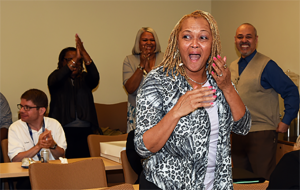
Each year, Larry J. Shapiro, MD, dean of the School of Medicine surprises employees with the highest accolades given to staff: the dean’s service awards. The top honor, the Dean’s Distinguished Service Award, this year went to Shirley R. Vaughn, of the Department of Anesthesiology. She is pictured with the dean.
Kenneth M. Ludmerer, MD, the Mabel Dorn Reeder Distinguished Professor of the History of Medicine, recently received the 2015 Distinguished Medical Alumnus Award from The Johns Hopkins University School of Medicine.
A new exhibit in the Bernard Becker Medical Library
celebrates the centennial anniversary of Washington University School of
Medicine’s three original campus buildings on what was once considered
the “new” Forest Park campus.
Paige McGinley, assistant professor of performing arts in Arts & Sciences at Washington University in St. Louis, received the American Theatre and Drama Society’s 2014 John W. Frick Award for the best book in American theater and drama for her book, “Staging the Blues: From Tent Shows to Tourism.”
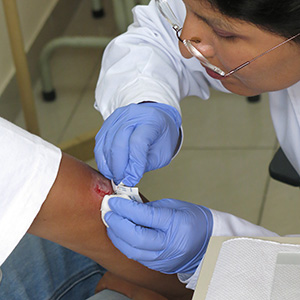
Two new studies explain why some parasite
infections, such as those common in developing countries, sometimes
can’t be cured with standard treatments. The research shows the parasite Leishmania — which infects 12 million
people worldwide — often harbors a virus that helps the parasite
survive treatments.
Washington University in St. Louis student Beakal M. Gezahegn has been named a 2015 STRIDE Undergraduate Research Fellow by the American Physiological Society.
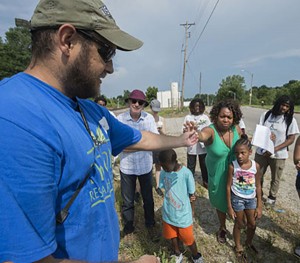
Victims of chronic flooding, dozens of homes in Baden neighborhood will be demolished this summer. But a team of Washington University in St. Louis researchers, together with the City of St. Louis, the Missouri Botanical Garden and the Missouri Department of Conservation, are determined to help the community create something better in the neighborhood.
The Lifelong Learning Institute of Washington University in St. Louis is celebrating in 2015 its 20th anniversary of educating adults age 55 or older. Since its founding, the program has served some 2,000 students from across the region and has offered hundreds of courses, all taught by fellow students or, in institute lingo, “facilitators.”