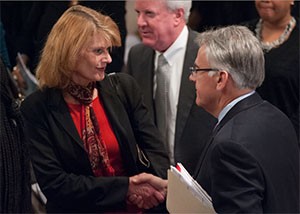
On Aug. 5, Mahendra R. Gupta, PhD, dean and the Geraldine J. and Robert L. Virgil Professor of Accounting and Management at Olin Business School at Washington University in St. Louis, attended a convening at the White House hosted by the White House Council on Women and Girls and the Council of Economic Advisers. Mark Brostoff, associate dean and director of Olin’s Weston Career Center, also attended.
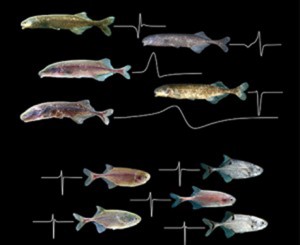
African fish called mormyrids communicate by means of electric signals. Fish in one group can glean detailed information from a signal’s waveform, but fish in another group are insensitive to waveform variations. Research at Washington University in St. Louis has uncovered the neurological basis for this difference in perception.
Annelise Finegan Wasmoen, a PhD candidate in comparative literature in Arts & Sciences at Washington University in St. Louis, won the 2015 Best Translated Book Award for fiction for her translation of Can Xue’s “The Last Lover” (Yale University Press, 2014) from Chinese to English.
Diversity and inclusion training is now available to staff and faculty on the Danforth Campus as well as the Medical Campus. The medical school’s diversity and inclusion team offers four levels of training, with each level lasting one hour.
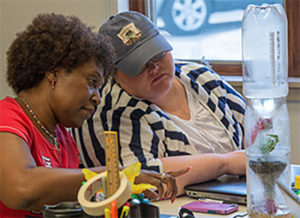
The Institute for School Partnership (ISP) is partnering once again with the Monsanto Fund to bring high quality science education to students in St. Louis through its MySci program. This month, the Monsanto Fund awarded ISP with a $1,935,000 grant to create, over the course of a three-year grant period, a hands-on, inquiry and project-based science curriculum for middle school students that integrates elements of science, technology, engineering and mathematics (STEM).
During a retreat this summer on the Medical Campus, department heads, division directors and other senior leaders at Washington University School of Medicine explored unconscious bias and how to diminish its impact in medical environments.
As a member of the Ferguson Commission, Rose Windmiller traveled across the region to learn more about the issues that divide St. Louis. Next, the commission will find ways to put its ideas into action. “This is where the rubber hits the road,” Windmiller says.
The city is filled with stories and tells stories of its own. Last fall, the Center for the Humanities and the Sam Fox School — with support from the Andrew W. Mellon Foundation — launched The Divided City, an urban humanities initiative exploring historical and contemporary segregation across the globe and in St. Louis. Funded projects include an oral history of the Ferguson movement, launched this summer by Jeffrey McCune, PhD, Clarissa Rile Hayward, PhD, and Meredith Evans, PhD.
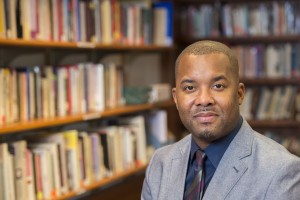
Two Washington University seniors and one 2015 alum (David Dwight, pictured) are assisting the Ferguson Commission to create and write its recommendations to improve education, municipal courts and governments, economic opportunities and the relationship between residents and law enforcement.