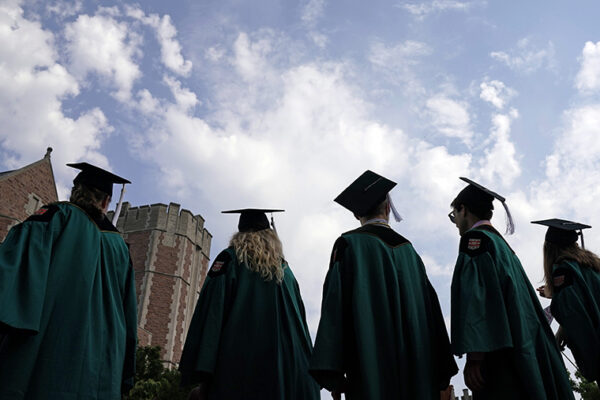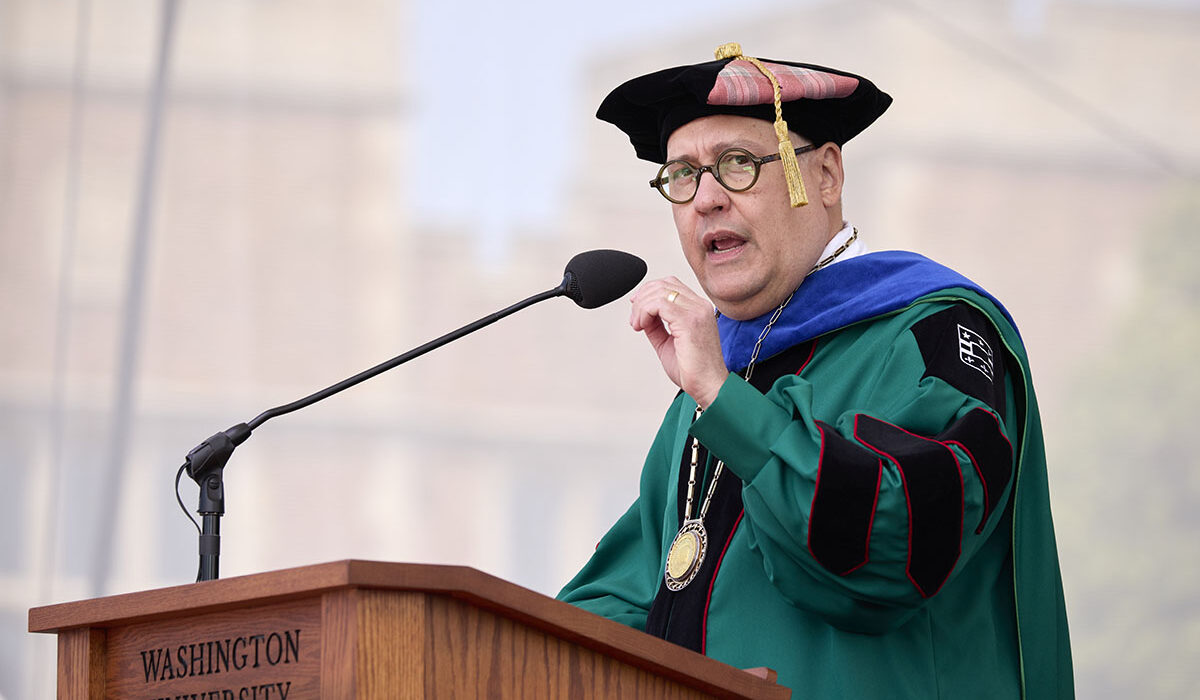
Chancellor Andrew D. Martin delivered his message to the Class of 2026 at Washington University in St. Louis during the May 15 Commencement ceremony on Francis Olympic Field.
Below are Martin’s prepared remarks to the graduates.
Good morning and welcome to Washington University in St. Louis. To the families and friends here today, and to those watching from afar, thank you. These graduates did not arrive at this moment on their own. Behind every one of them are people who showed up for them, believed in them, and carried what needed to be carried in order for them to shine. We are grateful for your support, and we’re happy you’re here.
I’m especially glad that we’re joined today by members of the WashU Class of 1976, who are with us in honor of their 50th reunion. While much has changed on campus since then, I believe the emotions of the day remain much the same: pride, relief, gratitude, and a heaping dose of excitement for what lies ahead. Our Class of 1976 can attest, I am sure, that the years ahead will be full of adventure, challenges, and joy yet unimagined. We’re glad to have them back among us today.
But, to the Class of 2026, this is your day. You’ve done remarkable work to be here. You’ve excelled academically, formed friendships that will last a lifetime, and have made our community better simply by being here. We are so proud of you.
Before we go further, I want to pause for a moment with you in remembrance of your classmate, Ella Elizabeth Johnson, who passed away in January. Ella’s parents are here today to celebrate her academic and artistic achievements among those who knew and loved her. Ella was an incredible young woman who lived a life of intellectual curiosity, kindness, service and a deep love for her family and friends. Please join me in a moment of silence as we remember Ella.
Thank you.
Today, graduates, you will join the WashU alumni who came before you — doctors, teachers, scientists, public servants, builders and artists of every kind — who’ve traveled these campus paths, who are making their mark on the world and who are now waiting to welcome you. I trust you’ll go out and show them what the Class of 2026 can do.
Here today to provide additional words of welcome, I now want to welcome the chair of the Washington University Board of Trustees, Andrew Bursky.
In my final act of academic leadership for the Class of 2026, I’m going to give you a pop quiz. I’m going to name three things, and I want you to tell me what they have in common.
First: Harry Potter and the Sorcerer’s Stone.
Next: Germ theory.
Finally: Post-it notes.
Harry Potter. Germ theory. Post-it notes. What do they have in common? All three of these things we take for granted as inevitable, but all three of them almost didn’t exist. Harry Potter was rejected by 12 publishers. The Post-it note sat in a drawer at 3M for years until someone came looking for a bookmark for their hymnal. And Ignaz Semmelweis was literally institutionalized for suggesting that doctors should wash their hands before delivering babies. But today, it’s hard to imagine life without these things.
I want to tell you about one more thing that almost didn’t exist. Unlike Harry Potter, this one doesn’t have a movie franchise. Unlike the Post-it note, you can’t buy it at Walgreens. But you likely used it this morning. It’s something so woven into the fabric of this country that it’s easy to forget that it had to be fought for, argued over and nearly abandoned altogether, and that is the Bill of Rights, including the First Amendment to the United States Constitution.
In just a few short weeks — on July 4, to be exact — America will celebrate the 250th anniversary of its founding. Some of you took Professor Van Engen’s class called “1776, Then and Now” this semester, where you learned about how the United States came to be, and what that origin story means for us today. I gave a guest lecture for that class, and although I’m not going to lecture today, I do want to tell you about one aspect of America’s founding you might not already know: that the Bill of Rights we often take for granted was a near miss and why that story is still relevant for the Class of 2026.
The story starts in Philadelphia in 1787. Founding father George Mason, in the final days of the Constitutional Convention, moved to add a bill of rights to the newly written and already-signed Constitution. But it was late summer and they had been working for four months in wool suits, with no air conditioning and the windows nailed shut. Everyone was sweaty and cranky and badly in need of an “everything shower.” The motion was voted down unanimously, they were dismissed and the Constitution went to the states for debate, and eventually, ratification.
During those debates, the bill of rights was a hot topic, on convention floors but also in public essays and private letters. Alexander Hamilton argued against it, and he made a very coherent and clever argument that if you list the rights that the government can’t touch, you imply that the government controls everything else. James Madison agreed with Hamilton at first. But Thomas Jefferson, in private letters sent to Madison from Paris, argued back. In letter after letter, he insisted that “a bill of rights is what the people are entitled to against every government on earth.” And Jefferson was not alone. Other people who Madison trusted also felt strongly that individual liberties were so important that they required clearly articulated protections.
You know what Madison did then? Well, I’ll tell you what he didn’t do. He didn’t deliver a rant on “Meet the Press.” He didn’t insult Jefferson’s intelligence, and he didn’t block him and those who agreed with him on social media. Nope. He listened. He realized that digging in his heels in opposition to a bill of rights could undermine support for the Constitution overall. Not only that, he was convinced. Even though he had been very publicly sure of his position, he was able and willing to change his mind.
And, two years after delegate James Madison opposed a list of rights at the Constitutional Convention, Congressman James Madison became a leading figure in amending the Constitution he had worked so hard to create.
There’s an important lesson in this story and it’s as relevant today as it’s ever been. The founders didn’t agree. In fact, they disagreed fiercely, publicly and oftentimes bitterly. But they didn’t treat their disagreement as a problem to solve, but rather, as a method to arrive at a solution.
In the new nation, Jefferson and Madison changed history through letters, through arguments backed by reason and evidence. Not force, or threats, or insults. Through a willingness to engage and the strength of their convictions. The humility to listen, and ultimately, to be wrong. Through the power of their voices. And in doing so, they also gave that power to you and me. They protected it and passed it on in the Bill of Rights.
It’s common for Commencement speakers to encourage graduates to go out and change the world. If you’re going to do that, Class of 2026 — and I do believe you will — you’ll need to use your voice responsibly. And what does that mean?
Well, you’ll have to decide what’s worth speaking up for. For the founders, that was life, liberty, equality, the pursuit of happiness and, fundamentally, the right for people to assemble and speak up for those ideals.
Now, it’s worth saying plainly that these principles didn’t apply to everyone at that time. But they wrote it down and each generation since has a duty — and must make the effort — to ensure we get closer and closer to that promise.
My point is: they knew what they were working toward. And that clarity of purpose is what made the argument productive. Without it, debate is just conflict. With it, debate is how you build something. So before you go out and change the world, I’d ask you to spend some time on a harder question than anything I put on today’s quiz: What are you working toward? What is your purpose?
At WashU, this is a question we now ask every incoming first-year student. It’s a question we provide opportunities to reflect on through your college experience. And it’s a question we want you to return to as you leave us for the world ahead. What is the purpose that drives you?
As you leave here and pursue your unique path, you’ll start to solidify your own foundational principles. Instead of pop quizzes, like the one I gave you today, you’ll be answering questions like: Who are you responsible for besides yourself? What are you willing to do to get ahead? What are you willing to sacrifice for the greater good? And what do you know to be true that you haven’t yet found the courage to speak about?
The First Amendment was specifically written to protect and advance the human conscience — the freedom not just to speak, but to think, to draw your own conclusions rather than having them handed to you. In today’s world and the one that will be shaped and reshaped by technology and other powerful forces in the years ahead — that is more in need of protection than it ever has been.
The same intellectual honesty and courage that saved the Bill of Rights is what will serve you as you set out to contribute your gifts to the world. Sometimes you’ll show strength by standing firm, like Jefferson did. Other times, your most powerful move is to change course, as Madison did.
When you’re watching fireworks on the Fourth of July, I hope you’ll think about this story and your part in it. We have yet to reach the ideals that inspired our founders, that is true. But we enjoy an enviable amount of freedom today because they were willing to engage, argue, compromise, change their minds and work together for solutions, refusing to ever give up on the hope they shared. They had the courage of their convictions to keep them going.
Jefferson wrote that the human mind is created free. Not the American mind. The human mind. The founders built a country around that idea — imperfectly, incompletely, and still in progress. But the idea itself belongs to everyone here. Class of 2026, I hope you honor it, defend it and advance it on whatever path you take from here.
Graduates, we wish you great success and fulfillment and joy. We are proud of you. And we hope you’ll come back and visit us often. Congratulations, Class of 2026. You made it!