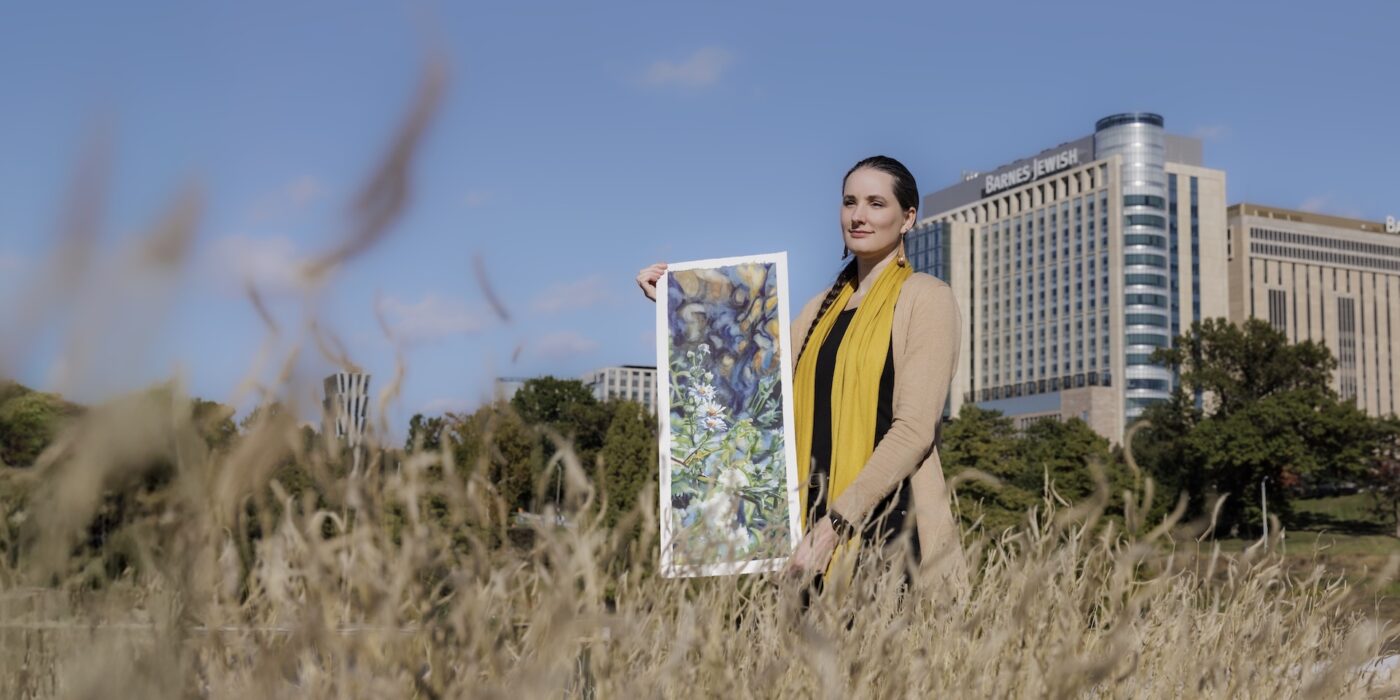
The new Plaza West Tower at Barnes-Jewish Hospital — a collaboration with WashU Medicine — represents a step forward in connecting the St. Louis region with world-class cardiovascular care. And when St. Louis artist Erin Blumer, BFA ’10, was commissioned to enhance the tower’s patient experience through her paintings, it was a dream opportunity — the ideal intersection of her talents, experience and vision.
The tower’s interior design was to be based on botanical imagery related to St. Louis habitats, created by St. Louis-based artists. Blumer’s challenge was to produce artworks for patient rooms across 12 of the tower’s 16 floors, bringing a more natural, more human element to the hospital space. In meeting this challenge, she tapped into two of her greatest passions: illustration and gardening.
A passion for illustration and affinity for nature
Blumer, who works for a marketing agency by day, has been drawing and sketching in her free time “since I could hold a pencil,” she says. During her first year at WashU’s Sam Fox School of Design & Visual Arts, Blumer was profoundly influenced by the teaching of Mary Borgman, BFA ’82, whose charcoal portraiture has been featured in the Smithsonian’s National Gallery.
Borgman emphasized the foundational importance of integrating observation into expression, something that remains essential to Blumer’s artistry today. “It’s about looking, making it accurate, but also making it yours,” says Blumer, who balances realism and abstraction in her own work.
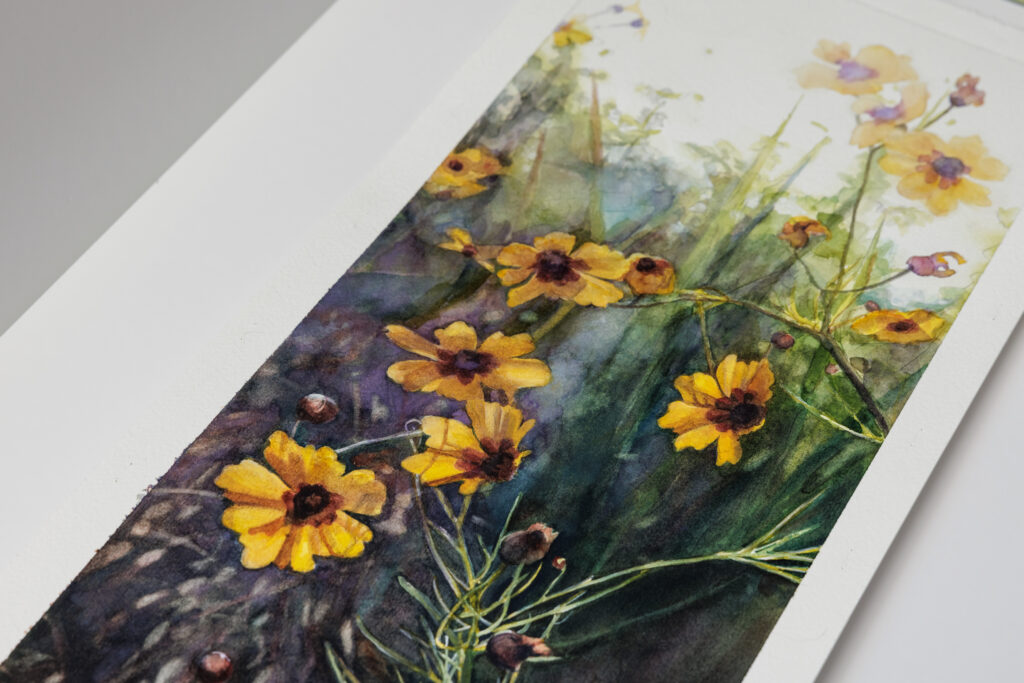
Blumer’s modes of expression include oil painting, graphic design, sketching and photography, but her chosen medium remains watercolor. “It’s practical because you can take it anywhere — a travel palette, brush, water, some paper, and I’m good,” she says. “And it’s fun because it forces you to relinquish some control. Watercolor has a mind of its own.
“Over time, you learn how things respond, and you use that to build things the way you want. But there’s always something unexpected to deal with — like every time, without fail — and that’s exciting for me.”
Blumer’s love of nature, and more specifically, of plants and gardening, added another spark to the art she created for Plaza West Tower. Gardening, she says, serves as a source of both food and inspiration. “Paying attention to shifts in temperature and light levels and how a plant responds to day length — you don’t think about these things unless you are actively observing a plant’s signals, essentially speaking its language,” she says.
She is also fascinated by biophilic design, an architectural and design concept based on the principle that humans respond positively to natural environments. For example, when a room has a larger window offering a treelined view and more natural light, or when plants (actual ones or representations) are incorporated into interior spaces, people can experience significant health benefits. The philosophy of biophilic design, part of the growing body of research on how the arts can influence health and community well-being, became recurringly apparent throughout Blumer’s commission.
A vision realized
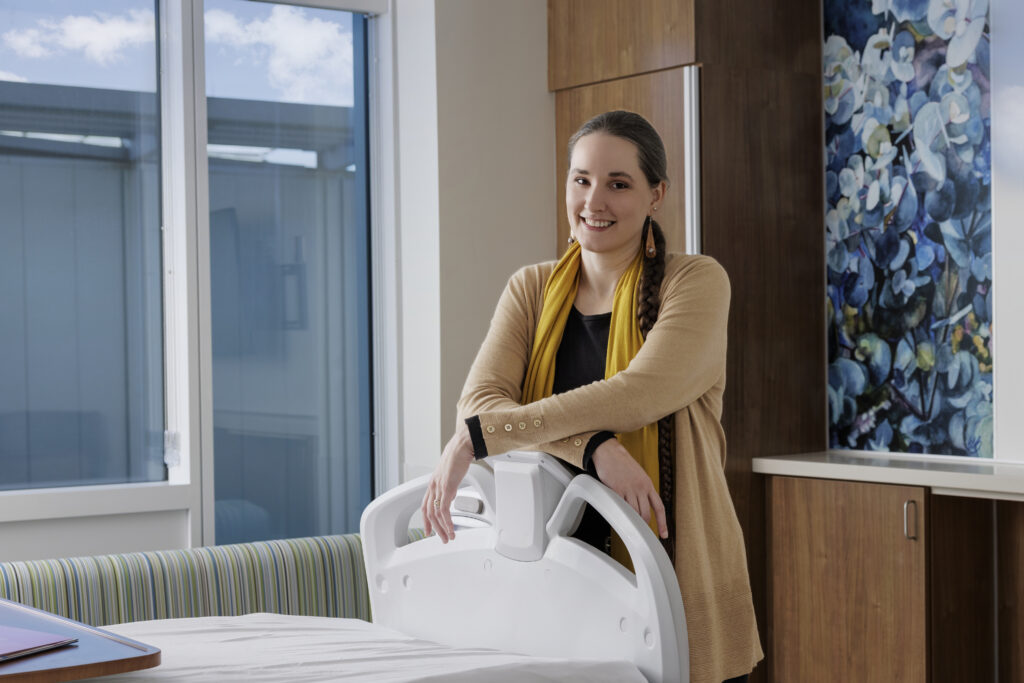
In October 2025, Plaza West Tower opened to patients. Its interior, centered on the botanical concept “A Journey Through Neighboring Gardens,” functions as a vibrant reflection of the region’s flora. “The whole idea, not just the part I was working on,” Blumer says, “was that every single piece was an original work by a St. Louis artist. That’s just a great commitment to the community.”
For her part, Blumer created 34 watercolor paintings, prints of which now appear in over 200 patient rooms. For the second, third and fifth floors, her focus was on Forest Park, acclimating patients and families to the beauty of their immediate surroundings. (Forest Park is literally across the street, overlooked by the tower’s west-facing windows). The park’s Klein Prairie and Hidden Creek Savanna areas were highlighted through their flowers — the native aster, foxglove beardtongue and woodland phlox, among others.
For the sixth floor and above, Blumer focused on the Missouri Botanical Garden, including flowers from its iris garden and native shade garden, as well as the Shaw Nature Reserve. “It was really special to me to bring the green spaces around the city into that hospital space.”
To create the paintings, Blumer first captured photographs that would guide her compositions. The process went well beyond a simple photo shoot. “It’s not just any flower in any place. It’s very specifically these flowers in this specific location at this specific time of year,” she says. Because the plants have varying peak seasons, she returned to each area repeatedly to photograph and observe, ensuring her art was firmly grounded in each locale.
“… as patients deal with life-threatening situations, anything we can do to improve their environment is beneficial. It lets them know that people in the building care.”
Erin Blumer, BFA ’10,
Blumer appreciates the artistic control she was afforded with the Plaza West Tower commission. “I could use certain paints, palettes and watercolor effects I found compelling while still meeting the project requirements,” she says. “For example, I would work in granulating pigments for certain realistic details but also have places where the background kind of fuzzes out into abstraction.”
Ultimately, the most rewarding aspect for Blumer was knowing she played some role in the tower’s patient experience. “Historically, hospitals have been very sterile,” she says. “It’s all equipment, and white everywhere.” Recalling up her own experience with hospitals, she says, “it can be depressing, honestly, and not just for the patients.
“But when you have something beautiful in the room, you’re in a better mood,” she says. “It offers that soothing aspect of nature and connects you to the local environment.
“And as patients deal with life-threatening situations, anything we can do to improve their environment is beneficial. It lets them know that people in the building care,” she says. “When people feel better about the space they’re in, that translates to a better healing process.”