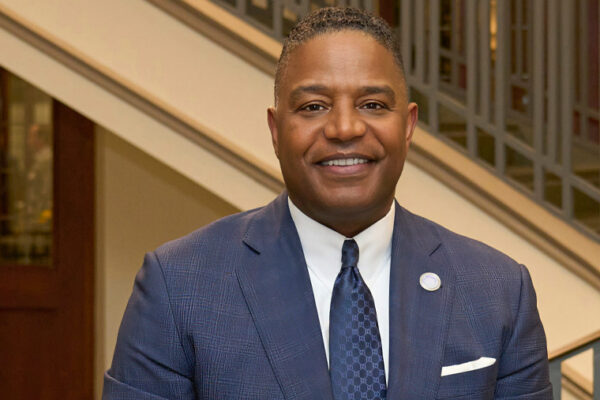
Bill Siedhoff, AB ’68, MSW ’74, can pinpoint moments in his life that led to a lifetime of public service. Like that 1950s-era family vacation from St. Louis to Florida, when the family stopped in Chattanooga, Tennessee, and he saw for the first time separate drinking fountains for whites and “colored.” Or those times as an 8-year-old when he tagged along with his parents to underserved neighborhoods of north St. Louis, working with a volunteer film association that provided first-run films and fellowship. Or the Brown School semester when he picked up a caseload that involved home visits in the waning years of St. Louis’ Pruitt-Igoe housing complex.
For a middle-class kid who grew up in the south St. Louis neighborhood of Holly Hills, Siedhoff says these experiences made him realize not only how fortunate his upbringing was, but also how important it is to level the playing field. “I think I’ve always been sensitive to the idea that everyone is equal,” says Siedhoff, who has been “retired” for over a decade from a lifetime career of public service.
Siedhoff’s career didn’t begin in the public sector. His first job out of college was as a management trainee with a life insurance company in Memphis, where he says he learned he didn’t want a life in insurance. He returned to WashU to attend the Brown School, earning his master’s degree while working as a social worker with the St. Louis office of the Missouri Division of Family Services.
Siedhoff worked some five decades in the public sector, including serving as director of two statewide agencies under Gov. John Ashcroft: the Missouri Division of Family Services (DFS) and the Missouri Division of Motor Vehicles (DVM). As DFS director, he was responsible for over 6,000 state employees involved in child abuse/neglect protective services, as well as the administration of public assistance programs such as Medicaid and food stamps for more than 1 million residents.
Siedhoff’s career reached a peak in 2001, when then-Mayor Francis Slay appointed him director of the Department of Human Services for the City of St. Louis. For 14 years, Siedhoff was on the front lines — and sometimes the front page — helping advocate for the unhoused, the disabled, seniors, children, families and veterans. He received national and local awards for his efforts and was given a symbolic key to the city when he retired.
Now, at 84, he’s busier than ever. “I have to be engaged,” he says. Even before this interview started, Siedhoff began talking about his role with a fundraiser for the Saint Louis Crisis Nursery. He holds leadership positions as chairman of the board of the St. Louis City Senior Fund and as vice chair for Developmental Disability Resources. He is also hands-on with his own William F. Siedhoff Foundation.
“You have to cross the aisle. Without that, you get nowhere.”
Bill Siedhoff
For Siedhoff, who remembers having difficulty making the transition from the Saint Louis Public School system to WashU, leveling the playing field begins with education. “That’s why I’m so focused on helping nonprofits develop programming for children,” he says. “My foundation is devoted to kids and families in St. Louis.”
Siedhoff continues to have an impact on the city and state he loves and offers a blueprint on how to serve, especially in these times of political uncertainty. “You have to cross the aisle,” he says. “Without that, you get nowhere.”

“My foundation is devoted to kids and families in St. Louis.”