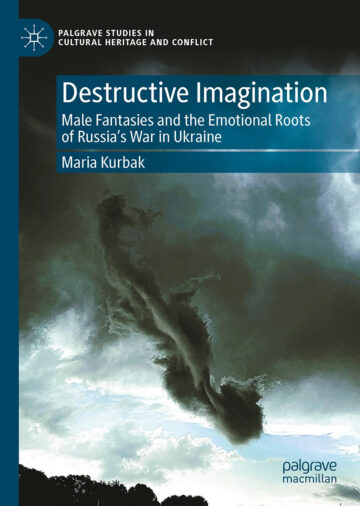
Russian soldiers did not go to war with only guns and orders—they went with fantasies that made killing feel meaningful.

Drawing on diaries, social media posts, memoirs, poems, and battlefield songs, Maria Kurbak reconstructs the war from below. She shows how Russian combatants turn old wounds—NATO’s bombing of Yugoslavia, the collapse of the USSR, personal shame, and perceived national betrayal—into narratives that make violence feel purposeful and necessary. These fantasies echo official slogans but also exceed them, binding private grievances to collective myths and turning imagined injuries into real acts of brutality.
The book moves backward through time: from the full-scale invasion, to the myths of “Novorossiya” in Donbas, to deeper crises of masculinity and memory carried from the late Soviet decades. Across this arc, Destructive Imagination demonstrates that fantasies do not distort war; they design it. The result is a new framework for understanding Russia’s invasion of Ukraine—one that brings into view the emotional and symbolic worlds that structure political behavior and make violence imaginable long before it becomes real.
About the author
Maria Kurbak is a postdoctoral associate in global studies at Washington University in St. Louis. She received her doctorate from the Institute of World History, Russian Academy of Sciences. From 2013 to 2022, she served as a senior fellow at the Institute of World History and as a lecturer at the National Research University–Higher School of Economics in Moscow. Her work focuses on national narratives, memory, masculinity, and the cultural roots of political violence in Russia.