The long view promises clarity.
From 50,000 feet, there’s no getting lost in the weeds. In our age of drone-, satellite- and AI-powered-imagery, the long view is confident and ubiquitous. It is untroubled by ambivalence or doubt.
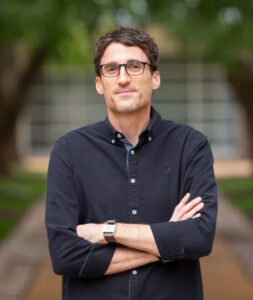
So argues Edward McPherson, an associate professor of English in Arts & Sciences at Washington University in St. Louis. In “Look Out: The Delight and Danger of Taking the Long View” (Astra House, 2025), McPherson examines the human desire for “big picture” or “bird’s eye” perspectives — and how such perspectives cultivate both awe and arrogance.
“Politicians and planners confront the challenges of today with lofty intelligence, always pointing to the forest, not the trees,” McPherson writes. “We trace people, viruses, crimes. We tear down a neighborhood and put up a spy agency. We tell stories about the past while we remake our city with an eye toward the future. We invent more ways to watch over ourselves. We pretend to know where we’re going.
“We have the view of gods.”
‘Higher and higher’
McPherson roots his analysis in St. Louis. Cahokian mounds once stretched to the sky. A 19th century map, 25 feet wide, traces every city block. Local powers back former airmail pilot and future isolationist Charles Lindbergh. For a time, St. Louis is the center of American aviation.
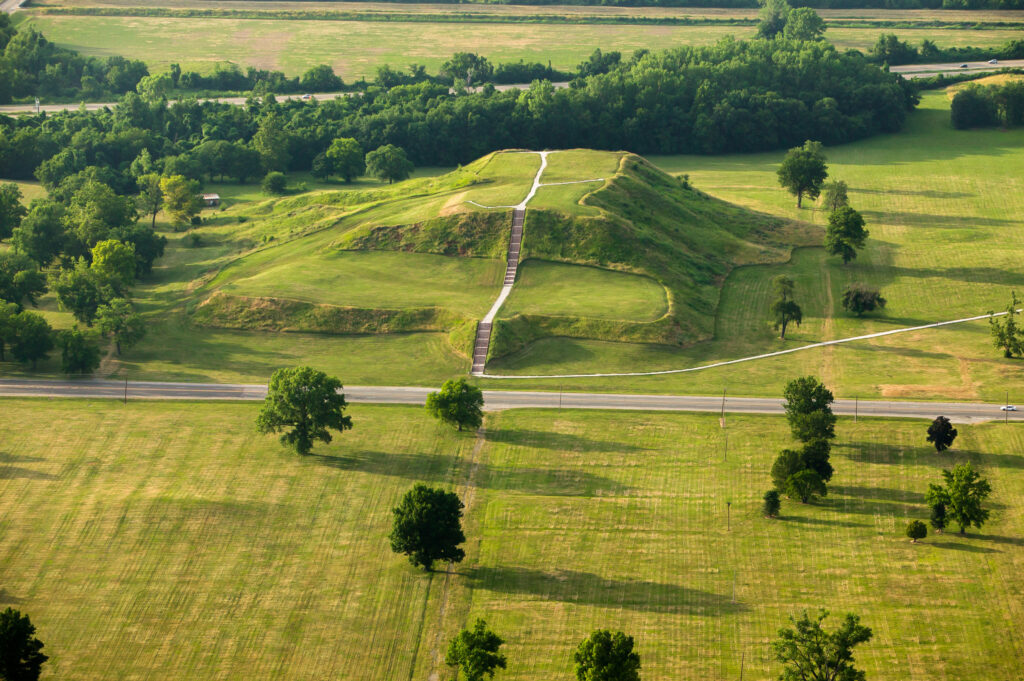
“The long view wants to fly higher and higher, to forget what it’s like to be on the ground,” McPherson writes. “It wants to forget us, to erase as much as it reveals.”
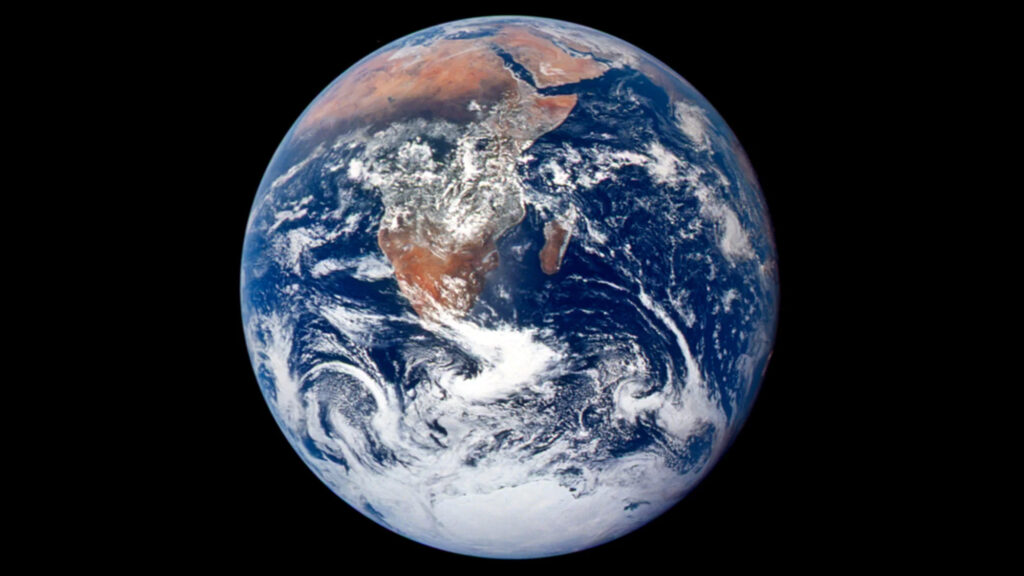
The heights can be humbling. McPherson describes NASA image AS17-148-22727, better known as the “Blue Marble.” Shot in 1972 by Apollo 17 astronaut Harrison H. Schmitt, this justly iconic photograph — among the most reproduced in history — shows a planet bathed in sunlight, aswirl with clouds, sands and oceans.
“Research suggests that cultivating a sense of awe can make us more humble, healthy, happy, and generous,” McPherson writes. “Our thinking sharpens. We become less materialistic, more likely to cooperate, sacrifice, and share. We care more deeply about others. Our wounds begin to heal.”
At least in theory. McPherson describes another NASA photo, “Pale Blue Dot,” taken by Voyager 1 in 1990. From 4 billion miles away, Earth, home to every human who ever lived, seems achingly insignificant.
“There’s no way you’d see us — just a single pixel — if you didn’t know where to look,” McPherson muses. “Lost. Puny. Meaningless. If I stare too long, the bottom drops out.
“Existential vertigo.”
Power moves
The big picture can reveal patterns. It also can be a tool of power. Who decides where to look?
The National Geospatial-Intelligence Agency (NGA) provides U.S. policymakers and defense agencies with mapping, intelligence and combat support. How much can it see? “While the exact specs remain secret, a comparison is often made,” McPherson writes. “Imagine the Hubble Telescope pointed at the ground.” Indeed, in 2012, NASA received two retired reconnaissance satellites. Both proved more powerful than Hubble.
The NGA typically keeps a low profile. In 2009, a recently elected Barack Obama, chatting for news cameras with NGA employees at a burger joint in southeast Washington, D.C., appeared unfamiliar with the group’s mission. (Two years later, Obama would rely on NGA analyses to order the raid that killed Osama bin Laden.)
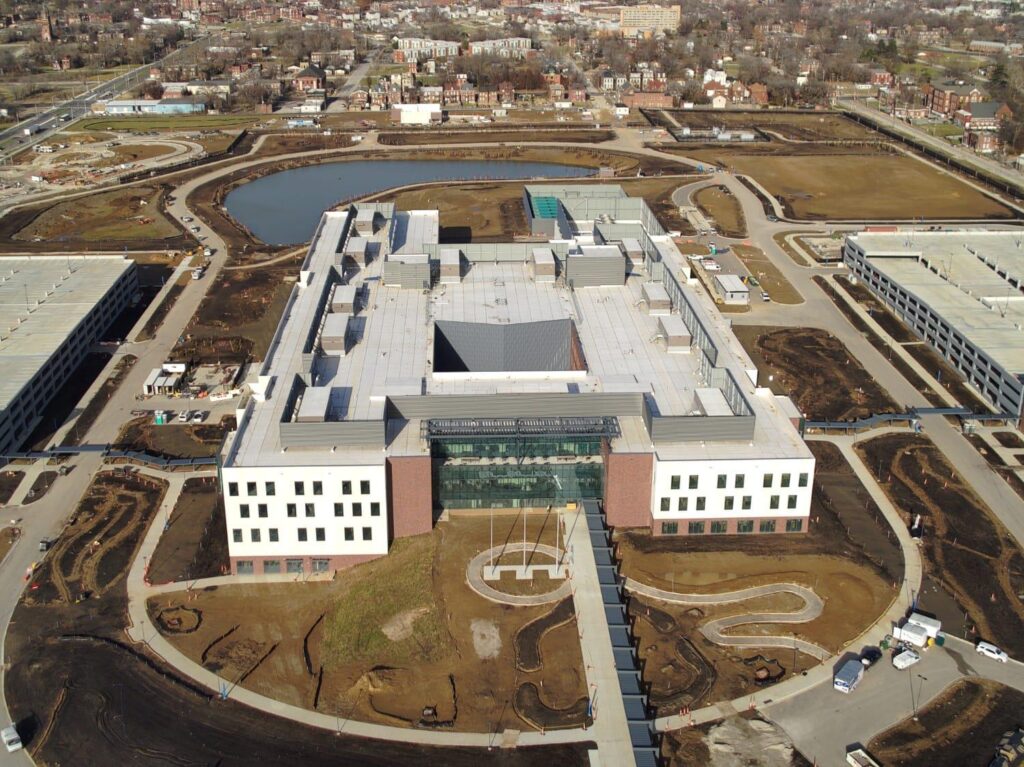
But in St. Louis, geospatial intelligence is a multibillion-dollar industry employing 11,000 people. NGA St. Louis, a new $1.7 billion campus on the near northside, sits atop 27 city blocks and over the objections of many former residents. Once again, St. Louis is nationally expert on the view from above. “Our faith in the big picture endures,” writes McPherson.

Endures and prospers. McPherson addresses the rise of drone surveillance, location tracking, facial recognition and, amidst the COVID-19 pandemic, remote learning, among other topics. Each technology creates vast new datasets to be surveyed, harvested, processed and sold to advertisers.
Increasingly, that data is coupled with artificial intelligence. The results can be incisive. Sometimes they’re grotesque. A Detroit woman, identified by facial recognition software, was booked for robbery despite being, unlike the suspect, visibly pregnant. A Baltimore man was jailed for assaulting a bus driver despite being 20 years older and seven inches shorter than the real culprit.
Comically, when the ACLU ran photos of members of Congress through a facial recognition tool, 28 were flagged for matching a criminal arrest photo. “Insert your own joke here,” McPherson deadpans.
“But seeing is never a neutral act, not even when done by a machine,” McPherson writes. Big data, like aerial surveillance, promises precision and delivers dazzling abstractions while too often replicating human bias. “Like us, the algorithm is flawed.”