Listen to this story:
In January 1975, the Federal Communications Commission (FCC) officially granted WashU a license to launch a new FM radio station at 90.3 MHz.
Securing the FCC’s approval required a two-year-long application process. It took another year of false starts and red tape before the station — dubbed KWUR — finally aired its inaugural broadcast from the basement of the Women’s Building.
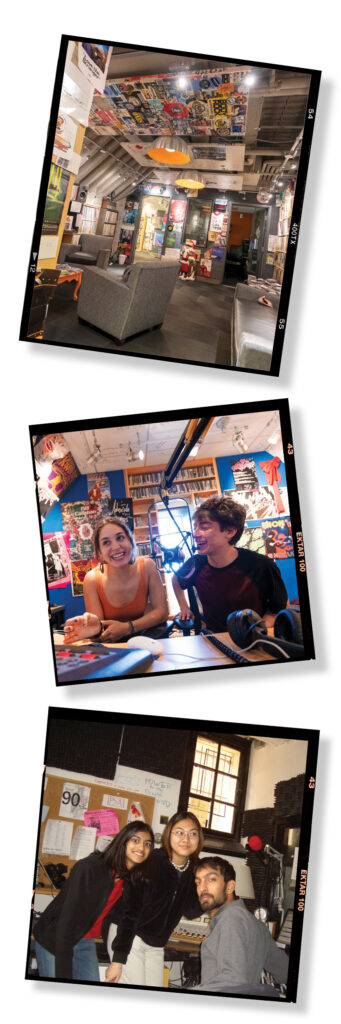
KWUR celebrates its 50th anniversary this year. Although it currently operates out of a modern space in the Danforth University Center, the student-run station maintains its independent spirit and commitment to original programming. KWUR also continues to hold special memories for generations of WashU grads who occupied the recording booth. Read on for behind-the-studio stories from past and present KWUR DJs.
Let’s get digital
While walking to the South 40, Jonathan Cobb, BS ’98, encountered a KWUR recruitment table littered with an eclectic mix of CDs and records. Then a first-year engineering student from Chicago, Cobb was intrigued and applied on the spot to become a DJ. The onboarding process included a training session, written test and recording demo.
“It wasn’t easy,” recalls Cobb. “A lot of students wanted time slots, and it was almost impossible to get a solo show in your first year.” Cobb, however, lucked out. The station paired him with an indie rock DJ, and they decided to split their two-hour block — effectively giving each a spotlight. During his hour, Cobb’s playlists featured heavy metal tunes covering subgenres with names like black, death and thrash. “It was probably an odd hour to be listening to that kind of music,” he says of the weekly midmorning program. “But I was just so excited to be on the air.”
“… I was just so excited to be on the air.”
Jonathan Cobb, BS ’98
As his on-air presence continued, Cobb’s off-air duties expanded in unexpected and often extramusical directions. He became responsible for securing sponsorships as KWUR’s underwriting director before assuming the role of general manager in his junior year. During his tenure, he helped usher the station into the streaming era.
Low wattage and a limited radius have long bedeviled KWUR and its staff. Even today, the station reaches only about two to three miles beyond campus with its 10-watt signal. But Cobb and others saw the internet as a means of broadening KWUR’s audience while circumventing these limitations — at least as much as the technology of the time would permit. The station’s initial streaming software was proprietary, and the license capped the number of concurrent listeners at 60.
For Cobb, KWUR was more than a cocurricular activity. It was the beginning of his professional life. While still an undergrad, he and a fellow student launched a side gig assisting local radio stations with the transition to online broadcasting. After graduation, he entered Silicon Valley’s startup scene and founded several digital media ventures. Today, Cobb is an app developer and software engineer based in Chattanooga, Tennessee. “Basically, all of my success came from KWUR,” he says.
New horizons
“What am I supposed to play?” thought Amy Fan, BS ’05, during KWUR’s new-member orientation in the spring of her sophomore year. The station proudly bills itself as a hub for deep cuts and up-and-comers, and advises incoming staff to avoid the Top 40 tracks that dominate mainstream radio. Growing up in San Diego, Fan gravitated toward alternative rock. At KWUR, however, she realized that her musical taste still leaned toward commercial hits. “KWUR really stoked my curiosity about all types of music and expanded my palette,” she says. She viewed KWUR, and WashU more broadly, as a place to experiment and explore.
“That’s the beauty of student groups like KWUR,” Fan says. “There’s no barrier to entry. You don’t need experience or qualifications. All you need is an interest and a desire to learn.”
She took a laid-back, freewheeling approach to her radio hour, which was nominally devoted to indie rock. “It was more like a parody of a show,” says Fan, who often invited friends and dormmates to co-host. “The format was primarily music, but we were very silly and not earnest about it at all.”
These days, Fan works as a freelance videographer and video editor in her hometown. She spends much of her free time discovering new bands and frequenting concerts, including the annual Coachella music festival. When Fan first encountered the festival lineup in 2006, she was amazed to find so many artists she had grown to love at KWUR. “The station played a big part in shaping my ongoing passion for music and live performance,” says Fan, who as a student was also involved with concert programming at WashU’s now-shuttered Gargoyle venue. “I’m really grateful to have been a part
of KWUR.”
Keep it classic
KWUR’s personnel rotates constantly as students graduate and new members come aboard. George Yeh, MA ’94, PhD ’97, however, has been a fixture at the station since 1996. Unlike most, he joined as a graduate student pursuing a doctorate in chemistry. After earning his degree, he stayed in St. Louis — and at KWUR.
Yeh’s passion for classical music developed as a kid, when he tuned into a local Philadelphia radio station. Now, he oversees classical music at KWUR and hosts the “Musica Esoterica” show every Saturday morning. “When I’m at home listening to classical music, I’m usually alone,” says Yeh, who works remotely for a global diagnostics and life sciences company. “Through KWUR, I’m able to share my musical interest and expertise with others.”
Yeh remains an invaluable resource for successive cohorts of KWUR staff. In addition to fielding questions, he quietly takes care of mundane but essential tasks like uploading new music files and updating software. “Nobody really notices the behind-the-scenes operational stuff, because I just do it,” says Yeh, who also volunteers with WashU’s music department.
During his nearly 30-year tenure, Yeh has seen the station weather technological shifts, institutional changes, relocation and more. He has also watched the area’s nonprofit media landscape consolidate and shrink. Though he has no immediate plans to step down, Yeh hopes the station continues to be a beacon for independent broadcasting in St. Louis. “There’s really nothing quite like KWUR,” he says.