Listen to this story:
“This,” engineer David Peters says, “is how we went to the moon.”

Peters, BS ’69, MS ’70, the McDonnell Douglas Professor of Engineering, is in his Jubel Hall office on WashU’s Danforth Campus gushing with excitement. He is being asked to explain root locus, a concept few outside of engineering have even heard of, much less comprehend.
So Peters is starting with relics of systems engineering’s past.
On his desk sits a Friden mechanical adding machine — a rather large device for a desktop that resembles a manual typewriter, except it’s rectangular and displays only numbers. There’s also a curious hybrid plastic gadget called a Spirule, which looks like a ruler with an attached wheel at one end, lined in 360-degree increments.
“Engineering in the 1940s and ’50s didn’t have electronic calculators or computers,” Peters says. “They didn’t exist.”
What did exist, Peters says, were mathematical concepts and, later, specialized tools like the Spirule. These devices aided in solving problems that engineers — in a crucial, post-World War II period in our nation’s history — could not yet solve in closed form but somehow had to account for.
The field of control systems engineering involves designing systems that can react to unexpected external changes. This basic problem — the need to respond to continuous feedback — had to be addressed in order to design Cold War technologies: a rocket thrusting into space, for example, or an unmanned vehicle being sent to the magnetic North Pole. Everyday systems, too, like a stoplight adjusting for traffic or a heating and air conditioning thermostat adjusting to a fluctuating temperature.
Before computers, how did an engineer account for outside factors that influence the reliability of a system? At the heart of it was root locus and its creator, WashU alumnus Walter R. Evans, BSEE ’41.
Evans is the man who not only came up with root locus, he helped guide the invention of a mechanical tool, the Spirule, to map it out — thus revolutionizing control systems design. Root locus, says Peters, shaped “the methodologies taught in classrooms and employed by engineers worldwide.
“There’s not a control systems engineering textbook in the world that doesn’t have a chapter on root locus,” Peters says. “Everybody uses this: mechanical engineers, aerospace engineers, chemical engineers, electrical engineers, industrial engineers.”

Four generations of WashU alumni
Walter Evans’ first and earliest connection to WashU was his maternal great-grandfather, James X. Allen. An obituary in Utah’s Ogden Standard says Allen served the Union Army as a surgeon from 1861-64 and then in 1867 graduated from St. Louis Medical College, a precursor to WashU Medicine. Other Evans family connections:
Gomer Louis Evans, Walter’s father, was a 1907 graduate in engineering. A vice president of Wagner Electric Corporation, Gomer died in 1934 at age 48 of complications from a routine surgery. He left behind his wife, Sybilia Burgess Evans, and four children, three of whom would matriculate at Washington University.
Cedric Evans and Samuel R. Evans, Walter’s brothers, earned degrees in engineering administration in 1935 and 1939, respectively.
Samuel Allen Burgess, his uncle on his mother’s side, earned a law degree in 1902.
Arline Pillisch Evans, Walter’s high school sweetheart and eventual wife, earned her Bachelor of Arts in 1941. As the Soldan High School Class of 1937 valedictorian, Arline would be the first in her family to attend college on a four-year scholarship that, at the time, was awarded to a student at each high school in Saint Louis Public Schools.
Stephen Walter Evans, Walter’s grandson (and Greg Evans’ son), earned his Bachelor of Science in mechanical engineering from the McKelvey School of Engineering in 2015. His middle name is in honor of his grandfather.
Even today, engineers who design control systems like cruise control in your car, for example, use the theory of root locus. “The system has to measure at what speed you want to be driving, say 60 miles per hour,” Peters says. “How much more gas should the engine be giving? How fast is the car closing in on another vehicle? Does it add another ounce of throttle, or what’s that constant?
“Engineers have to design every aspect of that, and root locus is the graphical tool that helped them do all of it,” Peters says, noting that control systems design is computerized now.
“Root locus stands as one of the most significant contributions of the post-World War II aerospace industry,” Greg Evans says of the concept that was first published in Transactions of the American Institute of Electrical Engineers in 1950. “But because my dad was so humble, he didn’t feel as if his name needed to be associated with it.”
The son has done his best to take care of that. His recently published book, Into Stability, tells the story of his father, known as “Walt” to his friends, and his breakthrough with root locus. The book includes notes and letters from the senior Evans as well as firsthand accounts of colleagues who worked with him at North American Aviation’s Astrophysics Laboratory (precursor to Rockwell International) in the mid- to late 1940s, where the root locus method was crystalized. It’s a triumph, a story of an engineer who saw a problem before him and had the ability to flip it until he saw a solution.
And the roots of root locus, if you will, began at Washington University in the late 1930s and early 1940s. It’s here, on a leafy, pre-World War II Hilltop Campus, where this story becomes not just one of a revolutionary engineering concept but also a story of a foundational education. It was at WashU, Greg Evans writes, where Walter Evans “honed his analytical abilities, built critical relationships and encountered mentors who would shape his thinking for decades.”
Scholars, strategists and innovators
Evans was born in St. Louis in 1920, the youngest of four children of Gomer Louis Evans, BS ’07, and Sybilia Burgess Evans. Not only did he follow his father and his two older brothers, Cedric, BS ’35, and Sam, BS ’39, to campus, his family had ties to Washington University that dated to the 1860s. Walter Evans’ first and earliest connection to WashU was his maternal great-grandfather, James X. Allen, who served the Union Army as a medic in the Civil War and then in 1867 graduated from St. Louis Medical College, a precursor of Washington University School of Medicine.
Walter Evans matriculated on campus in 1937, three years after the untimely death of his father. Gomer Evans had risen to vice president of the Wagner Electric Corporation when he died in 1934 at age 48 of complications from a routine surgery. A life insurance policy ensured his family would be taken care of and there would be money for his sons’ education — at WashU.
Accompanying Walter Evans was one of his classmates from St. Louis’ Soldan High School, a young woman named Arline Pillisch, AB ’41. As class valedictorian, she’d won a four-year honor scholarship that allowed her to attend WashU tuition-free. Within a year of graduation, on April 11, 1942, Pillisch and Evans would wed.
Greg Evans writes about four “intellectual guides” at WashU who had an impact on his father, including Roy Glasgow, who spent 29 years on the WashU faculty and who, Greg says, was his father’s favorite. The senior Evans had charted a path for himself in engineering management, but it was Glasgow who encouraged him “to prove [himself] as an engineer first and worry about the vice presidency later,” as Evans wrote in a letter to Glasgow in 1966.
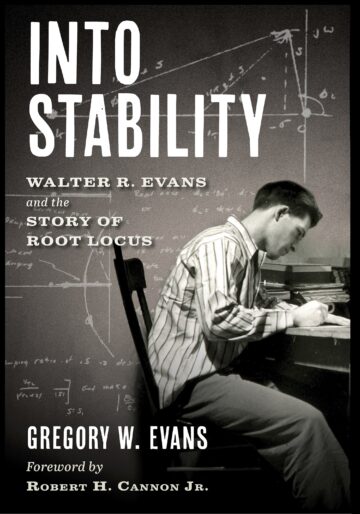
Into Stability
Walter R. Evans and the Story of Root Locus
Other noted WashU professors were Alexander Langsdorf, who served as both dean of the School of Engineering and a professor; Frank Bubb, who was part of the team that developed the cyclotron for splitting atomic particles (and that would eventually be used in the Manhattan Project); and Ross Middlemiss, a noted engineering mathematician. These great minds taught Evans how to look at a problem from all angles and figure out the solution from the ground up or inside out.
“By the time Walter Evans graduated from Washington University, he was not just an engineer — he was a thinker shaped by a rich lineage of scholars, strategists and innovators,” the younger Evans writes. “His early experiences in St. Louis provided him with the skill, relationships and intellectual curiosity necessary to make groundbreaking contributions to control systems engineering.”
Root locus is born
In addition to the faculty, John Moore, BS ’37, a mentor and friend of Evans, would prove to be a key connection. After graduation, Evans followed Moore to General Electric in Schenectady, New York, where a training program called the Advanced Engineering Course proved instrumental to Evans in furthering his engineering and teaching skills. He and Arline lived in Schenectady through the war years, with Walter receiving a Selective Service deferment for his technical work.
In 1947, Evans followed Moore back to WashU to serve as an instructor in the School of Engineering for one year before he and his young family followed John Moore again, this time with Walter accepting a job offer from Moore, by then a group leader at North American Aviation in Southern California.
At each step in his early career, Evans was practicing deep thinking and analysis. Importantly, he was also focusing his energies on the classroom and continued teaching systems engineering to young engineers in California. It was in one of those teaching sessions that the concept of root locus was born.
Writes Greg Evans: “The root-locus method was born not in a journal but in a lecture hall — crafted in response to a student’s question, refined in dialogue with practicing engineers, and strengthened by Evans’ pedagogical instincts. What made it transformative was not simply its novelty but also its utility: It provided a graphable, scalable and intuitive method for assessing system stability and performance as a function of gain.”
Before root locus, a control systems engineer had to, basically, think of every possible outcome and come up with a design for it.
Root locus, Evans writes, “filled a gap — between theory and practice, abstraction and intuition. It became part of the working vocabulary of control engineers because it made invisible dynamics visible. From a question in a summer lecture to a method that would appear in virtually every control systems textbook for the next half-century, root locus stands as a paradigm-shifting contribution.”
Evans’ book is full of stories of what came next. About how it took nearly a year for his father’s peers to read his paper and approve it for publication. About how he began writing a textbook when he thought he would never get the paper approved. About how one of his colleagues at North American Aviation developed a tool called the Spirule that put his theory into practical use. And about how Evans himself ended up marketing the Spirule and selling it out of his Whittier, California, home, with his wife and now four children fulfilling orders.
“He didn’t think the Spirule was going to take off,” Greg Evans says. “He thought people could figure it out with a push pin and two pieces of transparent plastic. It was a colleague named Jeff Schmidt at North American that came up with the idea of the Spirule.”
One hallmark of Evans’ career was that he wanted to make his knowledge accessible to as many as possible, and once word spread about root locus, engineers and engineering students wanted a Spirule. “Dad just sort of inherited the production of it because North American couldn’t get their act together to justify manufacturing these devices,” Evans says.
The Evans’ home eventually became the hub of the Spirule market. Walter would pay his kids $2.50 an hour to fulfill orders, with his wife, Arline, making a daily trip to the post office. Once, a young college student, thinking the family home was some kind of store, knocked on their door with a sense of urgency and said he needed a Spirule for an exam the next day. The family obliged.
“It was a nice little family side income,” says Nancy Evans Littrell, Walter’s only daughter. “But making money was never his goal.” Her dad’s vision, she says, was to get the Spirule to college students as cheaply as possible so they could use it to learn root locus. It worked. Thanks to Arline’s meticulous record-keeping, the family has an accounting of 103,550 Spirules being sold in 36 years, with sales peaking at 7,409 in 1965.
The aftermath
Through it all, Walter Evans remained modest and unassuming regarding his contributions to systems engineering. “I had no idea as a kid how important what he did was, because he was just so humble,” Littrell says. “He would talk about things going on at the office so much that I remember thinking the only career for anyone was to be an engineer. He didn’t talk about himself at all.”
But he was always thinking, Evans recalls, and always tinkering with ideas. “He was an early computer buff,” he says. “Remember those electronic kits the Heath Company sold? He tried to program one to do his tax returns.”
Other ideas he talked about were suitcases on wheels and colored tennis balls — long before anyone ever marketed those concepts. When he was at work, he wanted information to be shared easily, so he experimented with a very primitive form of a hyperlink. “He was so far ahead of his time,” Evans says. “I think the internet would have been very exciting for him.”
Sadly, Walter Evans never got to experience the technology revolution. On June 2, 1980, at the age of 60, he suffered a stroke that destroyed a large portion of the left hemisphere of his brain — including his center of speech production. The stroke would render him unable to walk or speak for the next 19 years, the remainder of his life.
That’s when Arline, his high school sweetheart, his WashU classmate and his wife of then-38 years, stepped in. Thanks to her, Walter Evans was not finished contributing to the world.
Writes Evans in Into Stability: “Arline devoted herself to Walter … she got him into the game. She developed a daily routine designed to minimize cognitive loss and to develop new skills to compensate for those he had lost.”
She gave him his own stability in an uncertain world and never left his side, keeping a diary of his activities, producing worksheets and puzzles for him, even providing him colored pens and pencils so he could learn to draw with his non-dominant left hand.
And draw he did. By the time of his death on July 10, 1999, Walter Evans had produced 258 drawings of birds and other animals, some from photographs and some from memory, including a drawing of a cardinal representing his favorite baseball team growing up in St. Louis.
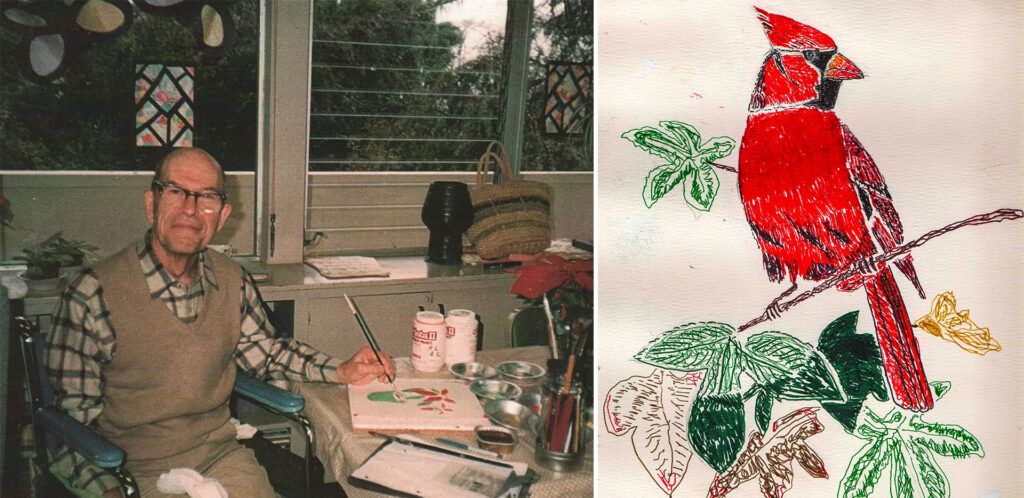
Walter Evans kept busy after a debilitating stroke, painting and drawing hundreds of birds and other animals. (Courtesy photos)
“The drawings aside, the last 19 years of his life were a remarkable story in themselves,” Greg Evans says. “Because he was so intense and work-oriented, we were all incredibly worried about him. But he found new ways to express himself and to live fully. And he kept his sense
of humor.”
It wasn’t until this part of his life that the Evans children began to realize the significant contribution their dad had made to the field of systems engineering. In 1987, the American Society of Mechanical Engineers awarded Evans the prestigious Rufus Oldenburger Medal. In 1988, the American Automatic Control Council gave him the Richard E. Bellman Control Heritage Award. And, in 1990, the McKelvey School of Engineering honored him with its Alumni Achievement Award.
“Whenever I meet someone who is an engineer, I always ask, ‘Did you study control systems? Do you know that root locus was my dad?’” Littrell says. “I’m just so proud of him.”
Even Peters, who jumped at the chance to get on a Zoom call with Greg and Nancy Evans, says Walter Evans’ contributions are legendary in the department and a point of pride at McKelvey because it represents a fulcrum in the field. “Everyone was figuring out things one way before root locus, and a completely different way after Walter Evans,” Peters says.
“It’s a tool that human beings can use to better mankind,” Peters says, “and that is everything.”