Everyone has reckoned with uncertainty. Should I switch majors? Can I be a better leader? What is the future of our democracy? Or, in the case of WashU alumnus Sam Goodwin, will I be slaughtered by my Syrian captors?
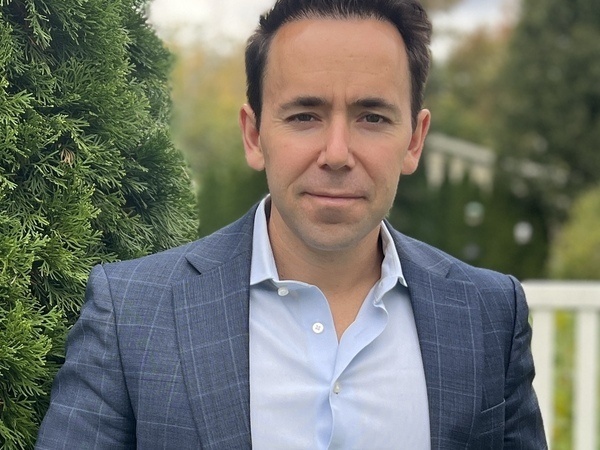
“Maybe what I experienced was a little different breed of uncertainty, but no matter the form of uncertainty — whether it’s in our personal or professional or spiritual lives — there are things we can do to adapt and to thrive,” said Goodwin, who was falsely accused of being a spy and imprisoned for two months in 2019 in Syria. “I often challenge people to think about their low points, their biggest challenges and to ask themselves, ‘What do I learn from that?’ When we’re at the top, it’s important to have humility and awareness and gratitude, but it’s at the bottom of the sine curve of life where all the growth happens. I was at the bottom in Syria, but so much good has come from that. And one of those things is perspective.”
Goodwin will share more about his experiences during his Assembly Series lecture at 5:30 p.m. Wednesday, Jan. 21, in Graham Chapel at Washington University in St. Louis.
Goodwin also will be teaching the new School of Continuing & Professional Studies (CAPS) course “The Entrepreneurial Edge.” Enrollment is still open for undergraduate and graduate students. Goodwin, a St. Louis native, also is author of the bestselling memoir “Saving Sam.”
Here, Goodwin shares more about his travels to all 193 United Nations sovereign countries, his hopes for Syria after the fall of the Assad regime and how today’s students can make the most of their college experience.
Your speech is titled “Winning through Uncertainty.” What does that mean?
“Winning through Uncertainty” means giving people practical tools to stay grounded and move forward when outcomes aren’t clear. Built on gratitude, control and reframing uncertainty as opportunity, the framework is intentionally universal. While I most frequently speak to business leaders, students can apply it to academic, career and personal challenges to build confidence and resilience without having all the answers.
Why did you develop the new course “The Entrepreneurial Edge”?
Here’s my perspective: Higher education and careers matter most when students pair them with creativity and initiative. I created “The Entrepreneurial Edge” to help students build that mindset. Whether they start a company or become intrapreneurs within an existing organization, the goal is to empower them to create value, solve problems, take ownership of ideas and learn through creativity, calculated risk-taking and mistakes. At 37, I can see that my own career has been shaped by a series of thoughtful risks — working at a startup in Singapore, traveling to every country in the world, writing a book, and eventually starting my own business. None of that would have been possible without the skills, discipline and foundation I gained along the way.
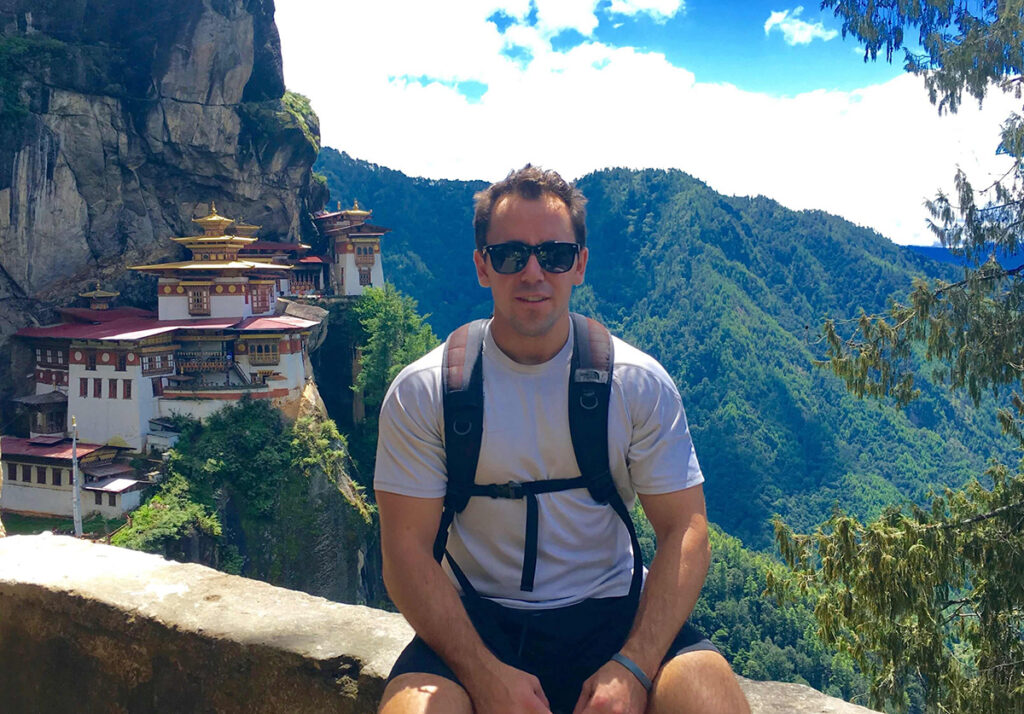
You have a doctorate in international affairs from Johns Hopkins University and a graduate degree in international affairs from University College, now CAPS. Still, you call traveling the best education. What fueled your passion for travel?
I have an unrelenting curiosity. And what I realized was the more I traveled, the more traveling I wanted to do. It was a never-ending cycle. Travel taught me how to let expectations take a backseat and replace stereotypes with real experiences. It’s taught me how to never, never judge people by the actions of their government. I’ve learned that people who have the least often give the most — that’s something that I found to be true in all corners of the world. I think curiosity is the most consistent source of innovation and worldly contributions, and a lack of it is why so much upside is often left on the table. And so I believe the world belongs to the curious.
What are your views on the future of Syria?
I’m optimistic that regardless of what comes next in Syria, it will be better than Assad. I met with the new Syrian president, Ahmed al-Sharaa, in September last year for 45 minutes when he was in New York City for the U.N. General Assembly. I brought my mom to the meeting, too. Despite his past, I found him to be presidential and an attentive listener. We talked about political challenges, sanctions and the future of the nation. I’ve traveled to every country in the world, and the Syrian people are among the most welcoming and hospitable anywhere. They need and deserve strong leadership and a lot of prayers.