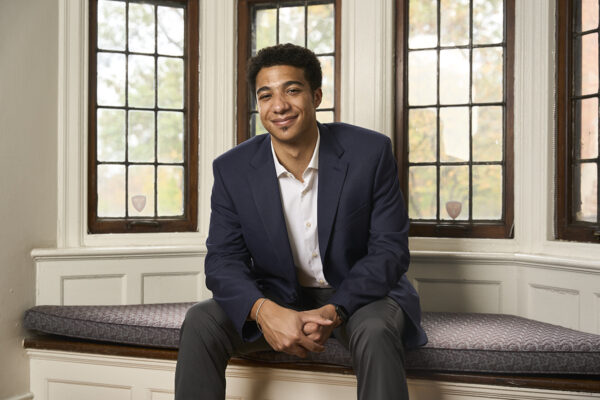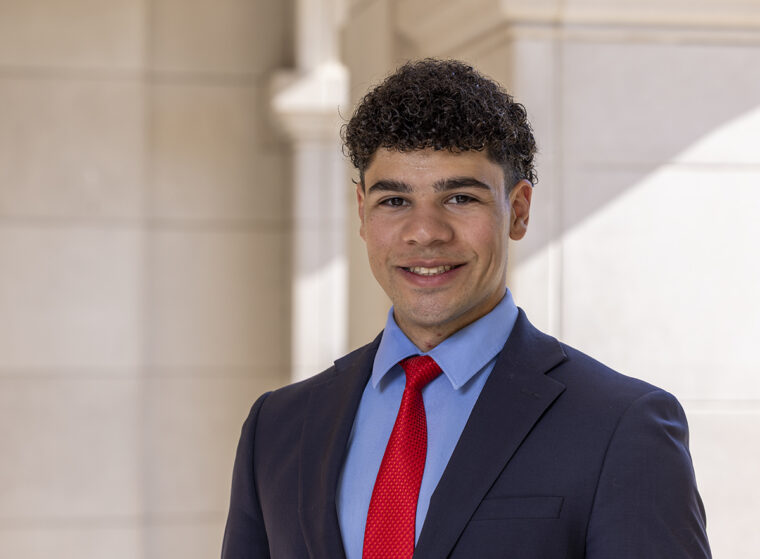
Less than 48 hours after he learned he would not be a Rhodes Scholar, WashU senior Omar Abdelmoity hopped on a plane to interview for the equally prestigious — yet somehow more elusive — Marshall Scholarship. Only seven WashU students had been awarded the Marshall since its founding in 1953, compared to the university’s 30 Rhodes Scholars.
“I was, of course, disappointed when I didn’t get the Rhodes. I grew up playing competitive soccer and so yes, anything I go for, I try to win,” said Abdelmoity, who is majoring in biology in Arts & Sciences at Washington University in St. Louis. “But standing there before the Marshall committee, I wasn’t thinking about the Rhodes; I wasn’t thinking about the odds. I was just focused on telling my story and helping those who are too often overlooked by our health-care system.”
Omar Abdelmoity
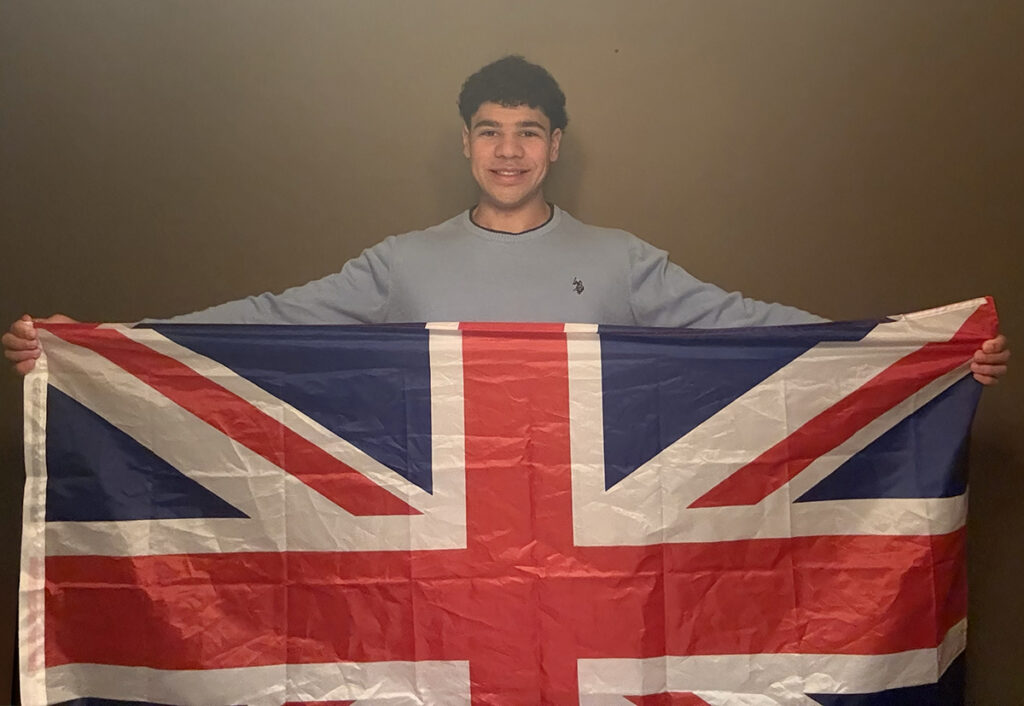
Age: 22
Hometown: Overland Park, Kan.
Experience: NIH MARC U-STAR and STEP UP scholar, lab of Beau Ances, MD, the Daniel J Brennan Professor of Neurology, WashU Medicine; president, College of Arts & Sciences Council; residential advisor
That story began in high school in Overland Park, Kan., where Abdelmoity developed an education program to prevent suicide among Black teenagers after two friends died by suicide. It continues today at WashU Medicine, where Abdelmoity is researching Alzheimer’s disease among individuals with Down’s syndrome.
His strategy worked; Abdelmoity got the scholarship. Next year, he will travel to the United Kingdom to earn an advanced degree in evidence-based social intervention and policy evaluation at Oxford University and a second graduate degree in population health sciences at Cambridge University. In many ways, the Marshall Scholarship, which prioritizes a candidate’s “ambassadorial potential,” is a perfect fit for Abdelmoity, who already has collaborated with and presented to scientists around the globe.
“I don’t see this as a two-year opportunity, but the start of a career-long collaboration with the organizations and community partners in the U.K.,” said Abdelmoity, who plans to attend medical school upon his return. “The Marshall also excites me because it brings together people who all are passionate about their respective fields to see how we can work together across boundaries.”
It’s easy to assume that Abdelmoity, with his long resume of activities and awards, was bound to win one of academia’s most prestigious honors. He is, after all, an Ervin Scholar, which perennially produces Rhodes and Marshall winners and finalists. Abdelmoity also is a WashU Medicine & Society Scholar and a Gephardt Institute Drs. Olsen & Marcus Civic Fellow as well as a National Institutes of Health (NIH) MARC U-STAR and STEP UP Scholar.
But applying for these elite scholarships is anything but easy, said Brooke Taylor, an assistant dean and fellowships and scholarships advisor in Arts & Sciences. Her job is to shepherd students through the long and arduous application process. She first met Abdelmoity as a sophomore and helped him apply as a junior for the Goldwater Scholarship, which he got, and the Truman Scholarship, which, though named a finalist, he did not.
“I talk a lot about the dark CV — the list of everything you have applied for and didn’t get,” Taylor said. “It takes a tremendous amount of work and courage to put yourself out there for something that is so competitive, something that — no matter how qualified you are — you are likely not to get.”
Every year, 10 to 15 WashU students apply for the Rhodes Scholarship, which requires students to write a personal statement and collect a whopping eight letters of recommendation. Its first cohort was in 1903. Taylor then brings the applications to a WashU faculty panel, which endorses those it considers the most promising — six this year. The Rhodes Selection Committee then picks finalists who best exemplify academic excellence, character, leadership and purpose. This year, as in many years past, the committee picked two WashU finalists — Abdelmoity and Marilee Karinshak, an environmental analysis major in Arts & Sciences who has completed two internships with NASA. They were among the 238 national finalists to travel to one of the 16 interview sites Nov. 14 and 15 to compete for 32 slots.
“Once you’re a finalist, everyone is equally qualified,” Taylor said. “The selection committee isn’t picking the best per se, but making a decision based on any number of factors. But even knowing that, I am always so surprised when our students aren’t selected because I know just how amazing they are.”
The process for the Marshall is similar. This year, the university endorsed eight WashU students; only Abdelmoity was selected by the Marshall selection committee. Like the Rhodes Scholarship, students interview in designated districts across the country. Unlike the Rhodes, where candidates are called into a room to learn their fates together, Marshall scholars get a call from the committee, typically the day after the interviews. On Nov. 18 — the day after his Marshall interview and four days after his Rhodes rejection — Abdelmoity got the call he had been waiting for. The Marshall Committee officially announced its final cohort of 43 scholars Dec. 9.
“I was at a loss for words. I literally didn’t know what to say,” Abdelmoity said. “The very first person I called after that was Dean Brooke, who has been there for me every step of the way. I was like, ‘I have some crazy news to share with you.’”
“I was driving home from work when I saw a call from Omar come in,” Taylor said, recalling the same moment. “I thought to myself, ‘If Omar is calling me, it’s probably good news.’ It was kind of like whiplash to go from the emotions of Saturday to the incredible elation of Tuesday.”
Abdelmoity felt the same way.
“It reminded me of finding out about the Ervin Scholarship, which I knew could provide unparalleled support for the next step in my journey,” Abdelmoity said. “The Ervin made the unattainable attainable here at WashU, and now the Marshall made what I thought was unattainable attainable in the United Kingdom.”