Their very first patient didn’t want to talk. She had no family. She had no friends. And she was dying.
Still, WashU students Oviya Kalaivanan and Timileyin Olugbenro continued their hospice visits, holding her hand and reading her stories. Then one day, Kalaivanan showed her a picture of her cat.
“That changed everything,” Olugbenro recalled. “From that point on, everything we brought was cat-themed. She opened up to us, waving us in and offering us her wheelchair to sit in. We became part of her chosen family.”
“It was hard on us when she died, but we were happy that we made the last days of her life a little better,” Kalaivanan continued. “The experience really shifted my idea of what it means to be a physician. It’s not just treatment plans; it can be gentle touch; it can be music; it can glazed donuts — anything that makes the patient happy.”
Oviya Kalaivanan and Timileyin Olugbenro are the founders of WashU Hospice and Palliative Care Club (WUHPAC), which serves 11 hospice providers in the St. Louis region. Advised by Brian Carpenter, an expert on aging and a professor of psychological and brain sciences in Arts & Sciences, the group’s 70 volunteers receive training from hospice professionals and commit to two patient visits per month.
“We do not provide clinical care, but we are an essential part of the care team,” Olugbenro said. “I tell our volunteers all of the time that it is an honor to have this role.”
Kalaivanan, who is studying cognitive neuroscience, and Olugbenro, who is majoring in biology, both in Arts & Sciences, are set to graduate this month from Washington University in St. Louis and are applying to medical school. But right now, their attention is on WUHPAC — strengthening its ties to St. Louis hospices; providing members educational opportunities with WashU Medicine palliative care physicians; securing Student Union funds so students can get to and from patient visits; and supporting volunteers as they navigate the challenges and heartache of the work.
“From the start, a core value was to build something that could last, something that would serve St. Louis long after we graduated,” Olugbenro said. “We are now a trusted resource in the community. Our partners know that when we say we’ll be there, we’ll be there.”
Jumping into their world
WUHPAC was born from a conversation between Kalaivanan and Olugbenro about their WashU admissions essays. Kalaivanan, who grew up in Bangalore, India, wrote about her experience volunteering in a hospice after her grandmother died of Huntington’s disease. What’s hospice, Olugbenro wanted to know.
“The concept was totally new to me,” said Olugbenro, who is from Nigeria. “Where I’m from, if you stop medicine, it’s seen as giving up, as wanting to die. A more peaceful end of life with dignity and free of pain isn’t accessible to people. It wasn’t accessible to my grandfathers, and that breaks my heart.”
The two decided to start an organization on campus and began recruiting and training student volunteers. Today, the club draws more applicants than it can accept. Still Kalaivanan acknowledged that many of her peers find the topic of death uncomfortable.
“There is stigma around death — no one wants to think about it, especially young people,” Olugbenro said. “Everyone talks about prolonging life, but we wanted to build a community where we can openly talk about death.”
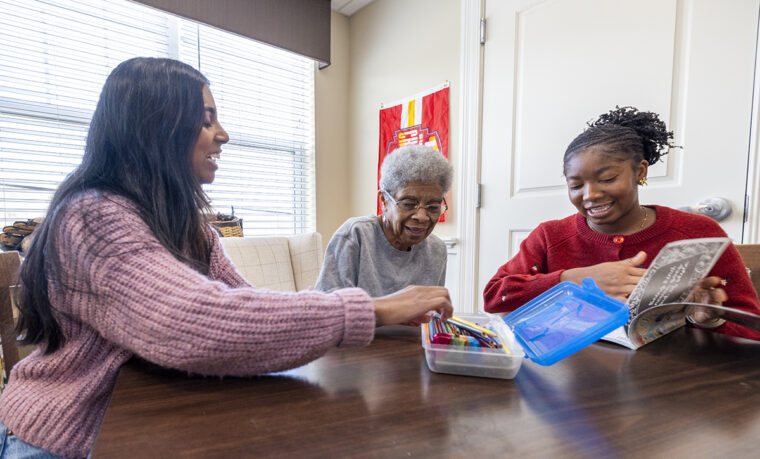
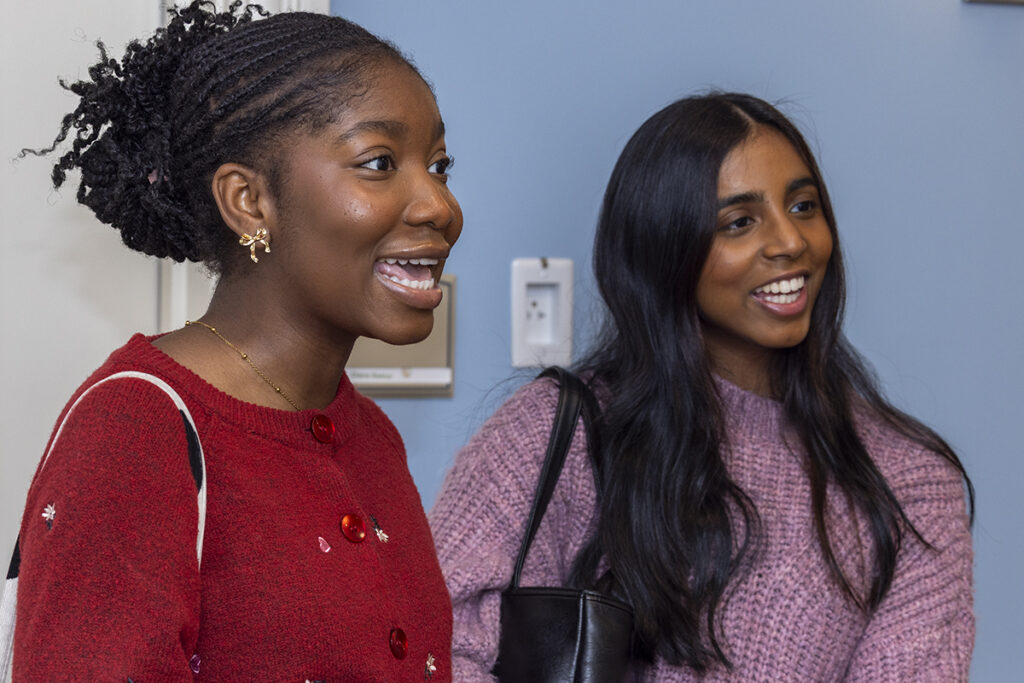
On this day, Olugbenro and Kalaivanan check into Kingsland Walk Senior Living in University City, where they find their patient, Ms. Ora, listening to The Temptations. Though Ms. Ora has a large circle of family and friends who visit frequently, Olugbenro and Kalaivanan bring a youthful energy to the floor.
“Do you want to finish the butterfly we started last time?” asked Kalaivanan as she pulled out a box of colored pencils.
“I’ve been really liking your short hair,” Olugbenro added.
Later, Ms. Ora asks Olugbenro where she will go after graduation.
“I’m staying in St. Louis for now. I’ll still be able to visit you,” Olugbenro answered.
Joan Bevirt, volunteer coordinator at Unity Hospice of Greater St. Louis, also has stopped by to say hello. Unity Hospice was WUHPAC’s first partner and supports patients in their homes and at care facilities like this one. Bevirt works closely with WUHPAC volunteers, meeting with them before their initial patient visit and checking in regularly throughout a patient’s care. Recently, Bevirt presented before the entire club, offering strategies to engage patients who may have hearing loss, dementia or other medical issues.
“These students are pretty incredible,” Bevirt said. “When they arrive, they put a big smile on that patient’s face. They say, ‘Hello. How are you? You look beautiful.’ ‘Let’s play cards. Let’s go outside.’ Many of our patients are non-communicative or have dementia, but the students just jump into their world.”
Bevirt believes that the students’ experiences in hospice will make them better caregivers in the future. Most WUHPAC volunteers are pre-medical students; all of them will inevitably have to care for an aging loved one.
“As someone who is older, I feel hopeful that these students will go on to be the sort of doctors who will really listen to their patients and take the time to get to know them,” Bevirt said.
Olugbenro isn’t sure what type of physican she will be, but knows she will bring the lessons from WUHPAC into her practice.
“Am I afraid of death? Yes. I visit these patients and know one day that could be me,” Olugbenro said. “But I’ve also come to understand that death is not a condition to be fixed or cured. Death is part of life, and how we make it meaningful is what matters.”