No Internet, few cell phones, no digital photographs. It sounds like something from the Dark Ages of the media, but it was only 12 years ago.
For the presidential debate in 1992, carpenters transformed showers in the Athletic Complex into darkrooms for photographers to process film, and SBC Communications Inc. employees installed 3,000 phone lines in the Recreational Gymnasium for media to file their stories. All of this was accomplished with only one week’s notice.
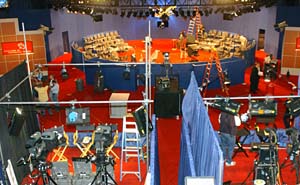
For the 2004 debate, the University learned almost a year ago that it would host the event and found out the format would be a “town-hall meeting” about two months ago. This time, photographers came with digital cameras, and Web sites instantly broke the news.
The weeks leading up to Oct. 8 were very busy. Workers laid 53 miles of fiber-optic cables throughout the Hilltop Campus and installed 80 high-speed computer lines and 20 video feeds in the Athletic Complex.
University employees, carpenters, electricians, technicians and a host of other workers completely transformed the complex, which had been closed since Sept. 30.
Outside the building, gardeners planted white and crimson mums encircled by a row of deep-purple pansies.
With the exterior looking spiffy, many contractors joined forces to prepare the interior.
In the Field House — which was to become the actual debate hall — Albert Arno Inc. employees installed giant silver air-conditioning ducts to keep the room at 65 degrees. President George W. Bush and Sen. John Kerry would remain cool under the studio lights, even when passions ran hot.
Paramount Convention Services Inc. hung heavy blue velour drapes, some more than 60 feet long, along the gymnasium’s interior walls to improve acoustics.
Carpenters from Helmkamp Construction Co. built six platforms to accommodate the television networks NBC, ABC, CBS, Fox, CNN and C-SPAN.
These platforms — at the back of the debate venue — rose 7 feet and measured 12 feet by 18 feet, said Steven G. Rackers, manager of capital projects in facilities planning.
|
Debate set design: Function is critical By Diane Duke Williams When viewers tuned into the debate, they probably had no idea that it took four 18-wheelers to bring everything for the “town-hall meeting” set. Some of the scenery, audio and lights came from the first presidential debate at the University of Miami, and the rest had been stored in a warehouse in Maryland. This set was almost identical to the one used at WUSTL in 2000, said John Hodges, owner of Virginia-based TSA Inc., the company that has designed and fabricated the presidential debate sets since 1988. The back of the stage consisted of flag-blue panels forming a semicircle.Two replicas of the Stars and Stripes framed the stage, and a giant eagle was the focal point on the stage’s back wall. President George W. Bush and Sen. John Kerry moved around a red-carpeted circle as they answered participants’ questions. One minor change this year was that moderator Charles Gibson requested a table instead of the swivel armchair that moderator Jim Lehrer used in 2000.Function is the most important goal in designing a set for a presidential debate, Hodges said. “You have to be clever in how you configure your participants and candidates in order to get good camera shots,” he said. In addition to designing sets for the presidential debates held at WUSTL, Hodges has another tie to the University. His daughter, Katie, is a freshman this year. |
“This time was much easier,” Rackers said. “We knew how to build the platforms and ‘pipe and drape’ the room to make the acoustics better.”
John LaVenture, fire marshal for the Clayton Fire Department, and his crew spent long hours conducting fire and other safety inspections.
“Our job is to make sure everything is constructed as safely as possible,” LaVenture said. “There’s so much new wiring in the Field House — it’s like spaghetti going through here.”
Workers from Fabick Power Systems added electrical power to surface lots for satellite trucks, Fabick and Sachs Electric Co. installed 4,000 electrical outlets and SBC employees installed 800-1,500 phone lines in the Athletic Complex.
Additionally the University installed 200 phone lines, 500-600 Internet connections and wired for Wi-Fi throughout the complex, inside and out.
Willie Mae Made, a general cleaner with Aramark, worked extra hours to clean the Athletic Complex and ensure it stayed tidy.
She said she was glad to be involved in preparations.
“This is something I’ll remember for a long time,” Made said.
The Recreational Gymnasium became the media filing center, with 170 tables placed end-to-end for the more than 1,500 journalists covering the event. Thirteen historical U.S. flags, weathered over the years, decorated the walls.
Along one wall of the room was “spin alley,” a series of 16 blue-curtained booths where political pundits, or “spin doctors,” gave reporters their take on who won the debate and why.
This year, security included monitoring of the candidates’ chairs.
In 2000, John M. Schael, director of athletics, said the two chairs used by Bush and then-Vice President Al Gore mysteriously disappeared after the debate. After the University let the campus and broader University community know it was a serious offense, the chairs reappeared on a loading dock near Mallinckrodt Student Center.
Coaches’ offices, conference rooms, classrooms and hallways were transformed into campaign and debate commission offices.
Many athletic personnel worked from home, and athletes practiced “around the debate” and at area gyms. On Oct. 7, Schael gave up his office for debate moderator Charles Gibson.
“In my wildest imagination, I never thought I’d be involved in presidential debates — I thought this position was all about sports,” Schael said. “But it’s a great opportunity to be involved and to be part of an extraordinary team working together to bring about spectacular results.”
The athletic department has a tradition that it hoped the candidates would continue: autographing a basketball.
The department displays basketballs signed by public figures who have debated, lectured or performed in the Field House, including most of the earlier presidential candidates.
The holding rooms for Kerry and Bush each contained a basketball and a pen. Did they sign?
Let’s just say candidates will do just about anything to score a few points with voters.