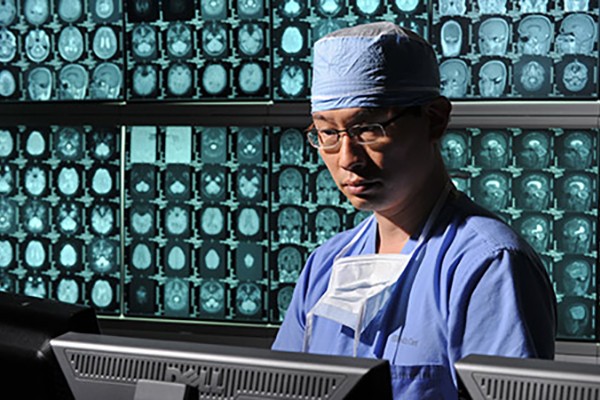
Scientists find way to disrupt brain tumor stem cells
Brain tumor stem cells can resist treatment and regrow tumors, but scientists have identified a vulnerability in these cells that could lead to a new approach in battling deadly brain tumors.
Stem cells lurking in tumors can resist treatment
Scientists are eager to make use of stem cells’ extraordinary power to transform into nearly any kind of cell, but that ability also is cause for concern in cancer treatment. New research at the School of Medicine has revealed that these stem cells are present even in slow-growing, less aggressive tumors.

New clue to aggressive brain tumors
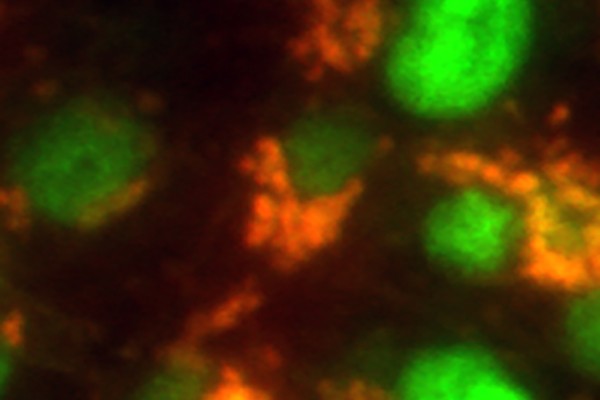
Scientists at the School of Medicine have identified a biological marker that may help predict overall survival of people with deadly brain tumors. The marker is made by noncancerous cells known as monocytes (pictured in brown).
Study offers clues to cause of kids’ brain tumors
Insights from a genetic condition that causes brain
cancer are helping scientists better understand the most common type of
brain tumor in children.
$3.3 million grant funds effort to identify cells that start brain tumors
With support from a new $3.3 million American Recovery and Reinvestment Act grant from the National Institute of Neurological Disorders and Stroke, researchers at Washington University School of Medicine in St. Louis are hunting for normal cells that help brain tumors form and grow
Brain tumor disorder impairs chemical system responsible for attention
A genetic condition that increases risk of brain tumors may also impair development of the brain system that facilitates attention, according to researchers at Washington University School of Medicine in St. Louis.
Researchers discover new way to kill pediatric brain tumors
Researchers at Washington University School of Medicine in St. Louis have shown once again that “ready, fire, aim,” nonsensical though it may sound, can be an essential approach to research.
Article sheds light on neurosurgery, use of anesthesia nearly 2,000 years ago
Invasive surgery — and anesthesia — has come a long way.While searching for answers to what it means to be Jewish — and at the same time completing a neuroscience course requirement — a doctoral student at Washington University in St. Louis came across what may be one of the earliest documented cases of brain surgery. And he found it in, of all places, the ancient texts of the Talmud. “Although this account raises several questions about the ailment itself, it provides us with a rare look at invasive cranial surgery dating nearly 2,000 years,” writes Adam Weinberg, a doctoral student in psychology in Arts & Sciences and author of an article on the surgery in the current issue of the Journal of the History of the Neurosciences. More…
Better brain imaging helps surgeons avoid damage to language functions
Jeff Ojemann/University of WashingtonImproved imaging of brain’s language areas may replace more invasive pre-surgery mapping techniques, such as the electrocortical stimulation method shown here.Advances in neurosurgery have opened the operating room door for an amazing array of highly invasive forms of brain surgery, but doctors and patients still face an incredibly important decision – whether to operate when life-saving surgery could irrevocably damage a patient’s ability to speak, read or even comprehend a simple conversation. Now, researchers at Washington University in St. Louis are developing a painless, non-invasive imaging technique that surgeons here are using to better evaluate brain surgery risks and to more precisely guide operations so that damage to sensitive language areas is avoided. The breakthrough could improve odds of success in an increasingly common surgery in which damaged sections of a patient’s temporal brain lobe are removed in an effort to alleviate epileptic seizures. November is National Epilepsy Awareness Month.