
Margolis receives grant for research on blinding diseases
Todd P. Margolis, MD, PhD, the Alan A. and Edith L. Wolff Distinguished Professor and head of the Department of Ophthalmology and Visual Sciences, has been awarded a $115,000 grant by Research to Prevent Blindness to support research into the causes, treatment and prevention of blinding diseases.
First-year medical students receive white coats
First-year students at the School of Medicine recently participated in the traditional White Coat Ceremony — a rite of passage in which future doctors are welcomed to medical school and the medical profession. In addition to receiving their white coats, the 123 students recited an oath promising honesty and integrity.
Closures due to Medical Campus construction start Aug. 25
On Monday, Aug. 25, the following will close because of construction on the Medical Campus: the sidewalk on Duncan Avenue along the garage construction site; one lane of Children’s Place west of Taylor Avenue along the St. Louis College of Pharmacy (STLCOP) garage; and the sidewalk through the center of the STLCOP west of Taylor Avenue to Whelpley Hall.
Apte receives young investigator award
Rajendra S. Apte, MD, PhD, the Paul A. Cibis Distinguished Professor of Ophthalmology & Visual Sciences, is the first recipient of the Presidents’ Young Investigator Award from the American Society of Retina Specialists.
Applications sought for K12 career development program
Applications for the K12 Clinical Hematology Research Career Development Program scholars are being accepted through Oct. 20.
Monthly transfusions reduce strokes in children with sickle cell anemia
A new multi-institutional study that originated at the School of Medicine showed that giving monthly blood transfusions to young sickle cell anemia patients who already had experienced silent strokes reduced by 58 percent their risk of another stroke, silent or otherwise.
Proteins critical to wound healing identified
Mice missing two important proteins of the vascular system develop normally and appear healthy in adulthood, as long as they are not injured in some way. If they are, their wounds don’t heal properly, a new study shows. The research has possible implications for treating diseases involving abnormal blood vessel growth, including in the skin and eye.
WashU Experts: Faculty available to comment on Ferguson unrest
As the St. Louis community grapples with recent events in the nearby suburb of Ferguson, Mo., a number of Washington University in St. Louis faculty members are offering their expertise, commentary and insight in hopes of promoting constructive dialogue on a number of challenging issues.
Medical center summer concert to be held Aug. 23
Musically talented members of the Washington University Medical Center community will be featured in a summer concert at 4 p.m. Saturday, Aug. 23, in the lobby of the Center for Advanced Medicine.
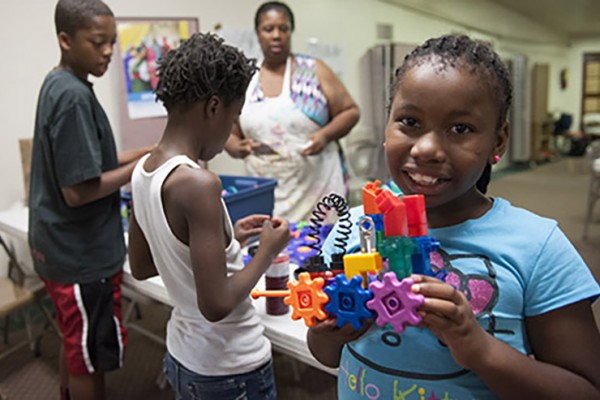
Building on success
The inaugural Health and Engineeering Careers Summer Camp took place in late July at West Side Missionary Baptist Church in St. Louis. Numerous Washington University in St. Louis groups co-sponsored the event, which aimed to encourage underrepresented children to focus on science and math subjects. Here, 10-year-old Deja Stallworth proudly shows off the robot she made.
View More Stories