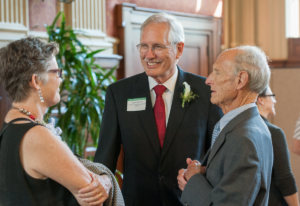
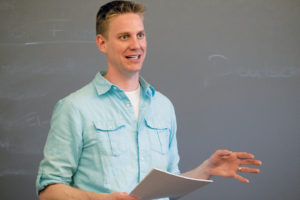
Research by Washington University psychologists Henry L. “Roddy” Roediger and Mark McDaniel will be featured in a PBS/NOVA documentary on “Schools of the Future,” which premieres on PBS stations nationwide Wednesday, Sept. 14.
As public rhetoric inflames and divides, the John C. Danforth Center on Religion and Politics cultivates rigorous scholarship to build bridges and broaden understanding of America’s most contentious issues.
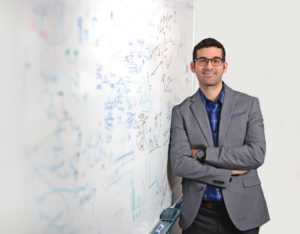
A transformative plan in Arts & Sciences will foster a collaborative ecosystem of esteemed faculty — such as Gary Patti (photo below) — students and facilities to usher in a new era of scientific discovery.
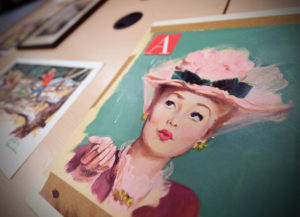
The Modern Graphic History Library recently acquired an extensive collection of work related to 20th-century illustrator Walter Baumhofer, who was known as the “King of the Pulps.”
Amelia Boone, AB ’06, is something of a superhero. By day, the 32-year-old works as a corporate lawyer for Apple in San Jose, California. But in her free time, she is an obstacle-course racing icon.
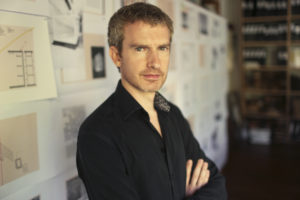
Thanks to a Wheelwright prize from Harvard University’s Graduate School of Design award-winning architect Erik L’Heureux is traveling to some of the world’s fastest growing cities along the equator to study how urbanization and tropical climates impact design.
Laura Meckler fell in love with journalism while an undergraduate and wrote for Student Life at Washington University. Now a reporter for the Wall Street Journal, Meckler has covered some of the country’s most controversial stories, including the current presidential election.