How to stop dividing cancer cells in their tracks

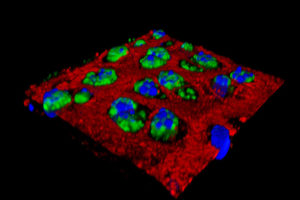
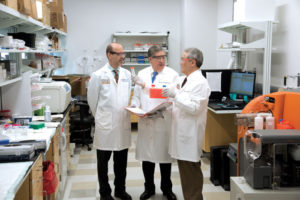
Researchers from Washington University in St. Louis and St. Jude Children’s Research Hospital in Memphis made a discovery that uncovers the molecular logic of how dividing cells are stopped in their tracks. The team zeroed in on a specific protein, whose job is to stop a cell from dividing or to slow the division.

Wysession receives award for geosciences education

Michael Wysession, professor of earth and planetary sciences in Arts & Sciences, has been recognized for his exceptional leadership in geosciences education by the Seismological Society of America with the 2016 Frank Press Public Service Award.

Time to renew your U-Pass

The current U-Pass — allowing faculty and staff free use of Metro, the region’s public-transportation bus and light-rail system — expires June 30. Benefits-eligible employees now may request a new U-Pass for the 2017 fiscal year through Parking & Transportation Services.

Itching for no reason? Immune system may be at fault

A hand scratching a wrist.
People who suffer itching with no clear cause may have previously unrecognized immune system defects. In a small study of such patients, researchers from the Center for the Study of Itch at Washington University School of Medicine in St. Louis identified immune system irregularities that may prompt the urge to scratch.

Dudukovic receives Neal Amundson Award

Milorad (Mike) Dudukovic, of the School of Engineering & Applied Science at Washington University in St. Louis, has received the prestigious Neal R. Amundson Award for Excellence in Chemical Reaction Engineering from the International Symposia on Chemical Reaction Engineering.

Terschluse selected for Grossman-Alexander Prize

Jack Terschluse, who just earned a bachelor’s degree in political science in Arts & Sciences, received the university’s Grossman-Alexander Prize. The competitive award is presented each year to an outstanding graduating senior with an emphasis on American politics.

As more states legalize marijuana, adolescents’ problems with pot decline

Marijuana leaves
A survey of more than 216,000 adolescents from all 50 states indicates the number of teens with marijuana-related problems is declining. Similarly, the rates of marijuana use by young people are falling despite the fact more U.S. states are legalizing or decriminalizing marijuana use and the number of adults using the drug has increased. Researchers at the School of Medicine examine the data.