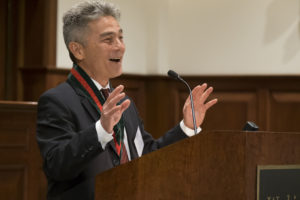
Shakespeare and business. Yoking together these two words seems almost surreal. Yet on April 15, Washington University’s Olin Business School — under the aegis of its dean, Mark P. Taylor — did something which would be unimaginable anywhere else in the United States.
Brian Z. Tamanaha has been named the John S. Lehmann University Professor at Washington University School of Law in St. Louis. He was installed Feb. 21 at a ceremony in the Bryan Cave Moot Courtroom in Anheuser-Busch Hall.
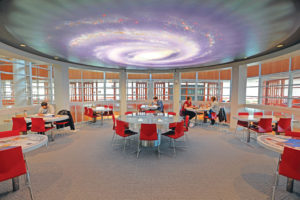
The transformed Olin Library at the heart of the Danforth Campus offers new, engaging spaces for the discovery, collaboration and instruction of the future.
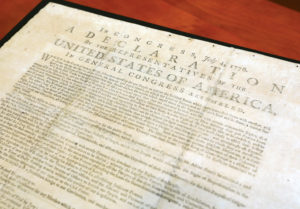
Students can enjoy a cup of coffee at the expanded Whispers Café and then marvel at a rare copy of the Declaration of Independence near the Jack E. and Debbie T. Thomas Gallery on Level 1.
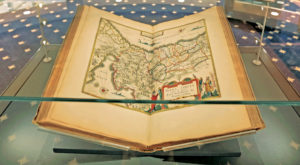
The transformation of the John M. Olin Library provides a new home for the Julian Edison Department of Special Collections. With more than 1,000 collections, the department is among academia’s largest and most diverse.
Five faculty members at Washington University School of Medicine in St. Louis recently were elected to the Society for Pediatric Research, which aims to improve child health through research, professional collaboration and advocacy. They are Megan A. Cooper, MD, PhD; Brian J. DeBosch, MD, PhD; Laura G. Schuettpelz, MD, PhD; Indi Trehan, MD; and Yumirle P. Turmelle, MD.
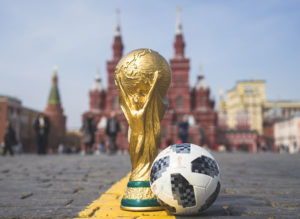
North America, even in the face of controversial policies regarding immigration under President Trump’s administration, had more to offer soccer’s international governing body, says Patrick Rishe, a sports business expert from Washington University in St. Louis. As a result, the “United Bid” of the United States, Canada and Mexico was awarded the 2026 World Cup on the eve of this year’s competition in Russia.
What happened on July 4, 1776? Not what you might think. On that historic day more than 200 years ago, the Continental Congress adopted the Declaration of Independence. But it would be weeks before the Founding Fathers actually signed the handwritten document now housed in the National Archives in Washington. In the meantime, official broadsides were printed and posted on courthouse doors across the colonies. One of those broadsides is now on view at Washington University.
Members of the Washington University in St. Louis community are invited to bring their children to Olympic Day 2018 from 10 to 11:30 a.m. Friday, June 22, at Francis Field and Sumers Recreation Center.