Deanna Barch, chair of the psychological and brain sciences in Arts & Sciences and the Gregory B. Couch Professor of Psychiatry at the School of Medicine, received a $554,195 grant from the National Institutes of Health (NIH) for computational psychiatry research. Computational psychiatry allows researchers to isolate specific mechanisms that determine behavior, bridging the gap between pathophysiology and psychopathology. However, […]
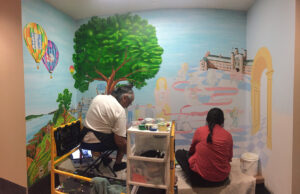
The Washington University in St. Louis community is invited to join current and former Rodriguez Scholars at the unveiling of the Annika Rodriguez 20th Anniversary Mural from 2-3 p.m. Saturday, Sept. 21, in the Danforth University Center’s Fun Room.
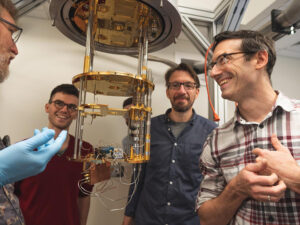
Washington University’s collaborative Center for Quantum Sensors was awarded a Quantum Leap Challenge Institute (QLCI) conceptualization grant from the National Science Foundation to help advance applications of quantum information science.
Gwen Randolph, an immunologist by training, began her career studying immune cells and how they travel around the body. But she has made a career out of breaking down scientific silos and asking questions no one else had thought to ask.
Patricia Weisensee, assistant professor of mechanical engineering and materials science at the McKelvey School of Engineering, has received a $330,221 grant from the National Science Foundation to study dropwise condensation and its effects on heat transfer. Lubricant-infused surfaces (LIS), which consist of a microporous surface infused with a thin oil layer, promote dropwise condensation, which leads to […]
The university’s Africa initiative seeks applications for its collaborative pilot grant program. The program aims to advance research in a variety of fields, such as health, entrepreneurship and sustainability, and to forge collaborations between university faculty and scholars at institutional partners in Africa. Letters of intent are due Sept. 30.
Aiming to encourage and inspire more physicians to develop careers that blend scientific research with patient care, the Burroughs Wellcome Fund has announced that Washington University School of Medicine in St. Louis will receive a prestigious, $2.5 million Physician-Scientist Institutional Award.
The inauguration of Andrew D. Martin as the 15th chancellor of Washington University Oct. 3 will begin with a faculty symposium that explores connections between research and discovery as well as connections to the St. Louis community at large.
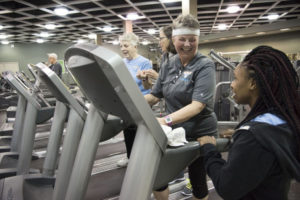
The Prevention Research Center at Washington University in St. Louis has been awarded a $3.8 million grant from the Centers for Disease Control and Prevention to lead a broad effort to better practice evidence-based policies to improve health.
The Center for the Humanities offers internal funding opportunities to Washington University faculty in the humanities and humanistic social sciences. Several programs have an Oct. 1 deadline, including the Faculty Fellowship, the Collaborative Research Seed Grant, the Summer Faculty Research Grant and the Grimm Travel Award. Learn more online.