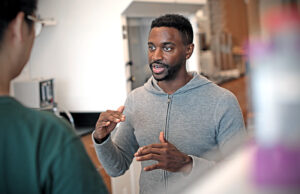
The McKelvey School of Engineering’s Damena Agonafer is one of 85 early-career engineers selected to attend the National Academy of Engineering’s 26th annual US Frontiers of Engineering symposium. Attendees were nominated by fellow engineers or organizations.
The U.S. Department of Energy’s Advanced Research Projects Agency-Energy (ARPA-E) has awarded the lab of Vijay Ramani, the Roma B. & Raymond H. Wittcoff Distinguished University Professor at the McKelvey School of Engineering, $2 million to further develop and de-risk its electrode-decoupled redox flow battery technology, and to position the team for scale-up and deployment after the […]
From retail businesses to international supply chains, the Sam Fox School’s Global Urbanism Studio explores how the COVID-19 pandemic is reshaping urban space.
New research shows marketers could win more customers by offering financial incentives to customers’ friends — providing a reputational boost to customers — than “selfish” financial incentives to customers. A Washington University in St. Louis marketing professor was a co-author on the study.
New research from Washington University in St. Louis finds early evidence that the pandemic has exacerbated — not improved — the gender gap in work hours, which could have enduring consequences for working mothers.
Fred Ssewamala, the William E. Gordon Distinguished Professor at the Brown School, and Proscovia Nabunya, research assistant professor, have received a two-year $425,000 award from the National Institute of Mental Health of the National Institutes of Health (NIH) to address HIV/AIDS-associated stigma among adolescents in southwest Uganda. The study will test two evidence-based interventions, group cognitive behavioral therapy […]
Question: University Libraries boasts a rare copy of the Declaration of Independence, known as a Southwick broadside. How many copies of it exist today?
A team of wildlife biologists and infectious disease experts, including some at the School of Medicine, propose in an article published in Science a decentralized, global wildlife biosurveillance system to identify animal viruses that have the potential to cause human disease – before the next pandemic emerges.
Parasitologist L. David Sibley at the School of Medicine is leading an international effort to find drugs to cure toxoplasmosis, a parasitic disease characterized by vision problems and brain complications.
To help address the international social, economic and public health ramifications of the COVID-19 pandemic, the McDonnell International Scholars Academy recently awarded seed grants to kick-start research projects led by Washington University faculty members and their international collaborators.